Umar Ijaz Muhammad, Rauf Ayesha, Mustafa Shama, Ahmed Hussain, Ashraf Asma, Al-Ghanim Khalid, Swamy Mruthinti Satyanarayana, Mahboob S
Department of Zoology, Wildlife and Fisheries, University of Agriculture, Faisalabad, Pakistan.
Department of Zoology, The University of Buner, Khyber Pakhtunkhwa, Pakistan.
Saudi J Biol Sci. 2022 Mar;29(3):1380-1385. doi: 10.1016/j.sjbs.2021.12.012. Epub 2021 Dec 11.
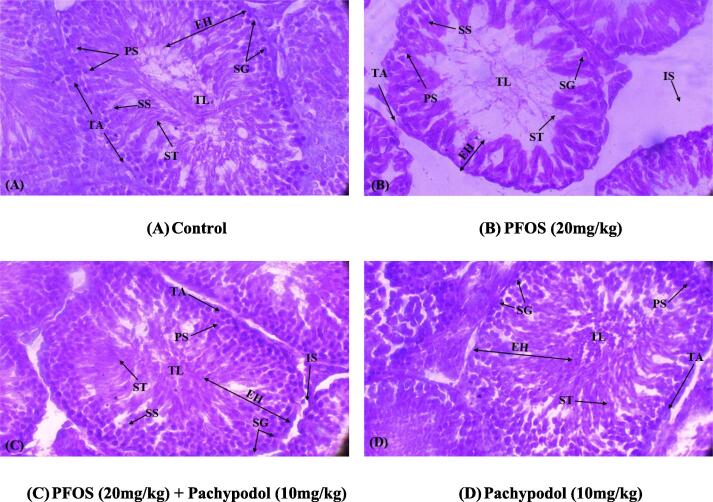
Perfluorooctane sulfonate (PFOS) is an endocrine disruptor chemical (EDC) with potentially adverse effects on the male reproductive system. Pachypodol (5,4'-dihydroxy-3,7,3'-trimethoxyflavone) is a promising flavonoid isolated from Pogostemon cablin (Blanco) Benth that shows a broad range of pharmacological properties. However, the potential curative effects of pachypodol on testicular toxicity are not available until now. Therefore, this research was proposed to examine the efficiency of pachypodol against PFOS-induced testicular toxicity in adult male rats. The experiments were conducted on Sprague-Dawley rats (n = 48), which were equally distributed into four groups: control, PFOS (20 mg/kg), PFOS + Pachypodol (20 mg/kg + 10 mg/kg respectively), and Pachypodol (10 mg/kg). After 56 days of treatment, testes were excised by slaughtering rats, weighed, and stored till further analysis. The estimated parameters include biochemical markers, spermatogenic indices, hormonal and histopathological profiles. PFOS exposure disturbed the biochemical profile by altering the antioxidant/oxidant balance. For instance, it decreased the activities of catalase (CAT), superoxide dismutase (SOD), glutathione peroxidase (GPx), and glutathione reductase (GSR) while increasing the concentration of reactive oxygen species (ROS) and level of thiobarbituric acid reactive substances (TBARS). PFOS intoxication also led to a notable decline in viability, motility, epididymal sperm count, and the number of HOS coiled-tail sperms, whereas the higher level of abnormality in the head, mid-piece, and tail of sperms were observed. Besides, it lowered luteinizing hormone (LH), follicle-stimulating hormone (FSH), and plasma testosterone. In addition, PFOS exposure led to histopathological damages in testicles. However, pachypodol treatment potently alleviated all the illustrated impairments in testes. Conclusively, our results demonstrate the promising free-radical scavenging activity of pachypodol, a novel phytochemical, against the PFOS-instigated testicular dysfunctions.
全氟辛烷磺酸(PFOS)是一种内分泌干扰化学物质(EDC),对雄性生殖系统可能产生不利影响。广藿香醇(5,4'-二羟基-3,7,3'-三甲氧基黄酮)是从广藿香中分离出的一种有前景的黄酮类化合物,具有广泛的药理特性。然而,迄今为止,广藿香醇对睾丸毒性的潜在治疗作用尚不明确。因此,本研究旨在探讨广藿香醇对成年雄性大鼠PFOS诱导的睾丸毒性的治疗效果。实验选用Sprague-Dawley大鼠(n = 48),将其平均分为四组:对照组、PFOS组(20 mg/kg)、PFOS + 广藿香醇组(分别为20 mg/kg + 10 mg/kg)和广藿香醇组(10 mg/kg)。治疗56天后,通过处死大鼠切除睾丸,称重并保存以备进一步分析。评估参数包括生化指标、生精指数、激素和组织病理学特征。PFOS暴露通过改变抗氧化/氧化平衡扰乱了生化指标。例如,它降低了过氧化氢酶(CAT)、超氧化物歧化酶(SOD)、谷胱甘肽过氧化物酶(GPx)和谷胱甘肽还原酶(GSR)的活性,同时增加了活性氧(ROS)浓度和硫代巴比妥酸反应物质(TBARS)水平。PFOS中毒还导致活力、运动能力、附睾精子计数和HOS盘绕尾精子数量显著下降,而精子头部、中段和尾部的异常水平更高。此外,它降低了黄体生成素(LH)、卵泡刺激素(FSH)和血浆睾酮水平。此外,PFOS暴露导致睾丸组织病理学损伤。然而,广藿香醇治疗有效地减轻了睾丸中所有上述损伤。总之,我们的结果表明,新型植物化学物质广藿香醇具有有前景的自由基清除活性,可对抗PFOS引发的睾丸功能障碍。