Mishra Siddharth, Daga Anoop, Gupta Anant
Department of Hospital Administration, All India Institute of Medical Sciences, New Delhi, India.
J Family Med Prim Care. 2021 Dec;10(12):4489-4492. doi: 10.4103/jfmpc.jfmpc_1000_21. Epub 2021 Dec 27.
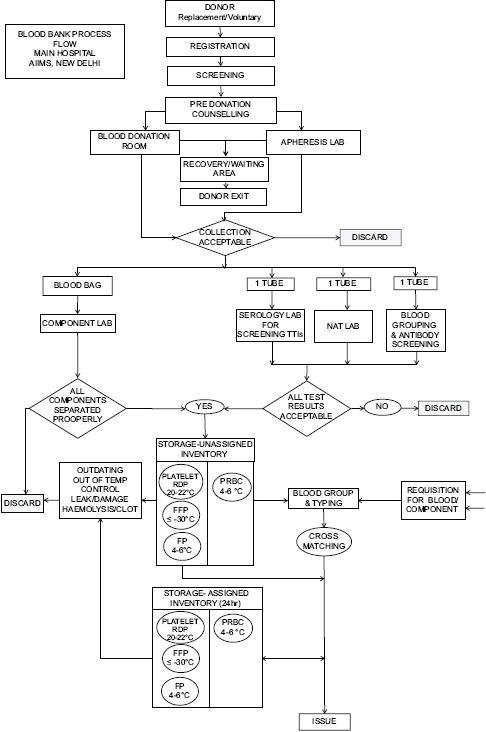
The demand and supply gap in blood and components has always existed in healthcare facilities. Blood inventory management is crucial to meet the demand and to minimize wastage. This study explores the blood inventory management practices at the blood bank of an institute of national importance in India.
The technicians of the blood bank were interviewed on the practices they followed on blood inventory management and records were reviewed where required.
Simple rule of thumb practices, the experience of staff, training, clear policy on stock keeping and allocation, daily stock review, record-keeping, monthly performance review, automation, adoption of information system, regular communications, and leadership emerged as factors contributing to inventory management.
The blood bank follows simple procedures and relies on the experience of its staff to manage its inventory. Rigorous training, strict oldest-unit-first-out (OUFO)/first-in-first-out (FIFO) principle for stock management, stringent allocation policy, diligent record-keeping, daily stock review, and monthly performance reports were identified as the key drivers for inventory management. Other measures like regular preventive maintenance of equipment, robust blood bank information system, communication with stakeholders, and effective leadership were found to contribute indirectly to inventory management practices.
医疗机构中血液及血液成分的供需缺口一直存在。血液库存管理对于满足需求和减少浪费至关重要。本研究探讨了印度一所具有国家重要地位的机构的血库的血液库存管理做法。
就血库技术人员在血液库存管理方面遵循的做法对他们进行了访谈,并在需要时审查了相关记录。
经验法则的简单做法、员工经验、培训、明确的库存管理和分配政策、每日库存审查、记录保存、月度绩效评估、自动化、信息系统的采用、定期沟通和领导力成为影响库存管理的因素。
血库遵循简单程序并依靠员工经验来管理库存。严格的培训、严格的库存管理先出旧单位/先进先出原则、严格的分配政策、认真的记录保存、每日库存审查和月度绩效报告被确定为库存管理的关键驱动因素。发现其他措施,如设备的定期预防性维护、强大的血库信息系统、与利益相关者的沟通以及有效的领导力,对库存管理做法有间接贡献。