Zhang Mengmeng, Wang Minggui, He Jian-Qing
Department of Respiratory and Critical Care Medicine, West China Hospital, Sichuan University, Chengdu, China.
Front Med (Lausanne). 2022 Feb 25;9:822201. doi: 10.3389/fmed.2022.822201. eCollection 2022.
Tuberculous meningitis is difficult to diagnose and is associated with high mortality. Recently, several studies evaluated the intensified regimen containing higher dose rifampin to treat tuberculous meningitis. However, this topic remains to be concluded. Therefore, this systematic review and meta-analysis was conducted to evaluate pharmacokinetics parameters, safety, and survival benefits of high-dose rifampin for tuberculous meningitis.
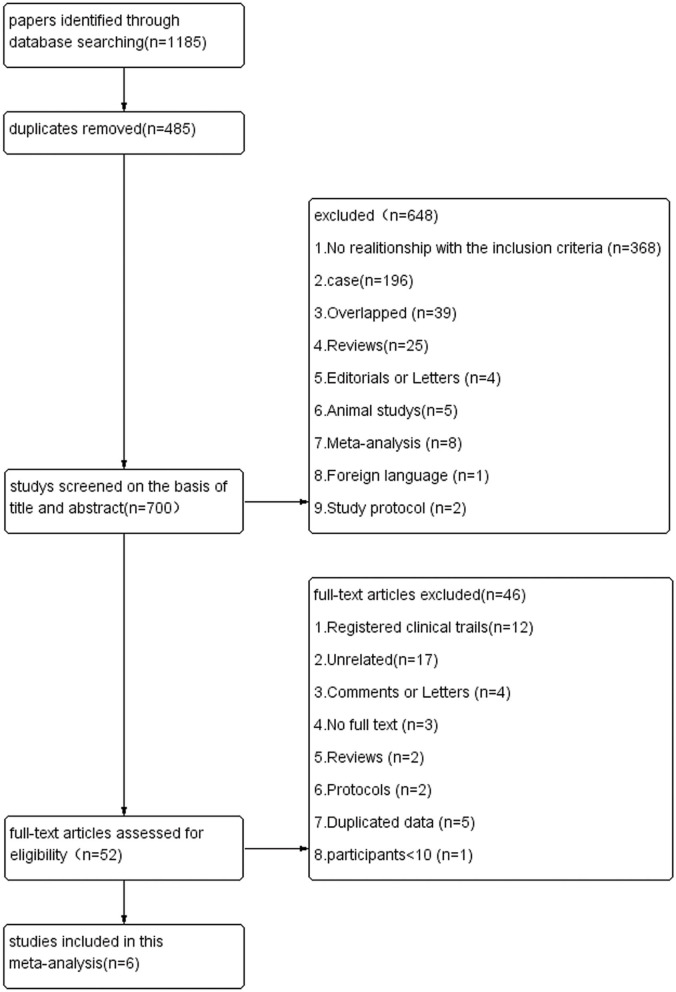
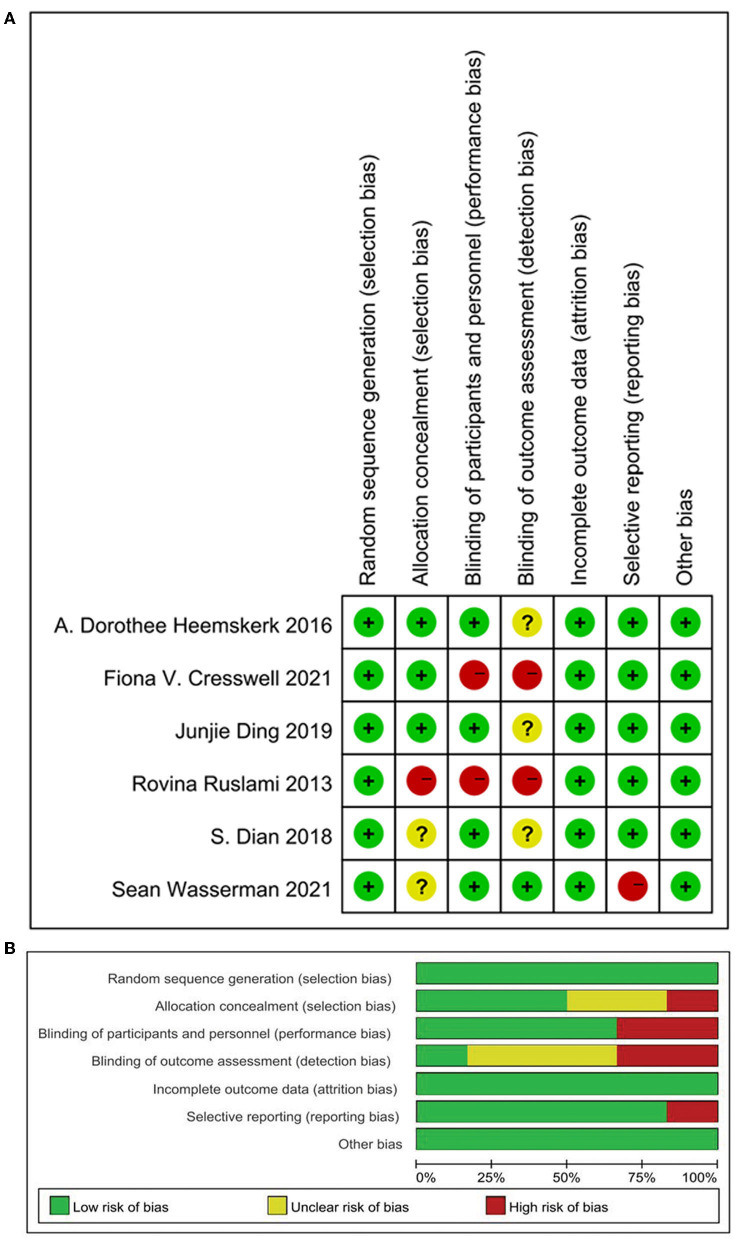
Data were searched from PubMed, EMBASE, The Cochrane Library, and Web of Science for studies describing an antituberculosis regimen including a higher dose of rifampin for patients with tuberculous meningitis. The quality of eligible studies was evaluated The Cochrane Risk of Bias Tool. The meta-analysis was performed by Review Manager 5.3 software, the synthesis of the data was shown in mean difference (MD) or relative risk (RR), and 95% confidence intervals (CIs).
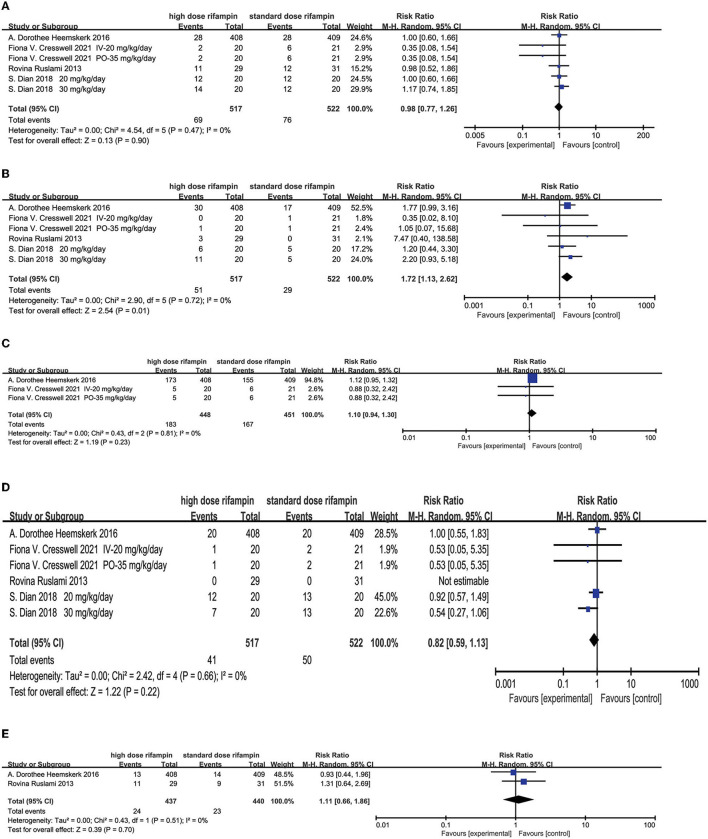
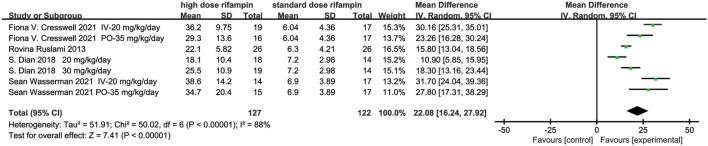
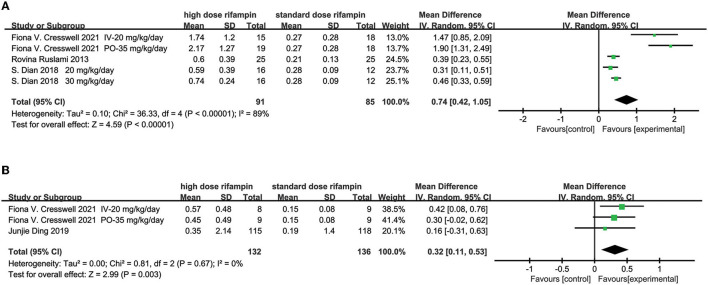
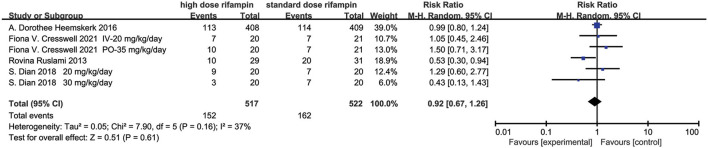
There were six randomized control trails included in this meta-analysis. The results showed that the concentration in plasma and cerebrospinal fluid (CSF) were significantly higher in the intervention group than the standard group [MD = 22.08, 95%CI (16.24, 27.92), < 0.00001; MD = 0.74, 95%CI (0.42, 1.05), < 0.00001], as well as the area under the time concentration curve between 0 and 24 h (AUC) of rifampin [MD 203.56, 95%CI (153.07, 254.05), < 0.00001] in plasma, but the overall survival did not improve [RR = 0.92, 95%CI (0.67, 1.26), = 0.61]. For adverse events, the results showed a statistically significant lower incidence of hypersensitivity compared with the intervention group [RR = 1.72, 95%CI (1.13, 2.62), = 0.01]. Fortunately, other common adverse drug reactions such as liver injury, neurological events, myelosuppression, and cardiotoxicity had no significant increase [RR = 0.98, 95%CI (0.77, 1.26), = 0.90; RR = 1.10, 95%CI (0.94, 1.30), = 0.23; RR = 0.82, 95%CI (0.59, 1.13), = 0.22; RR = 1.11, 95%CI (0.66, 1.86), = 0.70].
This meta-analysis suggested that the intensified treatment regimen including a higher dose of rifampin significantly increased the rifampin concentration both in the plasma and CSF, and it was safe in patients with tuberculous meningitis, but resulted in no improvement in survival rates.
结核性脑膜炎难以诊断且死亡率高。最近,多项研究评估了含高剂量利福平的强化方案治疗结核性脑膜炎。然而,该话题仍有待定论。因此,进行了这项系统评价和荟萃分析,以评估高剂量利福平治疗结核性脑膜炎的药代动力学参数、安全性和生存获益。
从PubMed、EMBASE、Cochrane图书馆和科学网检索描述含高剂量利福平抗结核方案治疗结核性脑膜炎患者的研究数据。采用Cochrane偏倚风险工具评估纳入研究的质量。使用Review Manager 5.3软件进行荟萃分析,数据合并以均值差(MD)或相对风险(RR)及95%置信区间(CI)表示。
该荟萃分析纳入了6项随机对照试验。结果显示,干预组血浆和脑脊液(CSF)中的浓度显著高于标准组[MD = 22.08,95%CI(16.24,27.92),P < 0.00001;MD = 0.74,95%CI(0.42,1.05),P < 0.00001],利福平血浆中0至24小时时间浓度曲线下面积(AUC)也是如此[MD = 203.56,95%CI(153.07,254.05),P < 0.00001],但总体生存率未改善[RR = 0.92,95%CI(0.67,1.26),P = 0.61]。对于不良事件,结果显示与干预组相比,超敏反应发生率在统计学上显著更低[RR = 1.72,95%CI(1.13,2.62),P = 0.01]。幸运的是,其他常见药物不良反应如肝损伤、神经事件、骨髓抑制和心脏毒性无显著增加[RR = 0.98,95%CI(0.77,1.26),P = 0.90;RR = 1.10, 95%CI(0.94,1.30),P = 0.23;RR = 0.82,95%CI(0.59,1.13),P = 0.22;RR = 1.11,95%CI(0.66,1.86),P = 0.70]。
该荟萃分析表明,含高剂量利福平的强化治疗方案显著提高了血浆和脑脊液中利福平的浓度,对结核性脑膜炎患者是安全的,但未提高生存率。