Meurot C, Jacques C, Martin C, Sudre L, Breton J, Rattenbach R, Bismuth K, Berenbaum F
4P-Pharma, Lille, France.
Sorbonne University, INSERM UMRS_938 and Labex Transimmunom, CDR St-Antoine Paris, Paris, France.
J Orthop Translat. 2022 Feb 25;32:121-129. doi: 10.1016/j.jot.2022.02.001. eCollection 2022 Jan.
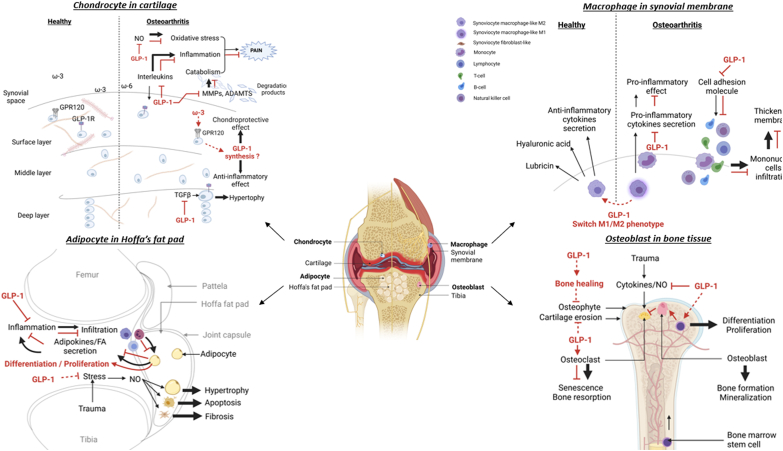
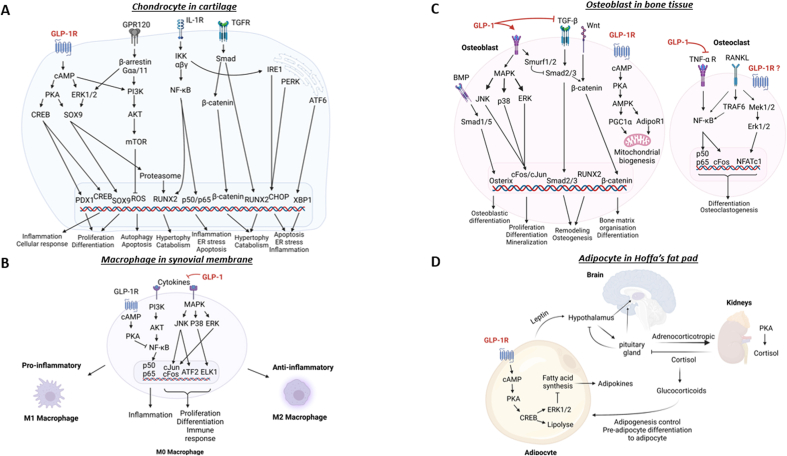
Osteoarthritis (OA) is a degenerative joint disease affecting millions of people worldwide. In OA, chondrocytes, synovial cells and other joint cells become activated when exposed to an abnormal environment, including mechanical stress, inflammatory cytokines or disorganization of matrix proteins. Several analogues of the hormones called incretins have been developed and are used notably for treating type 2 diabetes mellitus. Data has accumulated to suggest that incretinomimetics, which bind to the glucagon-like peptide-1 receptor (GLP-1R), have beneficial pleiotropic effects such as immunomodulation, anti-inflammation and neuronal protection. Thus, because of their anti-inflammatory properties, GLP-1-based therapies could benefit OA patients. This review focuses on the GLP-1R pathway, molecular mechanisms and phenotypes related to OA pathogenesis.
The search for new therapeutic targets to treat people suffering from OA remains urgent as there is currently no disease-modifyingtherapy available for this disease. This review discusses how GLP-1 analogues could be potential DMOADs for treating OA thanks to their anti-inflammatory, immunoregulatory and differentiation properties.
骨关节炎(OA)是一种退行性关节疾病,影响着全球数百万人。在骨关节炎中,软骨细胞、滑膜细胞和其他关节细胞在暴露于异常环境时会被激活,这些异常环境包括机械应力、炎性细胞因子或基质蛋白紊乱。已经开发出几种被称为肠促胰岛素的激素类似物,尤其用于治疗2型糖尿病。越来越多的数据表明,与胰高血糖素样肽-1受体(GLP-1R)结合的肠促胰岛素类似物具有有益的多效性作用,如免疫调节、抗炎和神经保护作用。因此,基于GLP-1的疗法因其抗炎特性可能会使骨关节炎患者受益。本综述重点关注与骨关节炎发病机制相关的GLP-1R途径、分子机制和表型。
由于目前尚无针对骨关节炎的疾病修饰疗法,寻找治疗骨关节炎患者的新治疗靶点仍然迫在眉睫。本综述讨论了GLP-1类似物如何因其抗炎、免疫调节和分化特性而成为治疗骨关节炎的潜在疾病修饰抗风湿药物。