Kouhpeikar Hamideh, Khosaravizade Tabasi Hamidreza, Khazir Zahra, Naghipour Armin, Mohammadi Moghadam Hussein, Forouzanfar Hasan, Abbasifard Mitra, Kirichenko Tatiana V, Reiner Željko, Banach Maciej, Sahebkar Amirhossein
Department of Hematology and Blood Bank, Tabas School of Nursing, Birjand University of Medical Science, Birjand, Iran.
Department of Nursing, Tabas School of Nursing, Birjand University of Medical Science, Birjand, Iran.
Front Cardiovasc Med. 2022 Feb 24;9:820260. doi: 10.3389/fcvm.2022.820260. eCollection 2022.
Coronavirus disease 2019 (COVID-19) might affect everyone, but people with comorbidities such as hypertension and cardiovascular disease (CVD) may often have more severe complications and worse outcomes. Although vaccinations are being performed worldwide, it will take a long time until the entire population of the world is vaccinated. On the other hand, we are witnessing the emergence of new variants of this virus. Therefore, effective therapeutic approaches still need to be considered. Statins are well-known lipid-lowering drugs, but they have also anti-inflammatory and immunomodulatory effects. This study aimed to investigate the effects of statins on the survival of COVID-19 hospitalized patients.
This retrospective study was performed on 583 patients admitted to a highly referenced hospital in Tabas, Iran, between February 2020 and December 2020. One hundred sixty-two patients were treated with statins and 421 patients were not. Demographic information, clinical signs, and the results of laboratory, and comorbidities were extracted from patients' medical records and mortality and survival rates were assessed in these two groups.
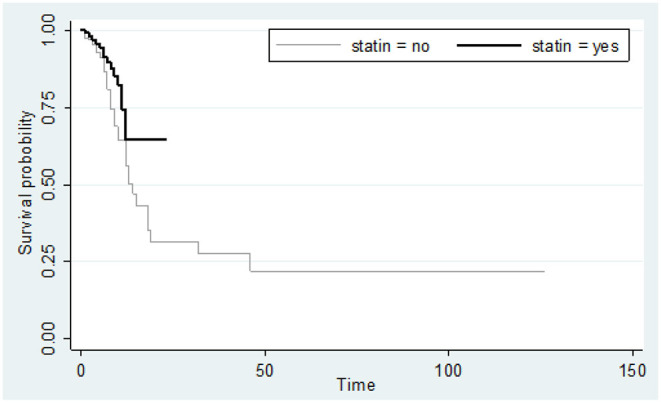
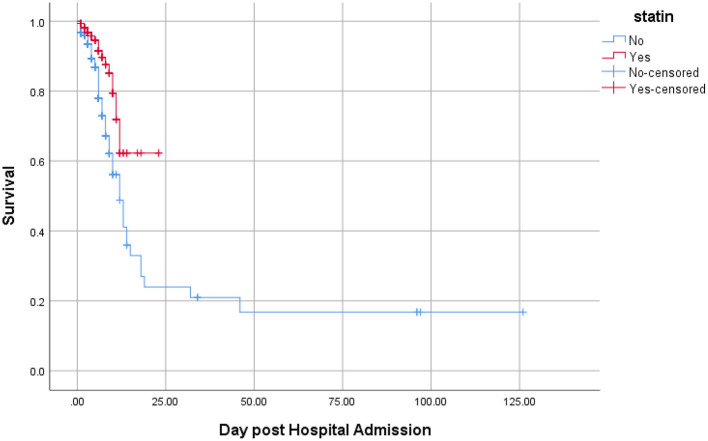
The results of the Cox crude regression model showed that statins reduced mortality in COVID-19 patients (HR = 0.56, 95% CI: 0.32, 0.97; = 0.040), although this reduction was not significant in the adjusted model (HRs=0.51, 95%CI: 0.22, 1.17; = 0.114). Using a composite outcome comprising intubation, ICU admission, and mortality, both crude (HR = 0.43; 95% CI: 0.26, 0.73; = 0.002) and adjusted (HR = 0.57; 95% CI: 0.33, 0.99; = 0.048) models suggested a significant protective effect of statin therapy.
Due to anti-inflammatory properties of statins, these drugs can be effective as an adjunct therapy in the treatment of COVID-19 patients.
2019冠状病毒病(COVID-19)可能会影响每个人,但患有高血压和心血管疾病(CVD)等合并症的人往往会出现更严重的并发症和更差的预后。尽管全球都在进行疫苗接种,但要让全世界所有人都接种疫苗还需要很长时间。另一方面,我们目睹了这种病毒新变种的出现。因此,仍需要考虑有效的治疗方法。他汀类药物是众所周知的降脂药物,但它们也具有抗炎和免疫调节作用。本研究旨在调查他汀类药物对COVID-19住院患者生存的影响。
本回顾性研究对2020年2月至2020年12月期间入住伊朗塔巴斯一家高水准医院的583例患者进行。162例患者接受他汀类药物治疗,421例患者未接受治疗。从患者的病历中提取人口统计学信息、临床体征、实验室检查结果和合并症,并评估这两组患者的死亡率和生存率。
Cox粗回归模型结果显示,他汀类药物可降低COVID-19患者的死亡率(HR = 0.56,95%CI:0.32,0.97;P = 0.040),尽管在调整模型中这种降低并不显著(HRs = 0.51,95%CI:0.22,1.17;P = 0.114)。使用包括插管、入住重症监护病房(ICU)和死亡率的复合结局,粗模型(HR = 0.43;95%CI:0.26,0.73;P = 0.002)和调整模型(HR = 0.57;95%CI:0.33,0.99;P = 0.048)均表明他汀类药物治疗具有显著的保护作用。
由于他汀类药物具有抗炎特性,这些药物可作为COVID-19患者治疗的辅助疗法有效发挥作用。