Yusuf Prasandhya Astagiri, Lamuri Aly, Hubka Peter, Tillein Jochen, Vinck Martin, Kral Andrej
Department of Medical Physics/Medical Technology IMERI, Faculty of Medicine, University of Indonesia, Jakarta, Indonesia.
Institute of AudioNeuroTechnology and Department of Experimental Otology of the ENT Clinics, Hannover Medical School, Hanover, Germany.
Front Syst Neurosci. 2022 Feb 25;16:806142. doi: 10.3389/fnsys.2022.806142. eCollection 2022.
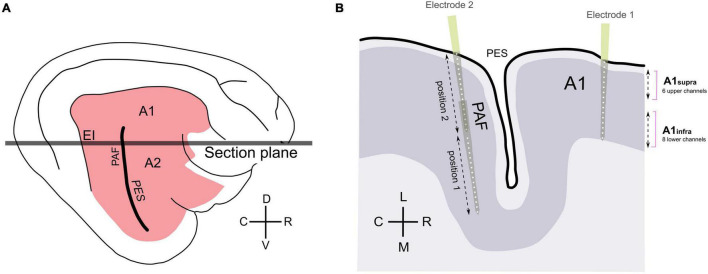
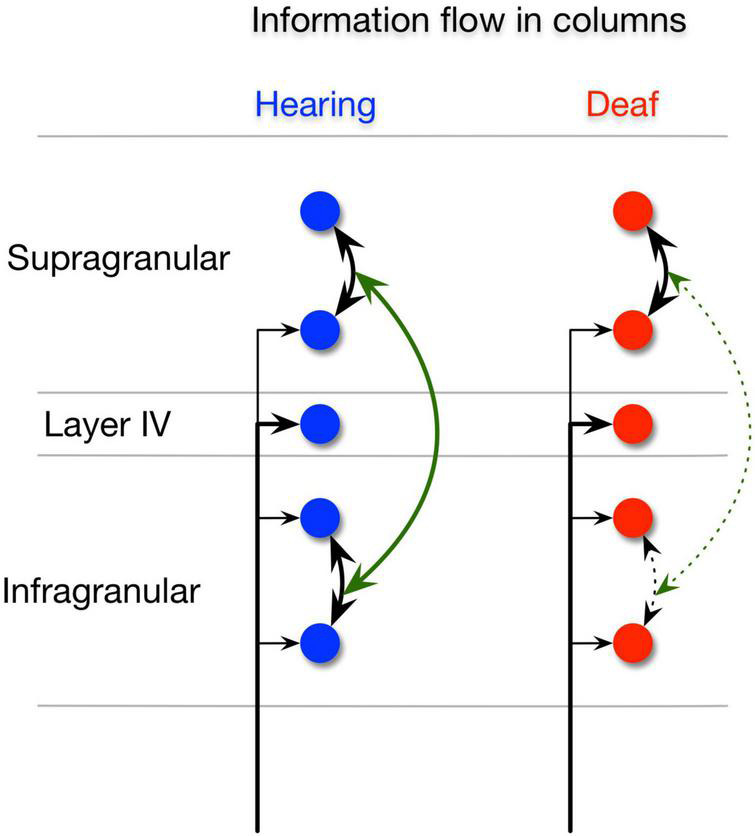
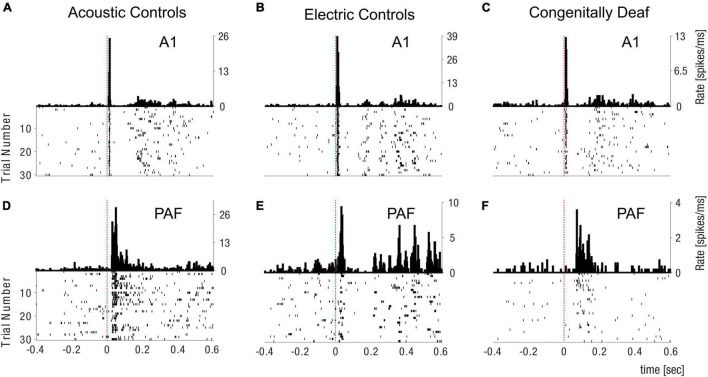
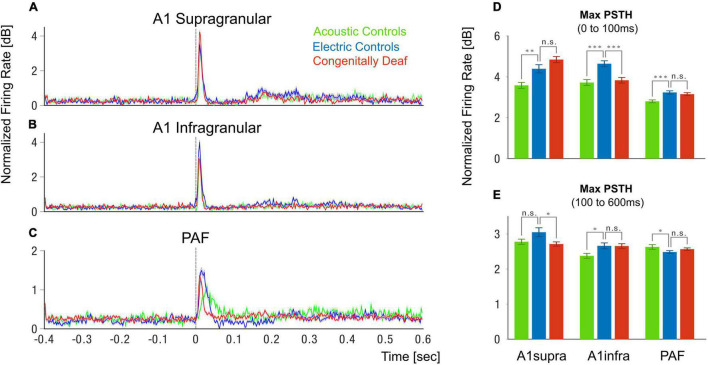
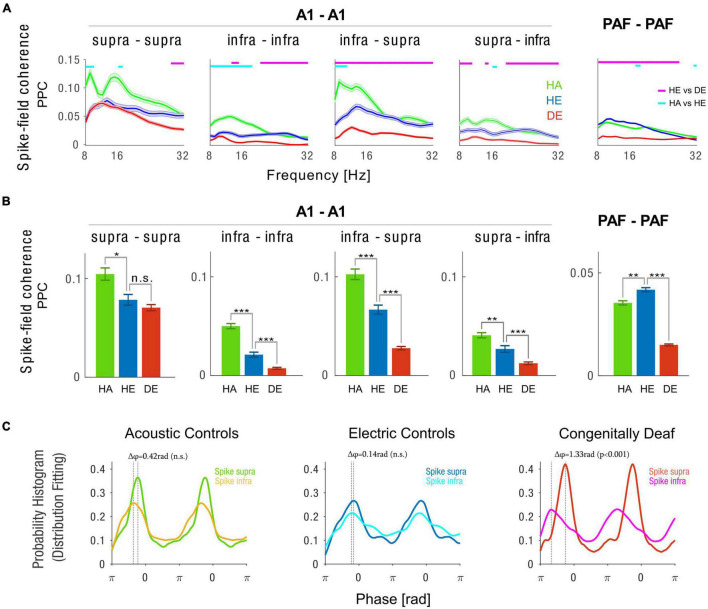
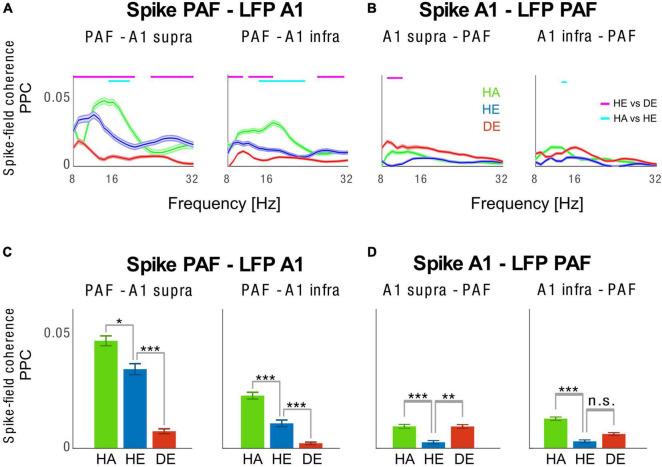
The influence of sensory experience on cortical feedforward and feedback interactions has rarely been studied in the auditory cortex. Previous work has documented a dystrophic effect of deafness in deep cortical layers, and a reduction of interareal couplings between primary and secondary auditory areas in congenital deafness which was particularly pronounced in the top-down direction (from the secondary to the primary area). In the present study, we directly quantified the functional interaction between superficial (supragranular, I to III) and deep (infragranular, V and VI) layers of feline's primary auditory cortex A1, and also between superficial/deep layers of A1 and a secondary auditory cortex, namely the posterior auditory field (PAF). We compared adult hearing cats under acoustic stimulation and cochlear implant (CI) stimulation to adult congenitally deaf cats (CDC) under CI stimulation. Neuronal activity was recorded from auditory fields A1 and PAF simultaneously with two NeuroNexus electrode arrays. We quantified the spike field coherence (i.e., the statistical dependence of spike trains at one electrode with local field potentials on another electrode) using pairwise phase consistency (PPC). Both the magnitude as well as the preferred phase of synchronization was analyzed. The magnitude of PPC was significantly smaller in CDCs than in controls. Furthermore, controls showed no significant difference between the preferred phase of synchronization between supragranular and infragranular layers, both in acoustic and electric stimulation. In CDCs, however, there was a large difference in the preferred phase between supragranular and infragranular layers. These results demonstrate a loss of synchrony and for the first time directly document a functional decoupling of the interaction between supragranular and infragranular layers of the primary auditory cortex in congenital deafness. Since these are key for the influence of top-down to bottom-up computations, the results suggest a loss of recurrent cortical processing in congenital deafness and explain the outcomes of previous studies by deficits in intracolumnar microcircuitry.
感觉经验对听觉皮层中皮层前馈和反馈相互作用的影响很少在听觉皮层中得到研究。先前的研究记录了耳聋对皮层深层的营养不良效应,以及先天性耳聋中初级和次级听觉区域之间区域间耦合的减少,这种减少在自上而下的方向(从次级区域到初级区域)尤为明显。在本研究中,我们直接量化了猫的初级听觉皮层A1的浅层(颗粒上层,I至III层)和深层(颗粒下层,V和VI层)之间的功能相互作用,以及A1的浅层/深层与次级听觉皮层,即后听觉场(PAF)之间的功能相互作用。我们将声学刺激和人工耳蜗(CI)刺激下的成年听力猫与CI刺激下的成年先天性耳聋猫(CDC)进行了比较。使用两个NeuroNexus电极阵列同时记录听觉区域A1和PAF的神经元活动。我们使用成对相位一致性(PPC)来量化尖峰场相干性(即一个电极处的尖峰序列与另一个电极处的局部场电位之间的统计依赖性)。同步的幅度以及首选相位均进行了分析。CDC中PPC的幅度明显小于对照组。此外,无论是在声学刺激还是电刺激下,对照组的颗粒上层和颗粒下层之间同步的首选相位均无显著差异。然而,在CDC中,颗粒上层和颗粒下层之间的首选相位存在很大差异。这些结果表明同步性丧失,并且首次直接证明了先天性耳聋中初级听觉皮层颗粒上层和颗粒下层之间相互作用的功能解耦。由于这些对于自上而下到自下而上的计算影响至关重要,因此结果表明先天性耳聋中皮层递归处理的丧失,并通过柱内微电路缺陷解释了先前研究的结果。