Castillo Carolina, Saez-Orellana Francisco, Godoy Pamela Andrea, Fuentealba Jorge
Laboratory of Screening of Neuroactive Compounds, Department of Physiology, School of Biological Sciences, Universidad de Concepción, Concepción, Chile.
Front Physiol. 2022 Feb 23;13:814999. doi: 10.3389/fphys.2022.814999. eCollection 2022.
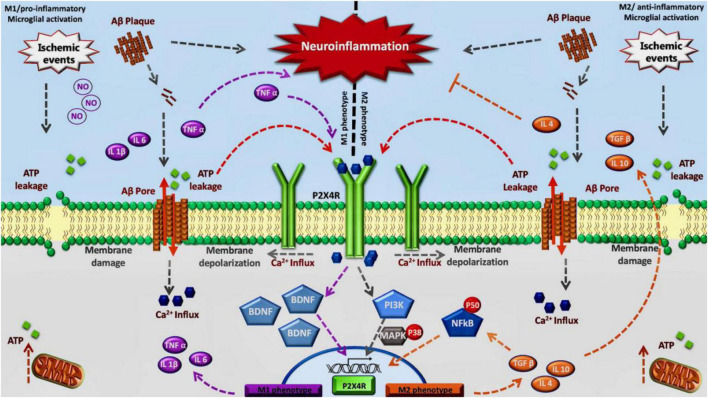
There are over 80 million people currently living who have had a stroke. The ischemic injury in the brain starts a cascade of events that lead to neuronal death, inducing neurodegeneration which could lead to Alzheimer's disease (AD). Cerebrovascular diseases have been suggested to contribute to AD neuropathological changes, including brain atrophy and accumulation of abnormal proteins such as amyloid beta (Aβ). In patients older than 60 years, the incidence of dementia a year after stroke was significantly increased. Nevertheless, the molecular links between stroke and dementia are not clearly understood but could be related to neuroinflammation. Considering that activated microglia has a central role, there are brain-resident innate immune cells and are about 10-15% of glial cells in the adult brain. Their phagocytic activity is essential for synaptic homeostasis in different areas, such as the hippocampus. These cells polarize into phenotypes or subtypes: the pro-inflammatory M1 phenotype, or the immunosuppressive M2 phenotype. Phenotype M1 is induced by classical activation, where microglia secrete a high level of pro- inflammatory factors which can cause damage to the surrounding neuronal cells. Otherwise, M2 phenotype is the major effector cell with the potential to counteract pro-inflammatory reactions and promote repair genes expression. Moreover, after the classical activation, an anti-inflammatory and a repair phase are initiated to achieve tissue homeostasis. Recently it has been described the concepts of homeostatic and reactive microglia and they had been related to major AD risk, linking to a multifunctional microglial response to Aβ plaques and pathophysiology markers related, such as intracellular increased calcium. The upregulation and increased activity of purinergic receptors activated by ADP/ATP, specially P2X4R, which has a high permeability to calcium and is mainly expressed in microglial cells, is observed in diseases related to neuroinflammation, such as neuropathic pain and stroke. Thus, P2X4R is associated with microglial activation. P2X4R activation drives microglia motility via the phosphatidylinositol-3-kinase (PI3K)/Akt pathway. Also, these receptors are involved in inflammatory-mediated prostaglandin E2 (PGE2) production and induce a secretion and increase the expression of BDNF and TNF-α which could be a link between pathologies related to aging and neuroinflammation.
目前有超过8000万人曾患中风。脑部的缺血性损伤引发一系列导致神经元死亡的事件,诱发神经退行性变,进而可能引发阿尔茨海默病(AD)。脑血管疾病被认为与AD的神经病理学变化有关,包括脑萎缩和异常蛋白质如β淀粉样蛋白(Aβ)的积累。在60岁以上的患者中,中风后一年痴呆症的发病率显著增加。然而,中风与痴呆症之间的分子联系尚不清楚,但可能与神经炎症有关。考虑到活化的小胶质细胞起着核心作用,它们是驻留在大脑中的固有免疫细胞,约占成人大脑胶质细胞的10 - 15%。它们的吞噬活性对于不同区域如海马体的突触稳态至关重要。这些细胞会极化形成不同的表型或亚型:促炎性M1表型或免疫抑制性M2表型。M1表型由经典激活诱导,此时小胶质细胞分泌高水平的促炎因子,可对周围神经元细胞造成损害。否则,M2表型是主要的效应细胞,具有抵消促炎反应和促进修复基因表达的潜力。此外,在经典激活后,会启动抗炎和修复阶段以实现组织稳态。最近已经描述了稳态小胶质细胞和反应性小胶质细胞的概念,它们与AD的主要风险相关,与小胶质细胞对Aβ斑块的多功能反应以及相关的病理生理学标志物如细胞内钙增加有关。在与神经炎症相关的疾病如神经性疼痛和中风中,观察到由ADP/ATP激活的嘌呤能受体,特别是对钙具有高通透性且主要在小胶质细胞中表达的P2X4R的上调和活性增加。因此,P2X4R与小胶质细胞活化有关。P2X4R激活通过磷脂酰肌醇-3-激酶(PI3K)/Akt途径驱动小胶质细胞运动。此外,这些受体参与炎症介导的前列腺素E2(PGE2)的产生,并诱导脑源性神经营养因子(BDNF)和肿瘤坏死因子-α(TNF-α)的分泌和表达增加,这可能是与衰老相关的病理和神经炎症之间的一个联系。