Department of Nutrition, School of Medicine and Health Sciences, University of Palestine, Gaza Strip, Palestine.
Regional Office for the Eastern Mediterranean (EMRO), World Health Organization (WHO), Cairo, Egypt.
Front Public Health. 2022 Feb 25;10:808700. doi: 10.3389/fpubh.2022.808700. eCollection 2022.
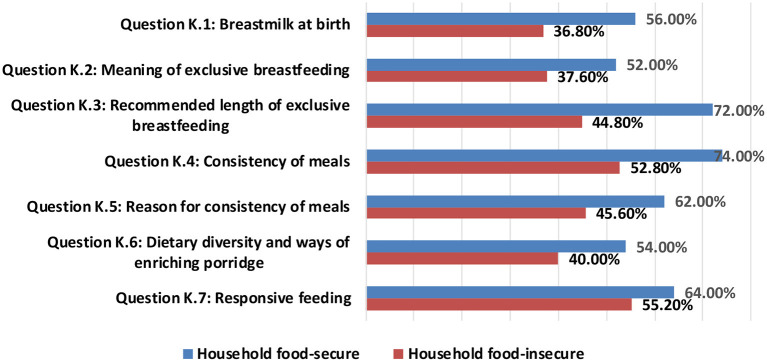
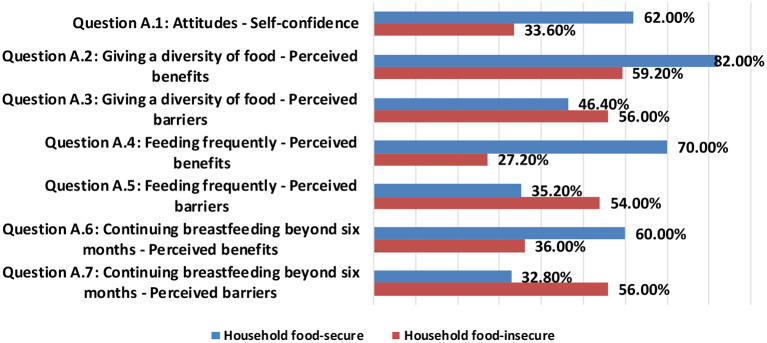
The present study aimed to determine the households' food insecurity and their association with dietary intakes, nutrition-related knowledge, attitudes and practices (KAP) among under-five children in the Gaza Strip, Palestine. This cross-sectional study was conducted in 2021 among a representative sample of under-five children. A total of 350 children and their proxy were selected from all Gaza strip governorates, using a cluster random sampling method. The Radimer/Cornell food-security scale was used. A 24-h dietary recall was employed for dietary intakes assessment. Nutrition-related KAP for feeding under-five children, anthropometric measurements, and demographic-socioeconomic characteristics were obtained with an interview-based questionnaire. Statistical analysis was performed using SPSS version 25. The children from food-insecure households had a high prevalence of moderate underweight (30.4%), stunting (32.8%), wasting (9.6%), and acute undernutrition (30.4%). Between food-insecure and food-secure groups there were significant differences in weight, height/length, mid-upper arm circumference, weight-for-age and mid-upper arm circumference z-scores, underweight, acute undernutrition, intakes of protein, fat, vitamin D, zinc, continued breastfeeding, having nutrition-related adequate knowledge, having nutrition-related positive attitudes, and achieved minimum dietary diversity score ( < 0.05 for all). Additionally, about (56.0%) food-insecure households have inadequate nutrition-related knowledge, (77.6%) have nutrition-related negative attitudes, and (95.2%) did not achieve a minimum dietary diversity score. In conclusion, the children from food-insecure households had a high prevalence of moderate underweight, stunting, wasting, and acute undernutrition. Moreover, low economic status, poor dietary intakes, low levels of nutrition-related KAP, and lack of dietary diversity could contribute to the high levels of food insecurity among under-five children.
本研究旨在确定加沙地带家庭的粮食不安全状况及其与 5 岁以下儿童饮食摄入、营养相关知识、态度和实践(KAP)的关系。这项横断面研究于 2021 年在 5 岁以下儿童的代表性样本中进行。使用聚类随机抽样方法从加沙地带所有行政区中选择了 350 名儿童及其代理人。采用 Radimer/Cornell 粮食安全量表进行评估。采用 24 小时膳食回忆法评估饮食摄入情况。采用基于访谈的问卷获取与喂养 5 岁以下儿童有关的营养相关 KAP、人体测量学指标和人口统计学社会经济特征。使用 SPSS 版本 25 进行统计分析。来自粮食不安全家庭的儿童中度消瘦(30.4%)、发育迟缓(32.8%)、消瘦(9.6%)和急性营养不良(30.4%)的患病率较高。在粮食不安全和粮食安全组之间,体重、身高/长度、中上臂围、体重年龄和中上臂围 z 评分、消瘦、急性营养不良、蛋白质、脂肪、维生素 D、锌的摄入量、持续母乳喂养、具有营养相关的充分知识、具有营养相关的积极态度以及实现最低饮食多样性评分(所有 p<0.05)有显著差异。此外,约 56.0%的粮食不安全家庭营养相关知识不足,77.6%有营养相关的消极态度,95.2%没有达到最低饮食多样性评分。总之,来自粮食不安全家庭的儿童中度消瘦、发育迟缓、消瘦和急性营养不良的患病率较高。此外,经济状况较差、饮食摄入不足、营养相关 KAP 水平较低以及饮食多样性缺乏可能导致 5 岁以下儿童粮食不安全程度较高。