He Wenjun, Liu Chunli, Liao Jing, Liu Fei, Lei Hui, Wei Danmei, Ruan Honglian, Kunwar Bibhav, Lu Wenju, Wang Jian, Wang Tao
State Key Laboratory of Respiratory Diseases, National Clinical Research Center for Respiratory Diseases, Guangzhou Institute of Respiratory Health, The First Affiliated Hospital of Guangzhou Medical University, Guangzhou, China.
Guangdong Key Laboratory of Vascular Diseases, Guangzhou Medical University, Guangzhou, China.
Front Med (Lausanne). 2022 Feb 25;8:774623. doi: 10.3389/fmed.2021.774623. eCollection 2021.
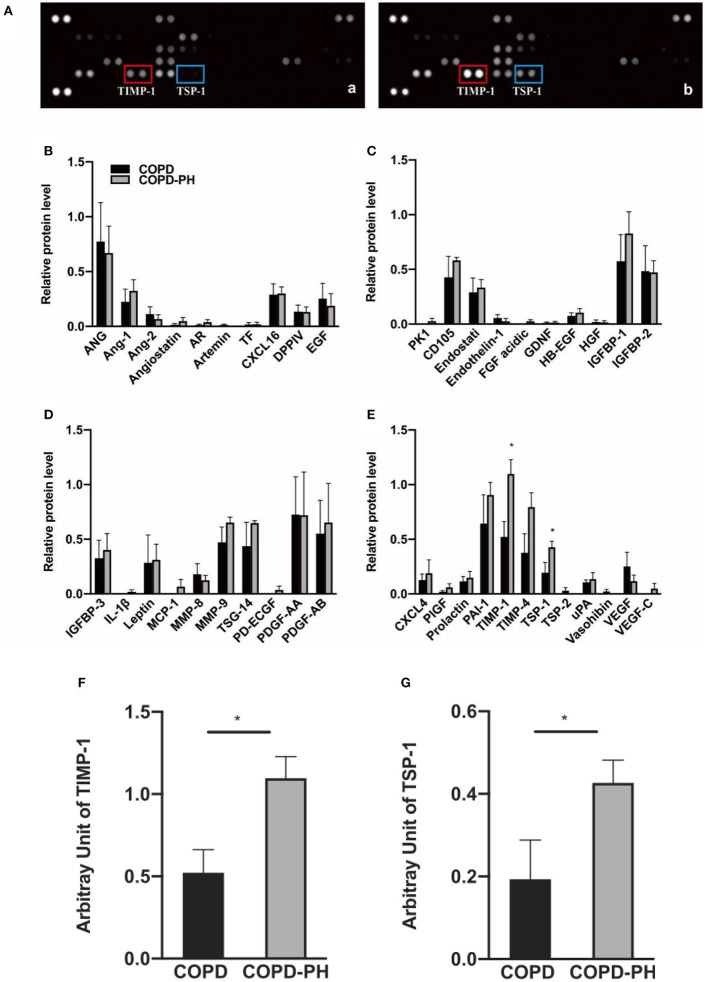
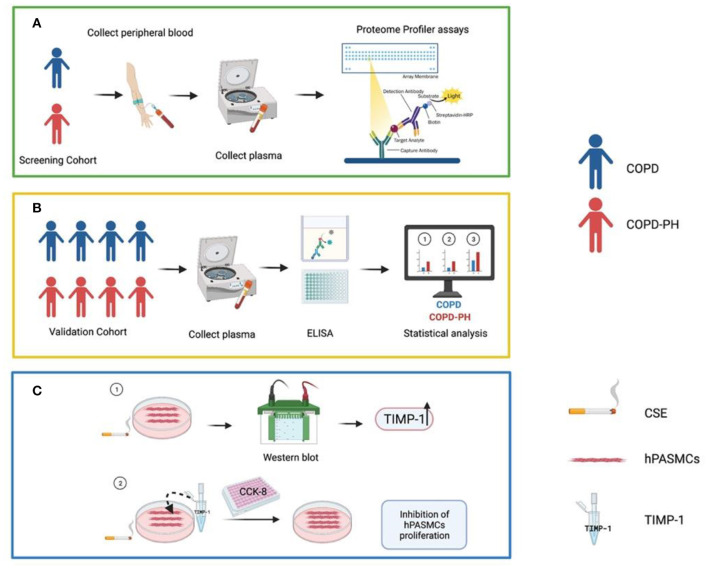
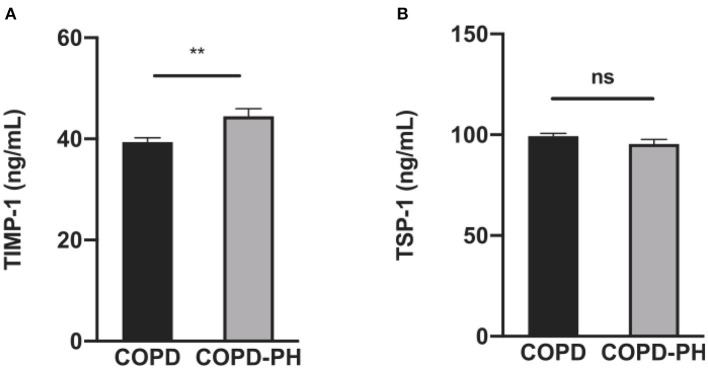
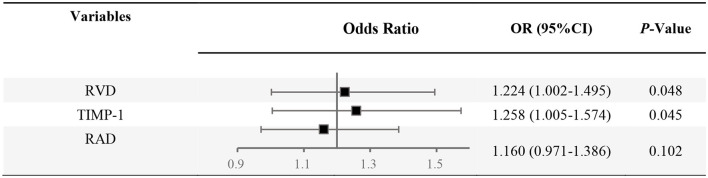
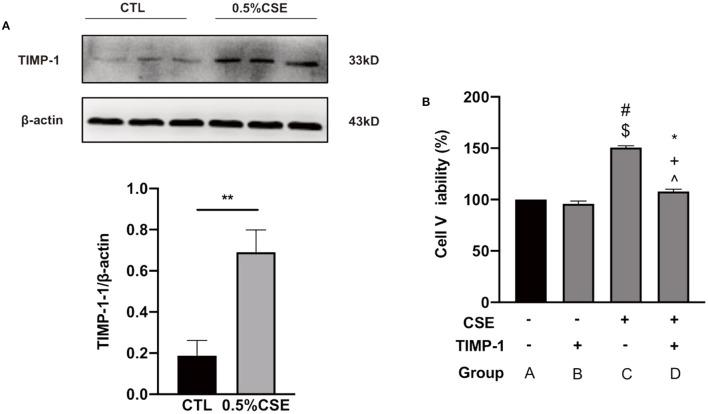
Pulmonary hypertension (PH) is a common complication of chronic obstructive pulmonary disease (COPD) and induces increased mortality among COPD patients. However, there are no blood biomarkers to identify PH in COPD. Here, we investigated whether circulating angiogenic factors and cytokines could serve as (a) biomarker (s) for COPD-PH patients. Using Angiogenesis and Cytokine proteome profile array assay, we measured the level of 36 cytokines and 55 angiogenesis-associated proteins in plasma from four COPD patients with PH (COPD-PH) and four COPD patients without PH (COPD), respectively, tissue inhibitor of metalloproteinase 1 (TIMP-1) and thrombospondin 1(TSP-1) were significantly different between the two groups. Enzyme-linked immunosorbent assay (ELISA) was applied to measured TIMP-1 and TSP-1 in a validation cohort (COPD-PH, = 28; COPD, = 18), and TIMP-1 was the only factor that was significantly different between COPD-PH and COPD patients ( < 0.01). Logistic regression analysis demonstrated that elevated TIMP-1 was an independent risk factor for COPD-PH [odds ratio (OR) = 1.258, 95% CI: 1.005-1.574, < 0.05). Next, we explored the expression level and function of TIMP-1 in human pulmonary arterial smooth muscle cells (hPASMCs) exposed to cigarette smoking extract (CSE, a major etiological factor of COPD). In cultured hPASMCs, CSE treatment increased both TIMP-1 protein level and cell proliferation, and exogenous TIMP-1 (25 ng/mL) treatment inhibited CSE-induced hPASMCs proliferation. Overall, our results indicated that TIMP-1 elevation could serve as a circulating biomarker to diagnose PH among COPD patients, and TIMP-1 elevation in COPD-PH could be adaptive.
肺动脉高压(PH)是慢性阻塞性肺疾病(COPD)的常见并发症,可导致COPD患者死亡率增加。然而,目前尚无用于识别COPD患者中PH的血液生物标志物。在此,我们研究了循环血管生成因子和细胞因子是否可作为COPD合并PH患者的生物标志物。使用血管生成和细胞因子蛋白质组谱阵列分析,我们分别测量了4例COPD合并PH患者(COPD-PH)和4例无PH的COPD患者(COPD)血浆中36种细胞因子和55种血管生成相关蛋白的水平,金属蛋白酶组织抑制剂1(TIMP-1)和血小板反应蛋白1(TSP-1)在两组之间存在显著差异。采用酶联免疫吸附测定(ELISA)在一个验证队列(COPD-PH,n = 28;COPD,n = 18)中检测TIMP-1和TSP-1,TIMP-1是COPD-PH和COPD患者之间唯一存在显著差异的因素(P < 0.01)。逻辑回归分析表明,TIMP-1升高是COPD合并PH的独立危险因素[比值比(OR)= 1.258,95%置信区间:1.005 - 1.574,P < 0.05]。接下来,我们探讨了TIMP-1在暴露于香烟烟雾提取物(CSE,COPD的主要病因)的人肺动脉平滑肌细胞(hPASMCs)中的表达水平和功能。在培养的hPASMCs中,CSE处理增加了TIMP-1蛋白水平和细胞增殖,而外源性TIMP-1(25 ng/mL)处理抑制了CSE诱导的hPASMCs增殖。总体而言,我们的结果表明,TIMP-1升高可作为诊断COPD患者中PH的循环生物标志物,且COPD合并PH时TIMP-1升高可能具有适应性。