Xia Xianru, Li Xiandong, Xie Fei, Yuan Guolin, Cheng Dongliang, Peng Chunyan
Department of Laboratory Medicine, Taihe Hospital, Hubei University of Medicine, Shiyan, China.
Outpatient Department, Taihe Hospital, Hubei University of Medicine, Shiyan, China.
Ann Transl Med. 2022 Feb;10(3):133. doi: 10.21037/atm-22-118.
This study sought to analyze non-targeted plasma metabolites in patients with atherosclerosis (AS).
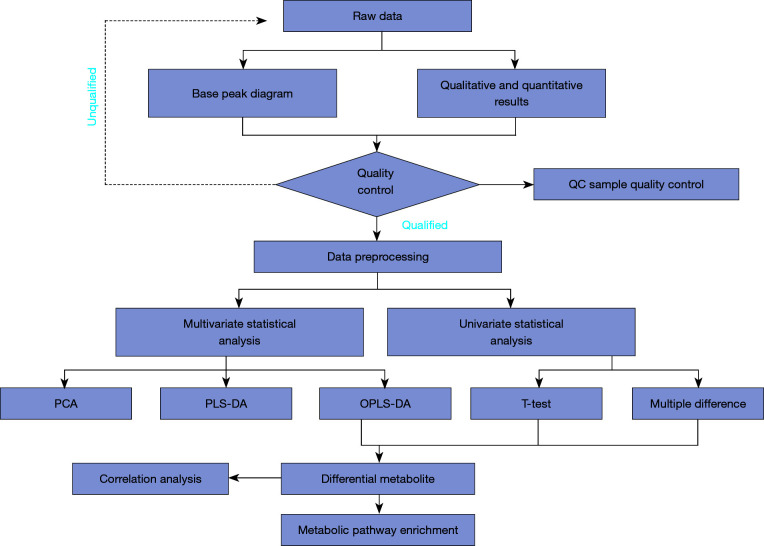
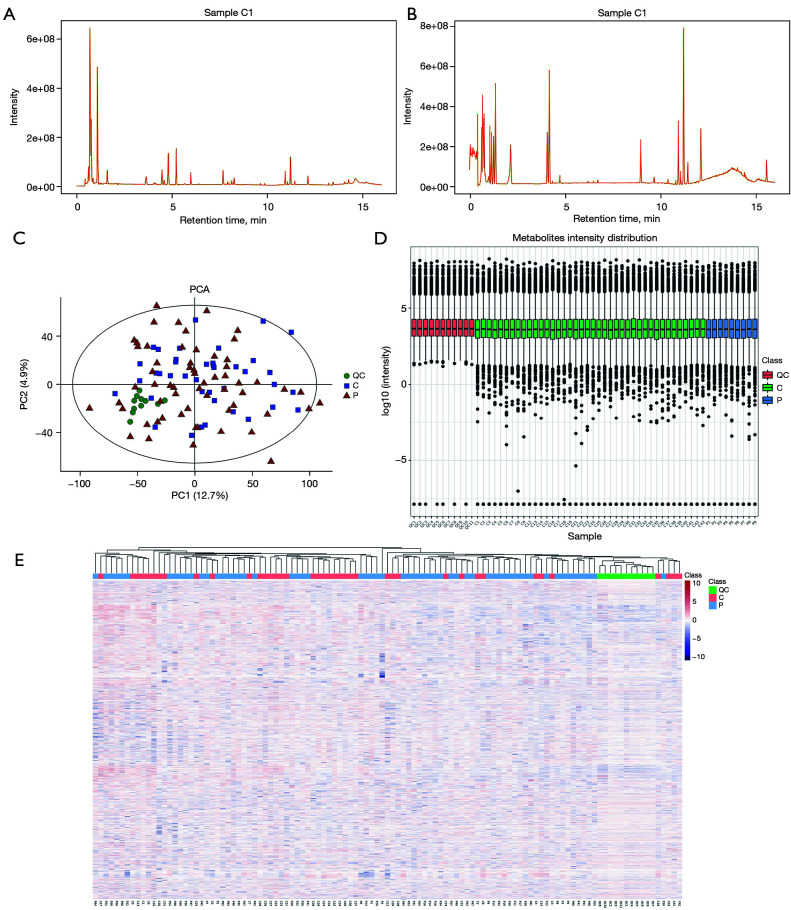
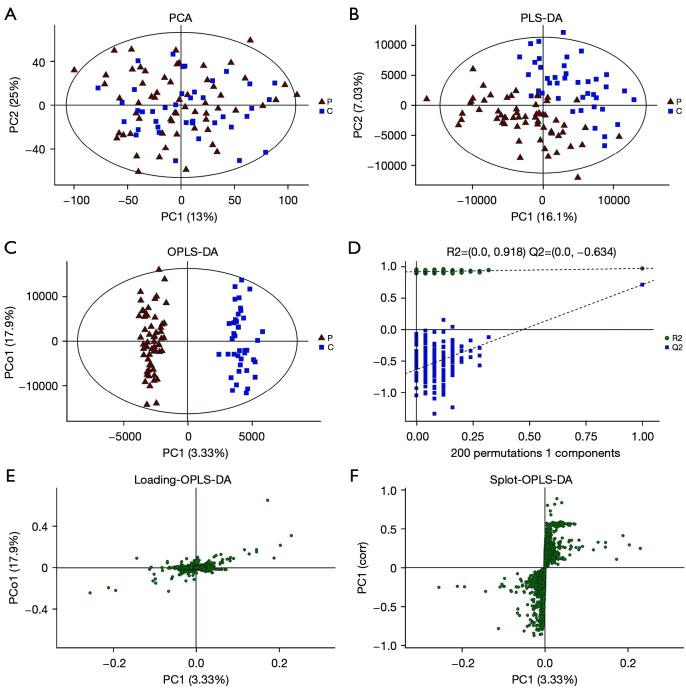
The plasma of patients with AS (the patient group) and the plasma of age-matched and gender-matched healthy individuals (the control group) at the Taihe Hospital was collected. One hundred patients were included in the study (60 in the patient group and 40 in the control group). Fasting venous plasma was collected in the morning. The metabolites in the plasma were examined by liquid chromatography-mass spectrometry (LC-MS). An unsupervised principal component analysis (PCA) was conducted to observe the overall distribution of each sample and the stability of the analysis process. Next, a supervised partial least squares-discriminant analysis (PLS-DA) and an orthogonal partial least squares-discriminant analysis (OPLS-DA) were conducted to examine the overall differences among the metabolic profiles of the groups and identify different metabolites in the groups. Pathway enrichment was analyzed using the Kyoto Encyclopedia of Genes and Genomes (KEGG) database.
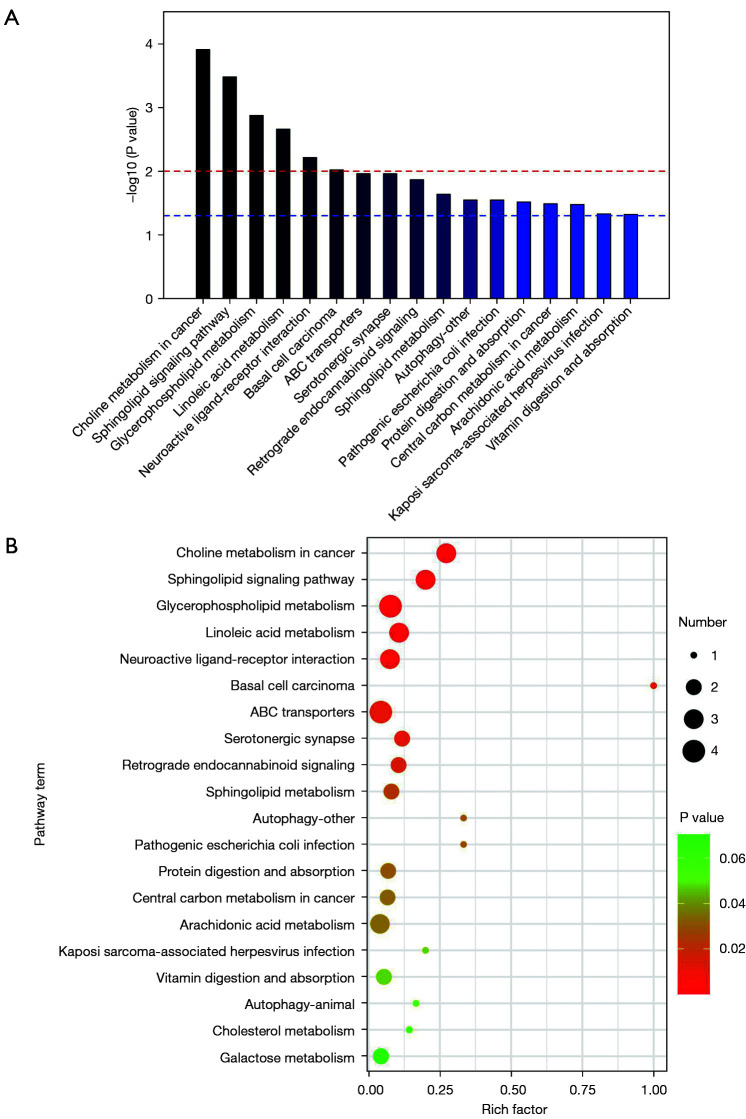
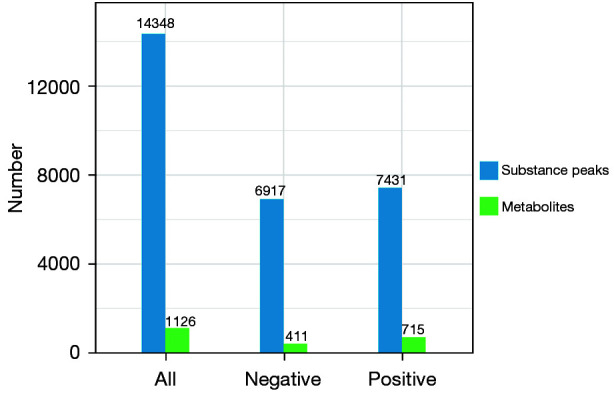
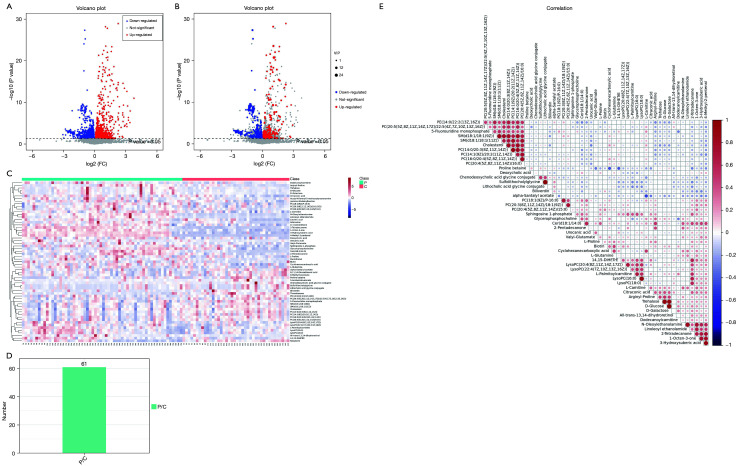
In total, 1,126 different metabolites were detected in the patient and control groups. Compared to the control group, 411 species decreased, and 715 species increased in the patient group. There were 61 different metabolites with a variable weight in the projection (VIP) >1 and a P<0.05. There were 34 types of lipid metabolites, 10 types of carbon and oxygen compounds, 8 types of organic acids and derivatives, 4 types of organoheterocyclic compounds, 3 types of nitrogen-containing organic compounds, and 2 types of nucleotides and analogs. Compared to the control group, 47 species decreased, and 14 species increased in the patient group. The following 9 metabolites had the most significant differences (|log2fold change| >1; P<0.05): 2-tetradecanone, pantothenol, all-trans-13,14-dihydroretinol, linoleoyl ethanolamide, N-oleoylethanolamine, 4-methyl-2-pentenal, Cer (d18:1/14:0), chenodeoxycholic acid glycine conjugate, and 5-acetamidovalerate. The enrichment analysis results of the 61 different metabolite pathways identified 17 metabolic pathways with significant differences (P<0.05), including the choline metabolism, lipid metabolism, autophagy, amino acid metabolism, vitamin digestion, and absorption pathways.
There are significant differences in non-targeted plasma metabolites between patients with AS and healthy individuals. The above-mentioned 9 most significantly different metabolites may be potential markers of AS.
本研究旨在分析动脉粥样硬化(AS)患者的非靶向血浆代谢物。
收集太和医院AS患者(患者组)及年龄和性别匹配的健康个体(对照组)的血浆。本研究纳入100例患者(患者组60例,对照组40例)。于早晨采集空腹静脉血浆。采用液相色谱-质谱联用(LC-MS)检测血浆中的代谢物。进行无监督主成分分析(PCA)以观察每个样本的总体分布及分析过程的稳定性。接下来,进行有监督的偏最小二乘判别分析(PLS-DA)和正交偏最小二乘判别分析(OPLS-DA)以检验各组代谢谱的总体差异并识别组间不同的代谢物。使用京都基因与基因组百科全书(KEGG)数据库进行通路富集分析。
患者组和对照组共检测到1126种不同的代谢物。与对照组相比,患者组中有411种代谢物减少,715种代谢物增加。有61种不同的代谢物其投影变量重要性(VIP)>1且P<0.05。其中包括34种脂质代谢物、10种碳氧化合物、8种有机酸及其衍生物、4种有机杂环化合物、3种含氮有机化合物以及2种核苷酸及其类似物。与对照组相比,患者组中有47种代谢物减少,14种代谢物增加。以下9种代谢物差异最为显著(|log2倍数变化|>1;P<0.05):2-十四烷酮、泛醇、全反式-13,14-二氢视黄醇、亚油酰乙醇胺、N-油酰乙醇胺、4-甲基-2-戊烯醛、神经酰胺(d18:1/14:0)、鹅去氧胆酸甘氨酸共轭物以及5-乙酰氨基戊酸。对这61种不同代谢物通路的富集分析结果确定了17条具有显著差异的代谢通路(P<0.05),包括胆碱代谢、脂质代谢、自噬、氨基酸代谢、维生素消化及吸收通路。
AS患者与健康个体的非靶向血浆代谢物存在显著差异。上述9种差异最为显著的代谢物可能是AS的潜在标志物。