• 文献检索
  • 文档翻译
  • 深度研究
  • 学术资讯
  • Suppr Zotero 插件Zotero 插件
  • 邀请有礼
  • 套餐&价格
  • 历史记录
应用&插件
Suppr Zotero 插件Zotero 插件浏览器插件Mac 客户端Windows 客户端微信小程序
定价
高级版会员购买积分包购买API积分包
服务
文献检索文档翻译深度研究API 文档MCP 服务
关于我们
关于 Suppr公司介绍联系我们用户协议隐私条款
关注我们

Suppr 超能文献

核心技术专利:CN118964589B侵权必究
粤ICP备2023148730 号-1Suppr @ 2026

文献检索

告别复杂PubMed语法,用中文像聊天一样搜索,搜遍4000万医学文献。AI智能推荐,让科研检索更轻松。

立即免费搜索

文件翻译

保留排版,准确专业,支持PDF/Word/PPT等文件格式,支持 12+语言互译。

免费翻译文档

深度研究

AI帮你快速写综述,25分钟生成高质量综述,智能提取关键信息,辅助科研写作。

立即免费体验

移动和可穿戴人工智能在儿童和青少年精神病学中的应用:范围综述。

Use of Mobile and Wearable Artificial Intelligence in Child and Adolescent Psychiatry: Scoping Review.

机构信息

Department of Molecular Pharmacology and Experimental Therapeutics, Mayo Clinic, Rochester, MN, United States.

Department of Psychiatry and Psychology, Mayo Clinic, Rochester, MN, United States.

出版信息

J Med Internet Res. 2022 Mar 14;24(3):e33560. doi: 10.2196/33560.

DOI:10.2196/33560
PMID:35285812
原文链接:https://pmc.ncbi.nlm.nih.gov/articles/PMC8961347/
Abstract

BACKGROUND

Mental health disorders are a leading cause of medical disabilities across an individual's lifespan. This burden is particularly substantial in children and adolescents because of challenges in diagnosis and the lack of precision medicine approaches. However, the widespread adoption of wearable devices (eg, smart watches) that are conducive for artificial intelligence applications to remotely diagnose and manage psychiatric disorders in children and adolescents is promising.

OBJECTIVE

This study aims to conduct a scoping review to study, characterize, and identify areas of innovations with wearable devices that can augment current in-person physician assessments to individualize diagnosis and management of psychiatric disorders in child and adolescent psychiatry.

METHODS

This scoping review used information from the PRISMA (Preferred Reporting Items for Systematic Reviews and Meta-Analyses) guidelines. A comprehensive search of several databases from 2011 to June 25, 2021, limited to the English language and excluding animal studies, was conducted. The databases included Ovid MEDLINE and Epub ahead of print, in-process and other nonindexed citations, and daily; Ovid Embase; Ovid Cochrane Central Register of Controlled Trials; Ovid Cochrane Database of Systematic Reviews; Web of Science; and Scopus.

RESULTS

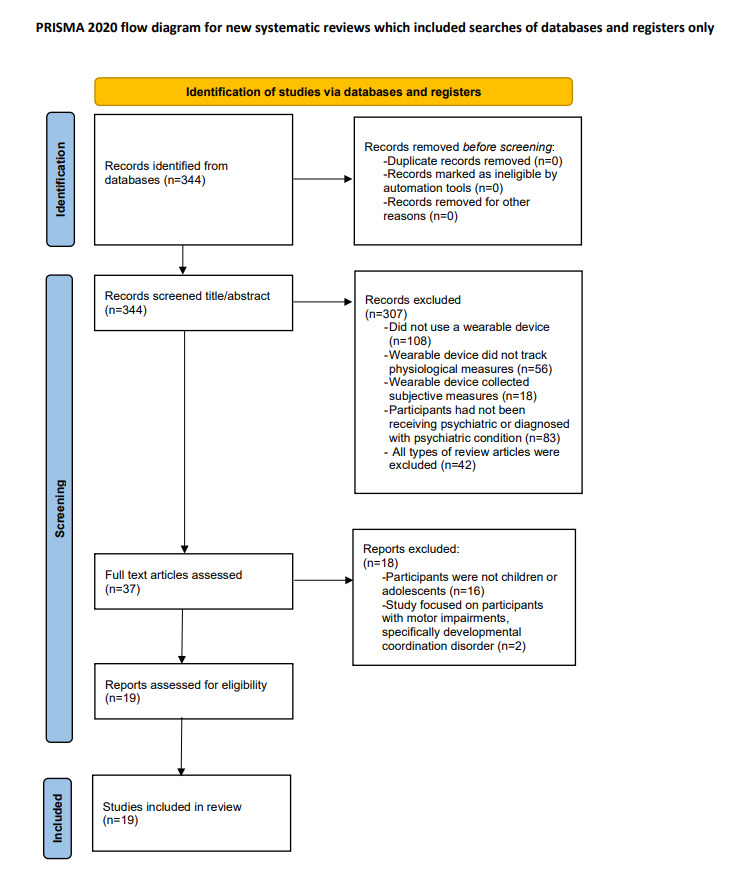
The initial search yielded 344 articles, from which 19 (5.5%) articles were left on the final source list for this scoping review. Articles were divided into three main groups as follows: studies with the main focus on autism spectrum disorder, attention-deficit/hyperactivity disorder, and internalizing disorders such as anxiety disorders. Most of the studies used either cardio-fitness chest straps with electrocardiogram sensors or wrist-worn biosensors, such as watches by Fitbit. Both allowed passive data collection of the physiological signals.

CONCLUSIONS

Our scoping review found a large heterogeneity of methods and findings in artificial intelligence studies in child psychiatry. Overall, the largest gap identified in this scoping review is the lack of randomized controlled trials, as most studies available were pilot studies and feasibility trials.

摘要

背景

精神健康障碍是导致个体一生出现医疗残疾的主要原因。由于儿童和青少年在诊断方面存在挑战,且缺乏精准医疗方法,因此这种负担在儿童和青少年中尤为严重。然而,广泛采用有利于人工智能应用的可穿戴设备(如智能手表)来远程诊断和管理儿童和青少年的精神疾病具有广阔的前景。

目的

本研究旨在进行范围界定审查,研究、描述和确定可穿戴设备在创新方面的领域,这些领域可以增强当前的医生面诊评估,从而实现儿童和青少年精神科精神疾病的个体化诊断和管理。

方法

本范围界定审查使用了 PRISMA(系统评价和荟萃分析的首选报告项目)指南中的信息。从 2011 年至 2021 年 6 月 25 日,对几个数据库进行了全面搜索,限于英文且排除了动物研究。这些数据库包括 Ovid MEDLINE 和 Epub ahead of print、in-process 和其他非索引引文、以及每日更新的 Ovid Embase、Ovid Cochrane 对照试验中心注册库、Ovid Cochrane 系统评价数据库、Web of Science 和 Scopus。

结果

最初的搜索产生了 344 篇文章,其中 19 篇(5.5%)文章被列入本次范围界定审查的最终来源列表。文章分为三组,主要集中在自闭症谱系障碍、注意力缺陷/多动障碍和内化障碍(如焦虑障碍)的研究。大多数研究使用带心电图传感器的胸带或腕带生物传感器,如 Fitbit 手表,都可以被动地收集生理信号。

结论

我们的范围界定审查发现,儿童精神病学人工智能研究方法和发现存在很大的异质性。总体而言,本范围界定审查中发现的最大差距是缺乏随机对照试验,因为大多数可用的研究都是试点研究和可行性试验。
https://cdn.ncbi.nlm.nih.gov/pmc/blobs/d9ce/8961347/3b48a6038e78/jmir_v24i3e33560_fig1.jpg

相似文献

1
Use of Mobile and Wearable Artificial Intelligence in Child and Adolescent Psychiatry: Scoping Review.移动和可穿戴人工智能在儿童和青少年精神病学中的应用:范围综述。
J Med Internet Res. 2022 Mar 14;24(3):e33560. doi: 10.2196/33560.
2
Folic acid supplementation and malaria susceptibility and severity among people taking antifolate antimalarial drugs in endemic areas.在流行地区,服用抗叶酸抗疟药物的人群中,叶酸补充剂与疟疾易感性和严重程度的关系。
Cochrane Database Syst Rev. 2022 Feb 1;2(2022):CD014217. doi: 10.1002/14651858.CD014217.
3
Wearable Technologies for Detecting Burnout and Well-Being in Health Care Professionals: Scoping Review.可穿戴技术在医疗保健专业人员的倦怠和健康监测中的应用:范围综述。
J Med Internet Res. 2024 Jun 25;26:e50253. doi: 10.2196/50253.
4
Longitudinal Coadaptation of Older Adults With Wearables and Voice-Activated Virtual Assistants: Scoping Review.老年人穿戴设备和语音激活虚拟助手的纵向协同适应:范围综述。
J Med Internet Res. 2024 Aug 7;26:e57258. doi: 10.2196/57258.
5
Beyond the black stump: rapid reviews of health research issues affecting regional, rural and remote Australia.超越黑木树:影响澳大利亚地区、农村和偏远地区的健康研究问题的快速综述。
Med J Aust. 2020 Dec;213 Suppl 11:S3-S32.e1. doi: 10.5694/mja2.50881.
6
An Exploration of Wearable Device Features Used in UK Hospital Parkinson Disease Care: Scoping Review.可穿戴设备在英国帕金森病医院护理中的应用特点探索:范围综述。
J Med Internet Res. 2023 Aug 18;25:e42950. doi: 10.2196/42950.
7
Wearable Artificial Intelligence for Sleep Disorders: Scoping Review.用于睡眠障碍的可穿戴人工智能:范围综述
J Med Internet Res. 2025 May 6;27:e65272. doi: 10.2196/65272.
8
Artificial Intelligence Applications to Measure Food and Nutrient Intakes: Scoping Review.人工智能在测量食物和营养素摄入量中的应用:范围综述。
J Med Internet Res. 2024 Nov 28;26:e54557. doi: 10.2196/54557.
9
Wearables and Smartphones for Tracking Modifiable Risk Factors in Metabolic Health: Protocol for a Scoping Review.可穿戴设备和智能手机在代谢健康可调节风险因素跟踪中的应用:系统评价方案。
JMIR Res Protoc. 2024 Nov 28;13:e59539. doi: 10.2196/59539.
10
The Impact of Wearable Technologies in Health Research: Scoping Review.可穿戴技术在健康研究中的影响:范围综述。
JMIR Mhealth Uhealth. 2022 Jan 25;10(1):e34384. doi: 10.2196/34384.

引用本文的文献

1
Deep learning approach for automatic assessment of schizophrenia and bipolar disorder in patients using R-R intervals.使用R-R间期对患者精神分裂症和双相情感障碍进行自动评估的深度学习方法。
PLoS Comput Biol. 2025 Sep 3;21(9):e1012983. doi: 10.1371/journal.pcbi.1012983. eCollection 2025 Sep.
2
Artificial Intelligence-Based Mobile Phone Apps for Child Mental Health: Comprehensive Review and Content Analysis.基于人工智能的儿童心理健康手机应用程序:综合综述与内容分析
JMIR Mhealth Uhealth. 2025 Jun 6;13:e58597. doi: 10.2196/58597.
3
Collecting Real-Life Psychophysiological Data via Wearables to Better Understand Child Behavior in a Children's Psychiatric Center: Mixed Methods Study on Feasibility and Implementation.

本文引用的文献

1
StopWatch: Pilot study for an Apple Watch application for youth with ADHD.秒表:针对患有注意力缺陷多动障碍(ADHD)的青少年的苹果手表应用程序的试点研究。
Digit Health. 2021 Apr 1;7:20552076211001215. doi: 10.1177/20552076211001215. eCollection 2021 Jan-Dec.
2
Digital Phenotype for Childhood Internalizing Disorders: Less Positive Play and Promise for a Brief Assessment Battery.儿童内化障碍的数字化表型:游戏积极性降低,预示着简短评估组合的出现。
IEEE J Biomed Health Inform. 2021 Aug;25(8):3176-3184. doi: 10.1109/JBHI.2021.3053846. Epub 2021 Aug 5.
3
Using Wearable Sensor Technology to Measure Motion Complexity in Infants at High Familial Risk for Autism Spectrum Disorder.
通过可穿戴设备收集现实生活中的心理生理数据以更好地了解儿童精神病中心的儿童行为:可行性与实施的混合方法研究
JMIR Form Res. 2025 May 30;9:e65559. doi: 10.2196/65559.
4
Wearable Artificial Intelligence for Sleep Disorders: Scoping Review.用于睡眠障碍的可穿戴人工智能:范围综述
J Med Internet Res. 2025 May 6;27:e65272. doi: 10.2196/65272.
5
Ecological Momentary Assessment of emotional dysregulation and outbursts among youth with ADHD: a feasibility study of a biomarker-driven predictive algorithm in the special education pre-K and early childhood classroom settings.注意缺陷多动障碍青少年情绪失调与爆发的生态瞬时评估:一项在特殊教育学前班和幼儿课堂环境中基于生物标志物驱动的预测算法的可行性研究。
Front Child Adolesc Psychiatry. 2025 Mar 21;4:1549220. doi: 10.3389/frcha.2025.1549220. eCollection 2025.
6
A randomized trial of an app-enhanced group cognitive behavioral therapy for adolescents with mood or psychotic spectrum disorders.一项针对患有情绪或精神病性谱系障碍青少年的应用程序增强型团体认知行为疗法的随机试验。
J Consult Clin Psychol. 2025 Mar;93(3):131-143. doi: 10.1037/ccp0000946.
7
Latest clinical frontiers related to autism diagnostic strategies.与自闭症诊断策略相关的最新临床前沿进展。
Cell Rep Med. 2025 Feb 18;6(2):101916. doi: 10.1016/j.xcrm.2024.101916. Epub 2025 Jan 28.
8
Digital phenotyping from wearables using AI characterizes psychiatric disorders and identifies genetic associations.利用人工智能从可穿戴设备进行数字表型分析,可对精神疾病进行特征描述并识别基因关联。
Cell. 2025 Jan 23;188(2):515-529.e15. doi: 10.1016/j.cell.2024.11.012. Epub 2024 Dec 19.
9
Decoding anxiety: A scoping review of observable cues.解读焦虑:可观察线索的范围综述
Digit Health. 2024 Nov 26;10:20552076241297006. doi: 10.1177/20552076241297006. eCollection 2024 Jan-Dec.
10
Commercial Wearables for the Management of People with Autism Spectrum Disorder: A Review.商业可穿戴设备在自闭症谱系障碍人群管理中的应用:综述。
Biosensors (Basel). 2024 Nov 15;14(11):556. doi: 10.3390/bios14110556.
利用可穿戴传感器技术测量自闭症谱系障碍高家族风险婴儿的运动复杂性。
Sensors (Basel). 2021 Jan 17;21(2):616. doi: 10.3390/s21020616.
4
Prediction of short-term antidepressant response using probabilistic graphical models with replication across multiple drugs and treatment settings.使用具有复制功能的概率图模型预测短期抗抑郁反应,该模型跨越多种药物和治疗环境。
Neuropsychopharmacology. 2021 Jun;46(7):1272-1282. doi: 10.1038/s41386-020-00943-x. Epub 2021 Jan 15.
5
A wearable heart rate measurement device for children with autism spectrum disorder.一款可穿戴式心率测量设备,适用于自闭症谱系障碍儿童。
Sci Rep. 2020 Oct 29;10(1):18659. doi: 10.1038/s41598-020-75768-1.
6
Physiological Signal Monitoring for Identification of Emotional Dysregulation in Children.用于识别儿童情绪失调的生理信号监测
Annu Int Conf IEEE Eng Med Biol Soc. 2020 Jul;2020:4273-4277. doi: 10.1109/EMBC44109.2020.9176506.
7
The Future is Knocking: How Artificial Intelligence Will Fundamentally Change Psychiatry.未来正在敲门:人工智能将如何从根本上改变精神病学。
Acad Psychiatry. 2020 Aug;44(4):461-466. doi: 10.1007/s40596-020-01243-8. Epub 2020 May 18.
8
Effectiveness of Noise-Attenuating Headphones on Physiological Responses for Children With Autism Spectrum Disorders.降噪耳机对自闭症谱系障碍儿童生理反应的有效性
Front Integr Neurosci. 2019 Nov 12;13:65. doi: 10.3389/fnint.2019.00065. eCollection 2019.
9
Artificial Intelligence in Psychiatry.精神病学中的人工智能。
Adv Exp Med Biol. 2019;1192:119-125. doi: 10.1007/978-981-32-9721-0_6.
10
Artificial Intelligence for Mental Health and Mental Illnesses: an Overview.人工智能在精神健康和精神疾病中的应用:概述。
Curr Psychiatry Rep. 2019 Nov 7;21(11):116. doi: 10.1007/s11920-019-1094-0.