Lifestyle Science Cluster, Advanced Medical and Dental Institute, Universiti Sains Malaysia, Penang, Malaysia.
Department of Social and Preventive Medicine, Faculty of Medicine, Universiti Malaya, Kuala Lumpur, Malaysia.
JCO Glob Oncol. 2022 Mar;8:e2100250. doi: 10.1200/GO.21.00250.
The aim of this study is to determine the pathway that women follow for Breast Cancer Care (BCC) and the time intervals from symptom discovery to treatment initiation and to develop a quality matrix framework.
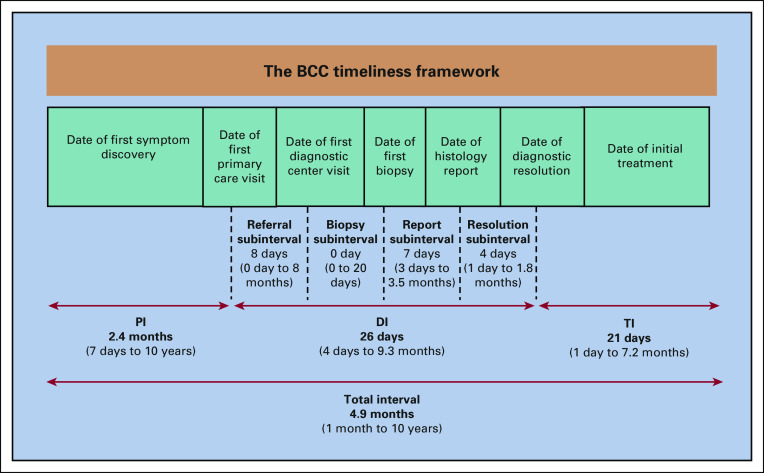
A retrospective cohort study was conducted at six tertiary centers in Malaysia. All women with newly diagnosed breast cancer were interviewed, and a medical records review was conducted using a structured questionnaire. The BCC timeliness framework showed that the total time between a woman discovering their first breast changes and the date of initial treatment was divided into three distinct intervals: presentation interval, diagnostic interval, and treatment interval. Four diagnosis subintervals, referral, biopsy, report, and diagnosis resolution intervals, were also looked into.
The BCC timeliness framework was used to capture important time points. The median total time, presentation interval, diagnostic interval, and treatment interval were 4.9 months (range, 1 month to 10 years), 2.4 months (range, 7 days to 10 years), 26 days (range, 4 days to 9.3 months), and 21 days (range, 1 day to 7.2 months), respectively. Meanwhile, the median time for the diagnosis subinterval of referral, biopsy, report, and diagnosis resolution was 8 days (range, 0 day to 8 months), 0 day (range, 0 day to 20 days), 7 days (range, 3 days to 3.5 months), and 4 days (range, 1 day to 1.8 months), respectively.
The BCC timeliness framework is based on the current sequenced trajectory of the BCC journey. Clarity in the measurement of timeliness provides a standardized language for monitoring and outcome research. It can serve as a quality indicator for community and hospital-based breast cancer programs.
本研究旨在确定女性接受乳腺癌护理(BCC)的途径以及从发现症状到开始治疗的时间间隔,并制定一个质量矩阵框架。
在马来西亚的六家三级中心进行了一项回顾性队列研究。对所有新诊断为乳腺癌的女性进行访谈,并使用结构化问卷进行病历回顾。BCC 及时性框架显示,女性从发现第一乳变化到初始治疗日期之间的总时间分为三个不同的间隔:就诊间隔、诊断间隔和治疗间隔。还研究了四个诊断子间隔:转诊、活检、报告和诊断解决间隔。
BCC 及时性框架用于捕获重要时间点。中位总时间、就诊间隔、诊断间隔和治疗间隔分别为 4.9 个月(范围为 1 个月至 10 年)、2.4 个月(范围为 7 天至 10 年)、26 天(范围为 4 天至 9.3 个月)和 21 天(范围为 1 天至 7.2 个月)。同时,转诊、活检、报告和诊断解决诊断子间隔的中位时间分别为 8 天(范围为 0 天至 8 个月)、0 天(范围为 0 天至 20 天)、7 天(范围为 3 天至 3.5 个月)和 4 天(范围为 1 天至 1.8 个月)。
BCC 及时性框架基于当前 BCC 旅程的顺序轨迹。及时性的明确衡量为监测和结果研究提供了标准化的语言。它可以作为社区和医院乳腺癌项目的质量指标。