Early Detection, Prevention and Infections Branch, International Agency for Research on Cancer, Lyon, France.
National Institute of Oncology, Rabat, Morocco.
Public Health. 2023 Oct;223:33-41. doi: 10.1016/j.puhe.2023.07.015. Epub 2023 Aug 17.
Rapid diagnostic and assessment pathways for cancer patients provide timely and effective care. This study took place in Morocco, where the majority of patients treated in the public sector are diagnosed at an advanced stage. The aim of this study was to determine the duration of different time intervals along the cancer patient pathway and to highlight problem areas so that strategies can be implemented to make the process more equitable and effective.
Cross-sectional study.
Recently diagnosed cancer patients were recruited from four major oncology centres in Morocco; namely, Marrakech, Casablanca, Rabat, and Fez. A questionnaire survey was administered, including sociodemographic and medical information and questions on access to the oncology centre, beliefs, and opinions on the medical staff. The dates of symptom recognition, assessment, diagnosis referral, biopsy, and treatment initiation were collected. Different time intervals (patient, diagnosis, biopsy, and treatment) were estimated and their determinants were investigated.
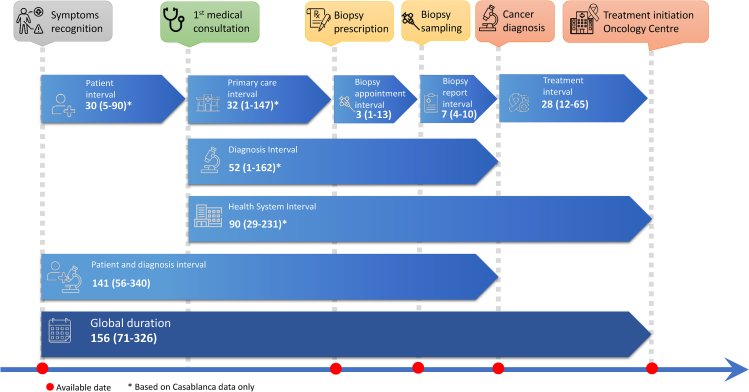
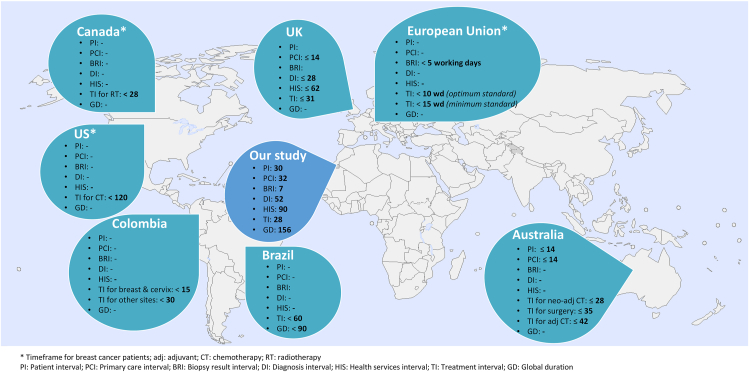
A total of 812 patients were interviewed. The majority of participants were breast cancer patients. In total, 60% of participants were at stage III-IV. The main facilitators of cancer diagnosis confirmation and treatment initiation were easy access to diagnosis and treatment facilities, financial resources, personal history of cancer, time availability, late stage at diagnosis, advanced age, and private health insurance. The patient interval (i.e., time from symptom recognition to initial healthcare assessment) had a median duration of 30 days. The biopsy and treatment intervals were within the current international recommendations (7 and 28 days, respectively). However, the diagnosis interval (52 days) was twice as long as the recommended timeframes from the UK, Australia, and the World Health Organization (<28 days).
Interval targets should be defined to encourage health systems to be more equitable and effective and to ensure that cancer patients are treated within a defined timeframe.
为癌症患者提供快速诊断和评估途径,以提供及时有效的护理。本研究在摩洛哥进行,在摩洛哥,大多数在公共部门接受治疗的患者被诊断为晚期。本研究旨在确定癌症患者路径中不同时间间隔的持续时间,并突出问题领域,以便实施策略,使该过程更加公平和有效。
横断面研究。
最近从摩洛哥的四个主要肿瘤中心(马拉喀什、卡萨布兰卡、拉巴特和菲斯)招募了癌症患者;即马拉喀什、卡萨布兰卡、拉巴特和菲斯。进行了问卷调查,包括社会人口统计学和医疗信息以及有关进入肿瘤中心的途径、信念和对医务人员的意见。收集了症状识别、评估、诊断转诊、活检和治疗开始的日期。估计了不同的时间间隔(患者、诊断、活检和治疗),并研究了其决定因素。
共采访了 812 名患者。大多数参与者是乳腺癌患者。总共,60%的参与者处于 III-IV 期。癌症诊断确认和治疗开始的主要促进因素是方便获得诊断和治疗设施、经济资源、个人癌症史、时间可用性、晚期诊断、年龄较大和私人健康保险。患者间隔(即从症状识别到初始医疗评估的时间)中位数为 30 天。活检和治疗间隔分别为 7 天和 28 天,均在当前国际建议范围内。然而,诊断间隔(52 天)是英国、澳大利亚和世界卫生组织建议的两倍(<28 天)。
应定义间隔目标,以鼓励卫生系统更加公平和有效,并确保癌症患者在规定的时间范围内得到治疗。