Renson Audrey, Dennis Alexis C, Noppert Grace, McClure Elizabeth S, Aiello Allison E
Department of Epidemiology, Carolina Population Center, UNC-Chapel Hill, Chapel Hill, USA.
Department of Sociology, Carolina Population Center, UNC-Chapel Hill, Chapel Hill, USA.
Curr Epidemiol Rep. 2022;9(2):66-76. doi: 10.1007/s40471-022-00284-x. Epub 2022 Mar 10.
Racial and socioeconomic inequities in respiratory pandemics have been consistently documented, but little official guidance exists on effective action to prevent these. We systematically reviewed quantitative evaluations of (real or simulated) interventions targeting racial and socioeconomic inequities in respiratory pandemic outcomes.
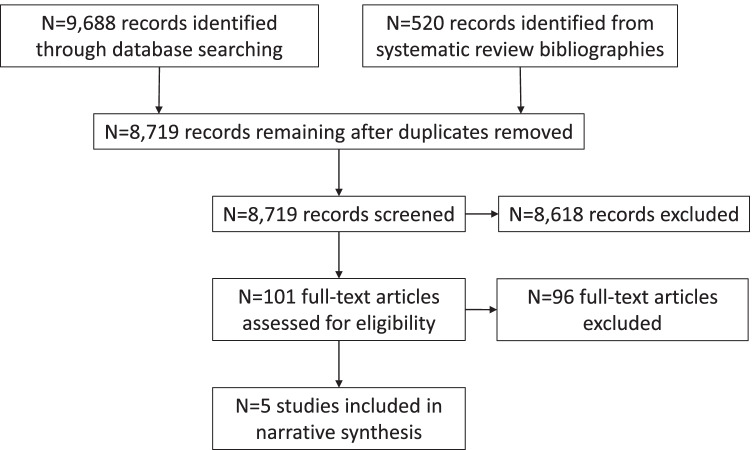
Our systematic search returned 10,208 records, of which 5 met inclusion criteria, including observational ( = 1), randomized trial ( = 1), and simulation ( = 3) studies. Interventions studied included vaccination parity, antiviral distribution, school closure, disinfection, personal protective equipment, and paid sick leave, with a focus on Black ( = 3) and/or Latinx ( = 4) or low-SES ( = 2) communities. Results are suggestive that these interventions might be effective at reducing racial and/or SES disparities in pandemics.
There is a dearth of research on strategies to reduce pandemic disparities. We provide theory-driven, concrete suggestions for incorporating equity into intervention research for pandemic preparedness, including a focus on social and economic policies.
呼吸道大流行中的种族和社会经济不平等现象一直有记录,但在预防这些不平等现象的有效行动方面几乎没有官方指导。我们系统地回顾了针对呼吸道大流行结果中的种族和社会经济不平等现象的(实际或模拟)干预措施的定量评估。
我们的系统检索返回了10208条记录,其中5条符合纳入标准,包括观察性研究(1项)、随机试验(1项)和模拟研究(3项)。所研究的干预措施包括疫苗接种公平性、抗病毒药物分发、学校关闭、消毒、个人防护设备和带薪病假,重点关注黑人社区(3项)和/或拉丁裔社区(4项)或低社会经济地位社区(2项)。结果表明,这些干预措施可能有效地减少大流行中的种族和/或社会经济差距。
关于减少大流行差距策略的研究匮乏。我们提供了理论驱动的具体建议,以便将公平纳入大流行防范干预研究,包括关注社会和经济政策。