Department of General Internal Medicine, Kyushu University Hospital, Fukuoka, Japan; Department of Comprehensive General Internal Medicine, Kyushu University Faculty of Medical Sciences, Fukuoka, Japan; Department of Internal Medicine, Haradoi Hospital, Fukuoka, Japan.
Department of Internal Medicine, Haradoi Hospital, Fukuoka, Japan.
J Infect Chemother. 2022 Jun;28(6):802-805. doi: 10.1016/j.jiac.2022.02.024. Epub 2022 Mar 8.
Many countries are administering a third dose of COVID-19 vaccines, but the evaluation of vaccine-induced immunity is insufficient. In addition, there are few reports of long-term observation of anti-spike IgG antibody titers after the vaccination in the Japanese population. This study aimed to evaluate anti-spike IgG levels in the Japanese health care workers six months after the BNT162b2 vaccination.
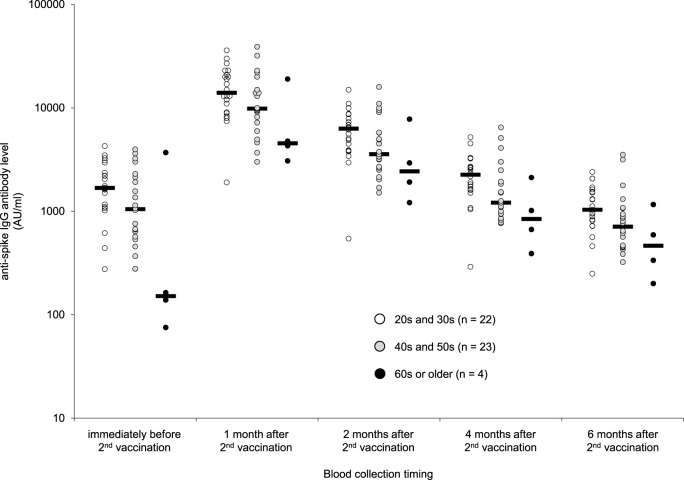
Dynamics of anti-spike IgG levels were assessed over a six-month period following the second vaccination in 49 participants (Analysis-1). A cross-sectional assessment of anti-spike IgG levels six months after the second vaccination was performed in 373 participants (Analysis-2).
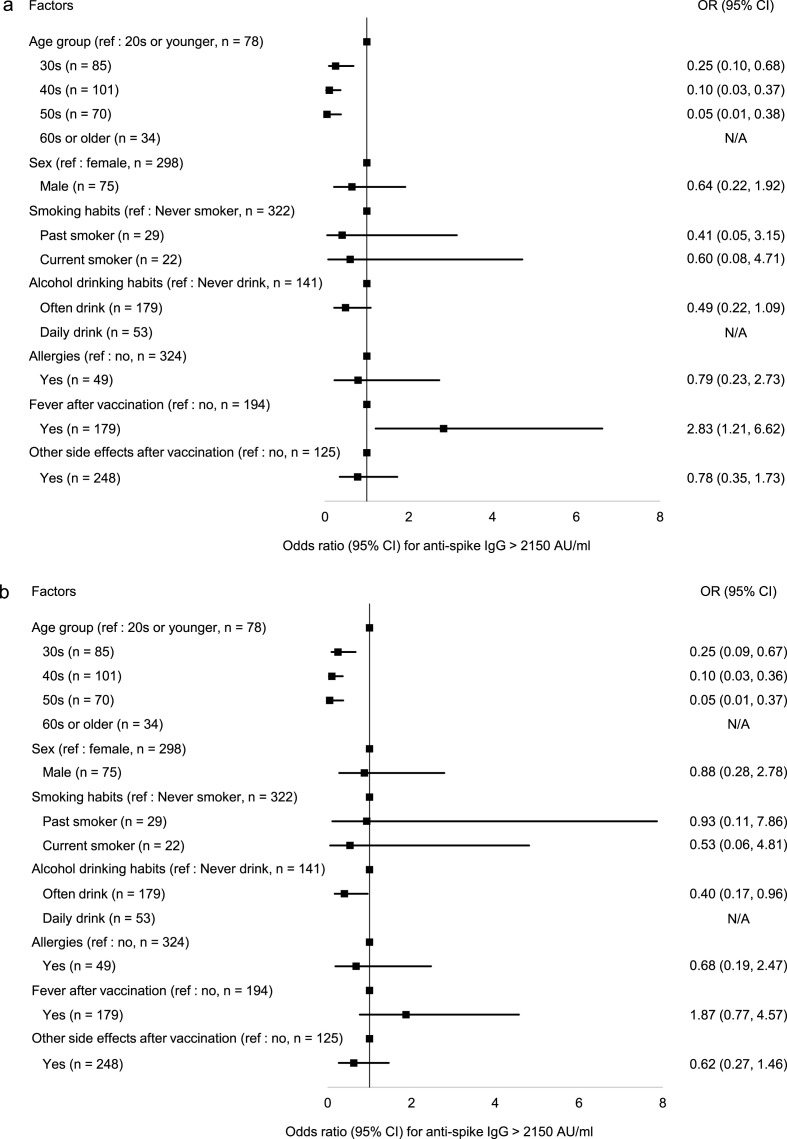
In Analysis-1, the geometric mean titer of anti-spike IgG was lower in the older age group and decreased consistently after the second vaccination regardless of age. In Analysis-2, the anti-spike IgG level was significantly negatively associated with age (r = -0.35, p < 0.01). This correlation remained statistically significant (r = -0.28, p < 0.01) after adjustment for sex, BMI, smoking habits, alcohol drinking habits, allergies, and fever or other adverse reactions at the time of vaccination. Additionally, participants who drank alcohol daily had significantly lower anti-spike IgG levels than participants who had never drunk alcohol. Sex, smoking habits, allergy, and fever and other side effects after vaccination did not show a significant association with anti-spike IgG levels.
Six months post-vaccination, the anti-spike IgG level was substantially lower in older persons and daily alcohol drinkers. This may be an indication for an additional vaccine dose for these at-risk categories.
许多国家正在接种第三剂 COVID-19 疫苗,但对疫苗诱导免疫的评估还不够。此外,在日本人群中,关于接种后刺突 IgG 抗体滴度的长期观察报告很少。本研究旨在评估接种 BNT162b2 疫苗 6 个月后日本医护人员的刺突 IgG 水平。
在 49 名参与者中(分析 1),在第二次接种后 6 个月内评估了抗刺突 IgG 水平的动态变化。在 373 名参与者中(分析 2),在第二次接种后 6 个月进行了抗刺突 IgG 水平的横断面评估。
在分析 1 中,年龄较大组的抗刺突 IgG 几何平均滴度较低,且无论年龄大小,第二次接种后均持续下降。在分析 2 中,抗刺突 IgG 水平与年龄呈显著负相关(r=-0.35,p<0.01)。调整性别、BMI、吸烟习惯、饮酒习惯、过敏和接种时发热或其他不良反应后,这种相关性仍然具有统计学意义(r=-0.28,p<0.01)。此外,每天饮酒的参与者的抗刺突 IgG 水平明显低于从不饮酒的参与者。性别、吸烟习惯、过敏和接种后的发热或其他副作用与抗刺突 IgG 水平无显著相关性。
接种后 6 个月,年龄较大者和每日饮酒者的抗刺突 IgG 水平显著降低。这可能表明这些高风险人群需要额外的疫苗剂量。