Urology Service, Department of Surgery, Memorial Sloan Kettering Cancer Center, New York, NY, USA; SUNY Downstate Health Sciences University, Brooklyn, NY, USA; Computational Oncology, Memorial Sloan Kettering Cancer Center, New York, NY, USA.
Computational Oncology, Memorial Sloan Kettering Cancer Center, New York, NY, USA; Physiology, Biophysics and Systems Biology Graduate Program, Weill Cornell Medicine, New York, NY, USA.
Eur Urol Focus. 2022 Sep;8(5):1278-1288. doi: 10.1016/j.euf.2021.12.002. Epub 2022 Mar 11.
Succinate dehydrogenase-deficient and fumarate hydratase-deficient renal cell carcinomas (SDHRCC and FHRCC) are rare kidney cancers driven by loss of TCA cycle enzymes.
To define and compare the genomic and metabolomic hallmarks of SDHRCC and FHRCC.
DESIGN, SETTING, AND PARTICIPANTS: We analyzed SDHRCC and FHRCC tumors with either immunohistochemical evidence of loss of protein expression or genomically confirmed biallelic inactivation of SDHA/B/C/D/AF2 or FH.
Somatic alterations were identified using clinical pipelines, with allele-specific copy number alterations (CNAs) identified using FACETS. Mass spectrometry-based metabolomic profiling was performed on available SDHRCC and FHRCC tumors.
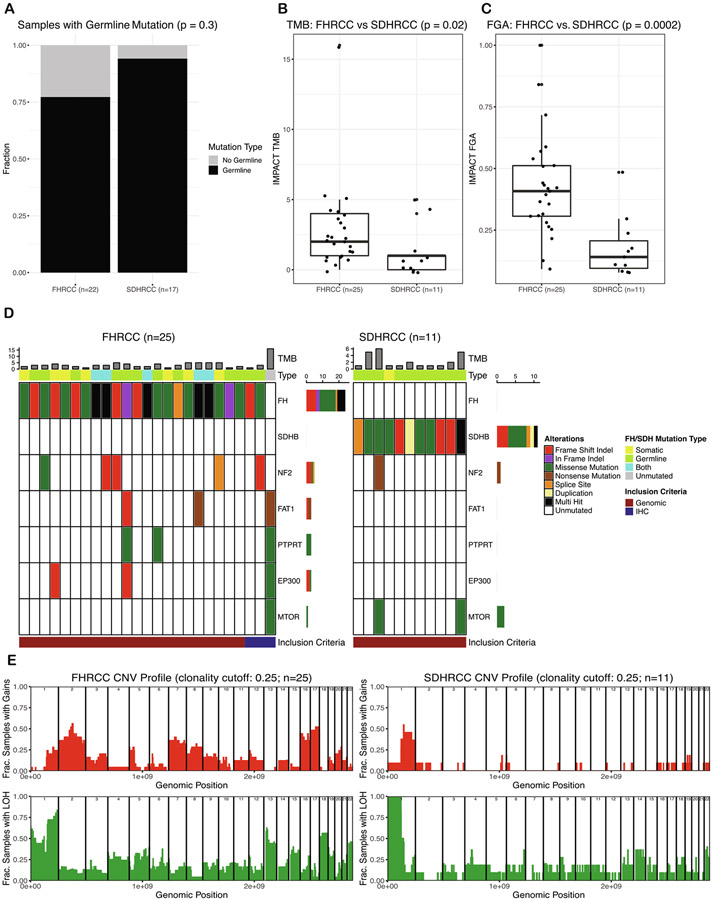
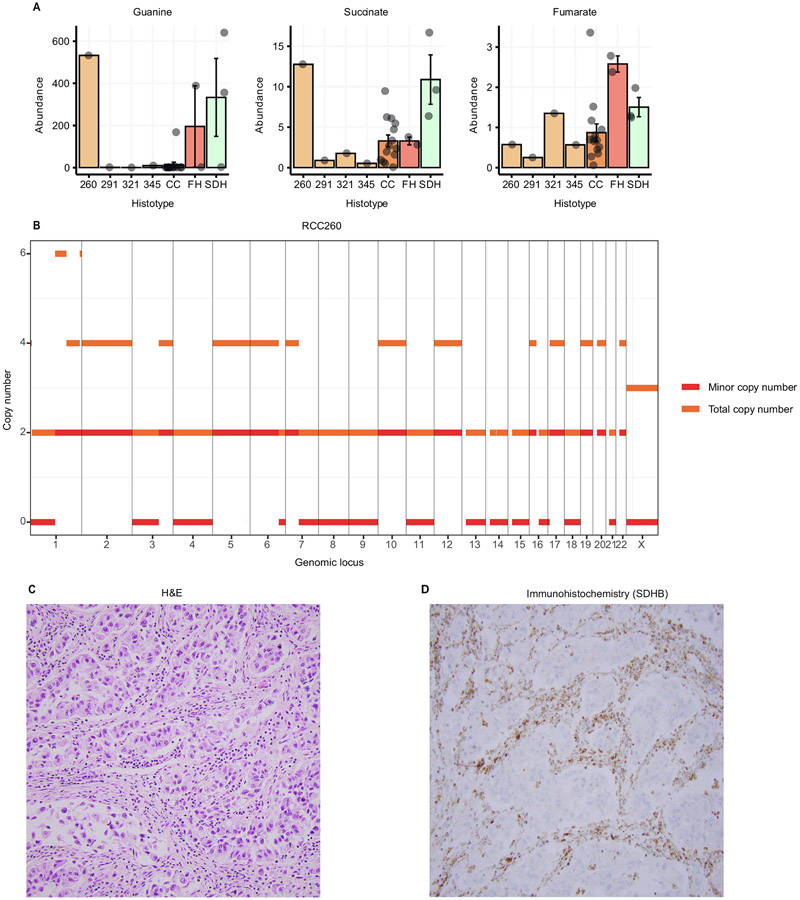
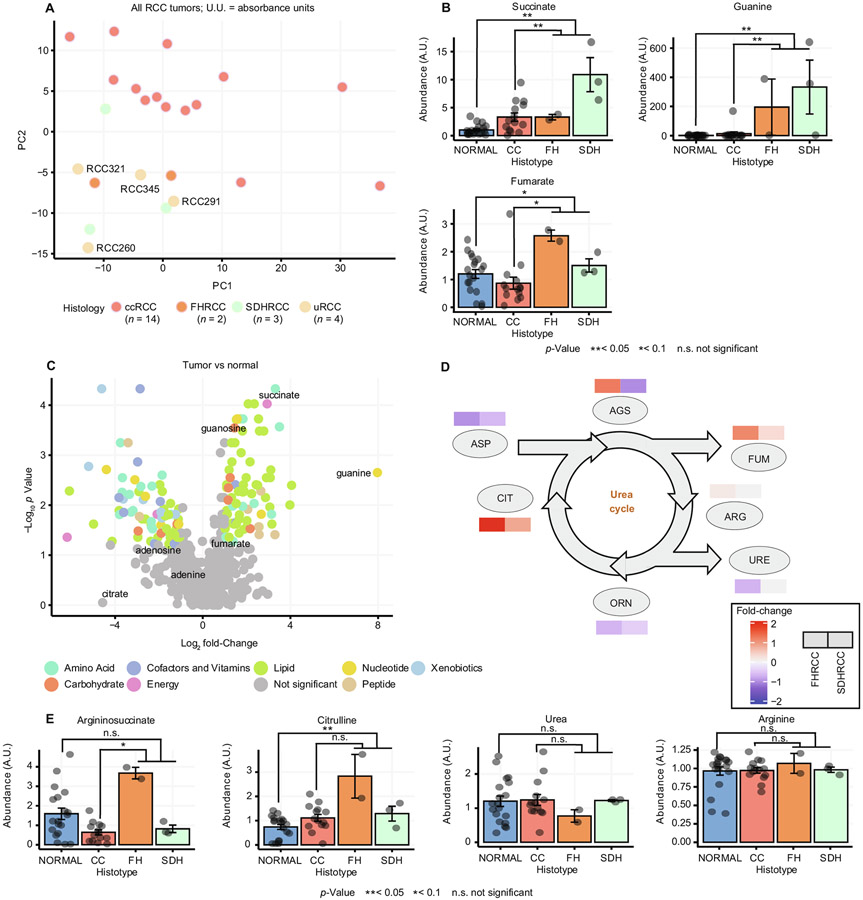
Tumors were analyzed for 42 patients (25 FHRCC, 17 SDHRCC). In the germline analysis, 16/17 SDHRCCs harbored a germline alteration in SDHB, whereas only 17/22 FHRCCs had pathogenic germline FH variants. SDHRCCs had a lower mutation burden (p = 0.02) and CNA burden (p = 0.0002) than FHRCCs. All SDHRCCs presented with deletion of chromosome 1p (overlapping SDHB), whereas FHRCCs demonstrated high but not ubiquitous loss of 1q (FH locus). Both SDHRCCs and FHRCCs exhibited significant idiopathic accumulation of the metabolite guanine. FHRCC tumors had elevated levels of urea cycle metabolites (argininosuccinate, citrulline, and fumarate), whereas SDHRCC tumors had elevation of numerous acylcarnitines. These characteristic metabolic changes allowed identification of a previously unrecognized SDH-deficient RCC.
Despite sharing similar genetic etiology, SDHRCC and FHRCC represent distinct molecular entities with unique genetic and metabolic abnormalities.
Kidney cancers driven by loss of the gene encoding either the succinate dehydrogenase or fumarate hydratase enzyme are rare. We sought to define and compare the genetic and metabolic features of these cancer entities.
琥珀酸脱氢酶缺陷型和富马酸水合酶缺陷型肾细胞癌(SDHRCC 和 FHRCC)是由三羧酸(TCA)循环酶缺失驱动的罕见肾癌。
定义并比较 SDHRCC 和 FHRCC 的基因组和代谢组学特征。
设计、地点和参与者:我们分析了具有蛋白表达缺失免疫组化证据或 SDHA/B/C/D/AF2 或 FH 基因座纯合失活的 SDHRCC 和 FHRCC 肿瘤。
使用临床管道识别体细胞改变,使用 FACETS 识别等位基因特异性拷贝数改变(CNA)。对可用的 SDHRCC 和 FHRCC 肿瘤进行基于质谱的代谢组学分析。
对 42 名患者(25 例 FHRCC,17 例 SDHRCC)进行了肿瘤分析。在种系分析中,17 例 SDHRCC 中有 16 例携带 SDHB 的种系改变,而 22 例 FHRCC 中只有 17 例存在致病性 FH 种系变异。SDHRCC 的突变负担(p=0.02)和 CNA 负担(p=0.0002)均低于 FHRCC。所有 SDHRCC 均表现为 1p 染色体缺失(重叠 SDHB),而 FHRCC 则表现为 1q 的高但非普遍缺失(FH 基因座)。SDHRCC 和 FHRCC 均表现出鸟嘌呤的异常积累。FHRCC 肿瘤的尿素循环代谢物(精氨酸琥珀酸、瓜氨酸和富马酸)水平升高,而 SDHRCC 肿瘤中多种酰基辅酶 A 升高。这些特征性的代谢变化允许识别以前未被识别的 SDH 缺陷型 RCC。
尽管具有相似的遗传病因,但 SDHRCC 和 FHRCC 代表具有独特遗传和代谢异常的不同分子实体。
由编码琥珀酸脱氢酶或富马酸水合酶的基因缺失驱动的肾癌很少见。我们试图定义和比较这些癌症实体的遗传和代谢特征。