Department of Biochemistry, University of Colorado, Boulder, CO 80309.
BioFrontiers Institute, University of Colorado, Boulder, CO 80309.
Proc Natl Acad Sci U S A. 2022 Mar 22;119(12):e2113535119. doi: 10.1073/pnas.2113535119. Epub 2022 Mar 15.
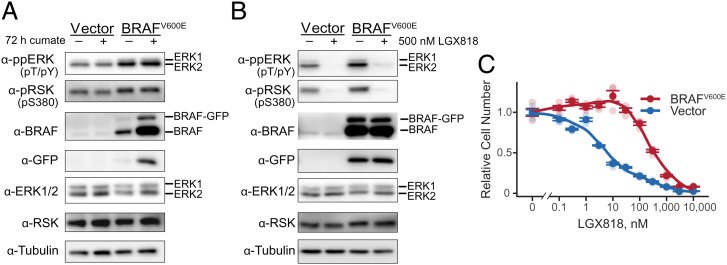
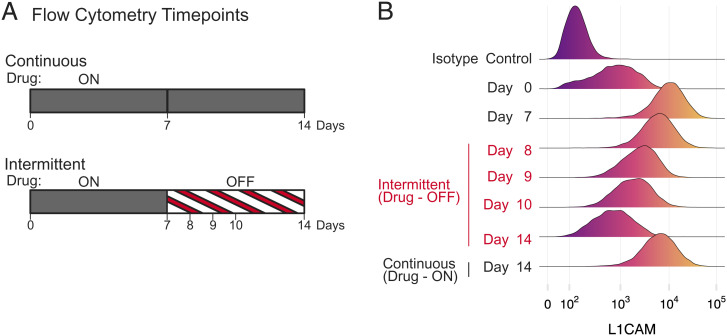
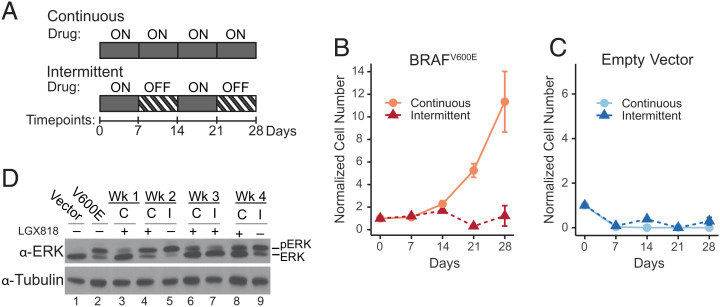
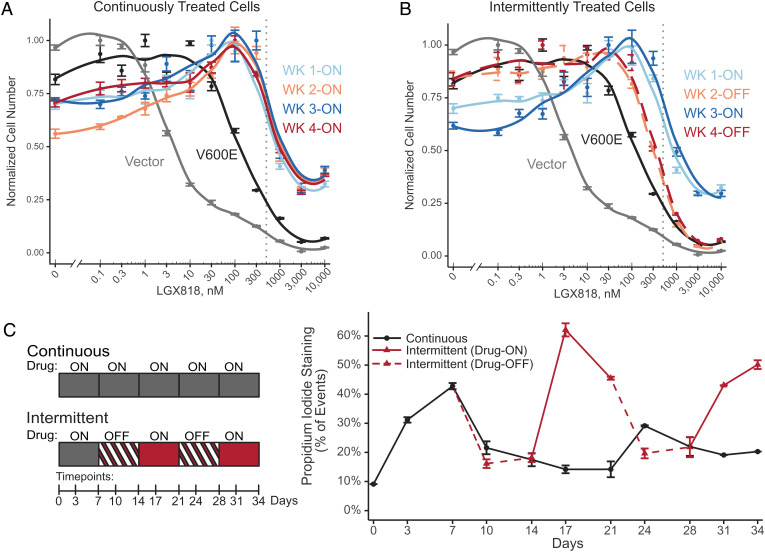
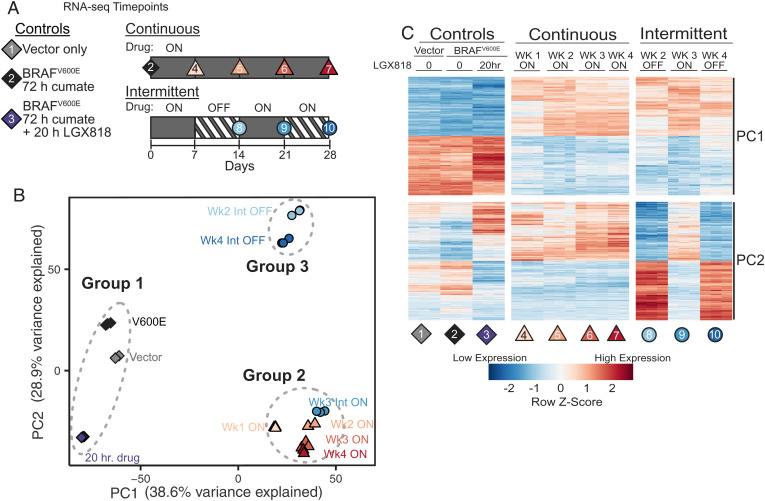
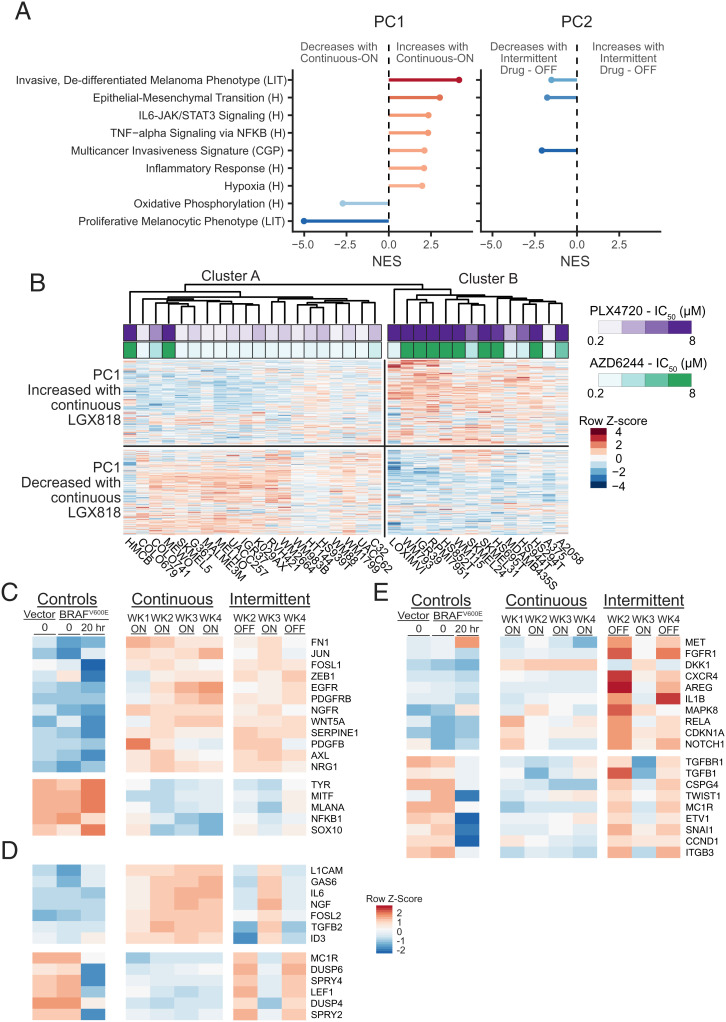
Patients with melanoma receiving drugs targeting BRAFV600E and mitogen-activated protein (MAP) kinase kinases 1 and 2 (MEK1/2) invariably develop resistance and face continued progression. Based on preclinical studies, intermittent treatment involving alternating periods of drug withdrawal and rechallenge has been proposed as a method to delay the onset of resistance. The beneficial effect of intermittent treatment has been attributed to drug addiction, where drug withdrawal reduces the viability of resistant cells due to MAP kinase pathway hyperactivation. However, the mechanistic basis of the intermittent effect is incompletely understood. We show that intermittent treatment with the BRAFV600E inhibitor, LGX818/encorafenib, suppresses growth compared with continuous treatment in human melanoma cells engineered to express BRAFV600E, p61-BRAFV600E, or MEK2C125 oncogenes. Analysis of the BRAFV600E-overexpressing cells shows that, while drug addiction clearly occurs, it fails to account for the advantageous effect of intermittent treatment. Instead, growth suppression is best explained by resensitization during periods of drug removal, followed by cell death after drug readdition. Continuous treatment leads to transcriptional responses prominently associated with chemoresistance in melanoma. By contrast, cells treated intermittently reveal a subset of transcripts that reverse expression between successive cycles of drug removal and rechallenge and include mediators of cell invasiveness and the epithelial-to-mesenchymal transition. These transcripts change during periods of drug removal by adaptive switching, rather than selection pressure. Resensitization occurs against a background of sustained expression of melanoma resistance genes, producing a transcriptome distinct from that of the initial drug-naive cell state. We conclude that phenotypic plasticity leading to drug resensitization can underlie the beneficial effect of intermittent treatment.
接受靶向 BRAFV600E 和丝裂原活化蛋白(MAP)激酶激酶 1 和 2(MEK1/2)的黑色素瘤患者不可避免地会产生耐药性并面临持续进展。基于临床前研究,已经提出了涉及药物停药和再挑战交替期的间歇性治疗作为延迟耐药发生的方法。间歇性治疗的有益效果归因于药物成瘾,其中药物停药由于 MAP 激酶途径的过度激活而降低耐药细胞的活力。然而,间歇性作用的机制基础尚不完全清楚。我们表明,与连续治疗相比,BRAFV600E 抑制剂 LGX818/encorafenib 的间歇性治疗可抑制表达 BRAFV600E、p61-BRAFV600E 或 MEK2C125 癌基因的人黑色素瘤细胞的生长。对过表达 BRAFV600E 的细胞进行分析表明,虽然明显发生了药物成瘾,但它不能解释间歇性治疗的有利效果。相反,生长抑制在药物去除期间的再敏化以及药物再添加后的细胞死亡后得到了最好的解释。连续治疗导致与黑色素瘤化学抗性密切相关的转录反应。相比之下,间歇性治疗的细胞显示出一组转录本,这些转录本在药物去除和再挑战的连续循环之间逆转表达,并包括细胞侵袭和上皮-间充质转化的介质。这些转录本在药物去除期间通过适应性切换而不是选择压力发生变化。再敏化发生在持续表达黑色素瘤耐药基因的背景下,产生与初始药物敏感细胞状态不同的转录组。我们得出结论,导致药物再敏化的表型可塑性可以为间歇性治疗的有益效果提供依据。