Roman Souza Gabriel, Abdalla Ahmed, Mahadevan Daruka
Institute for Drug Development, Division of Hematology and Medical Oncology, Mays Cancer Center, University of Texas Health San Antonio MD Anderson Cancer Center, San Antonio, Texas, USA.
Neurooncol Adv. 2022 Jan 16;4(1):vdac005. doi: 10.1093/noajnl/vdac005. eCollection 2022 Jan-Dec.
There is a paucity of literature that comprehensively analyzes previous and current clinical trials targeting neurofibromatoses-related tumors. This article aims to provide readers with drug development efforts targeting these tumors by analyzing translational and clinical findings.
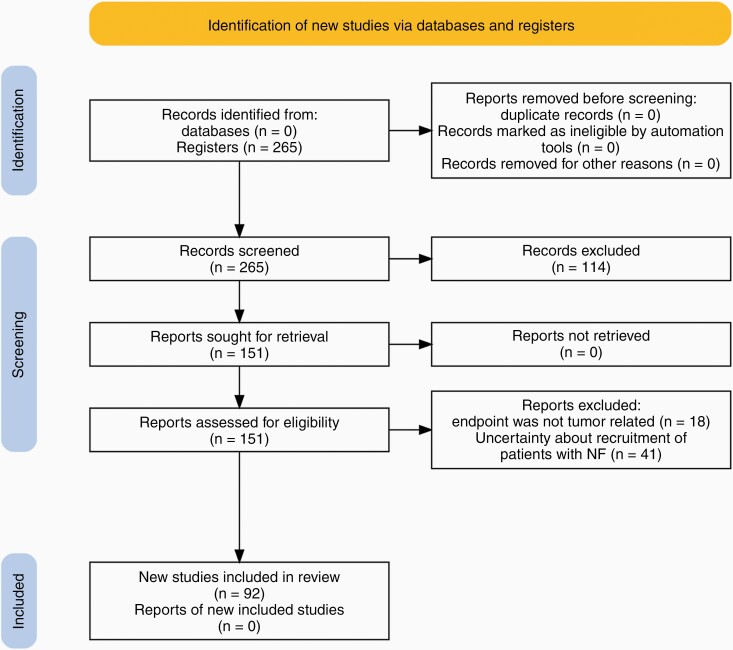
This systematic review was written according to the PRISMA guidelines. Inclusion criteria were clinical trials involving patients with neurofibromatosis type 1, type 2, or schwannomatosis that were treated with therapies targeting neurofibromatoses-associated tumors and that were registered on clinicaltrials.gov. In addition, a search was performed in PubMed, Web of Science, Google Scholar, and Embase European for articles fully describing these clinical trials.
A total of 265 clinical trials were registered and screened for eligibility. Ninety-two were included in this systematic review involving approximately 4636 participants. The number of therapies analyzed was more than 50. Drugs under investigation mainly act on the MAPK/ERK and PI3K/AKT/mTOR pathways, tumor microenvironment, or aberrantly over-expressed cell surface receptors. Selumetinib was the most effective medication for treating a neurofibromatosis type 1-associated tumor with approximately 68%-71% partial response for inoperable or progressive plexiform neurofibromas in children 2 years of age and older and bevacizumab for a neurofibromatosis type 2-related tumor with approximately 36%-41% partial response for vestibular schwannomas in patients 12 years of age and older.
This systematic review presents the results of previous clinical investigations and those under development for neurofibromatoses-associated tumors. Clinicians may use this information to strategize patients to appropriate clinical trials.
目前缺乏全面分析既往和当前针对神经纤维瘤病相关肿瘤的临床试验的文献。本文旨在通过分析转化研究和临床研究结果,向读者介绍针对这些肿瘤的药物研发进展。
本系统评价按照PRISMA指南撰写。纳入标准为涉及1型、2型神经纤维瘤病或神经鞘瘤病患者的临床试验,这些试验采用针对神经纤维瘤病相关肿瘤的疗法,并已在clinicaltrials.gov上注册。此外,还在PubMed、科学网、谷歌学术和Embase欧洲数据库中检索了全面描述这些临床试验的文章。
共登记并筛选了265项临床试验以确定其 eligibility。本系统评价纳入了92项试验,涉及约4636名参与者。分析的疗法超过50种。正在研究的药物主要作用于MAPK/ERK和PI3K/AKT/mTOR信号通路、肿瘤微环境或异常过度表达的细胞表面受体。对于1型神经纤维瘤病相关肿瘤,司美替尼是最有效的药物,2岁及以上儿童不可切除或进展性丛状神经纤维瘤的部分缓解率约为68%-71%;对于2型神经纤维瘤病相关肿瘤,贝伐单抗对12岁及以上患者前庭神经鞘瘤的部分缓解率约为36%-41%。
本系统评价展示了既往针对神经纤维瘤病相关肿瘤的临床研究结果以及正在开展的研究。临床医生可利用这些信息为患者制定合适的临床试验策略。