Goemans Sophie L, Singh Abhishek, Yadav Ajit Kumar, McDougal Lotus, Raj Anita, Averbach Sarah H
University of California San Diego School of Medicine, La Jolla, CA.
Department of Public Health & Mortality Studies, International Institute for Population Sciences, Mumbai, India.
AJOG Glob Rep. 2021 Nov;1(4). doi: 10.1016/j.xagr.2021.100029. Epub 2021 Oct 19.
Previous studies have shown that women who experience intimate partner violence have higher rates of unintended pregnancy and abortion-but whether there are differences between the types of abortion care accessed is unknown. Understanding the predictors of self-managed abortion is important for providing risk-mitigating information and resources to those at highest risk for unintended pregnancy and intimate partner violence. With access to information and medication abortion drugs, it is possible that self-managed abortion can be performed safely, increasing reproductive autonomy for women.
The purpose of this study is to evaluate the association between experiencing intimate partner violence and using self-managed abortion.
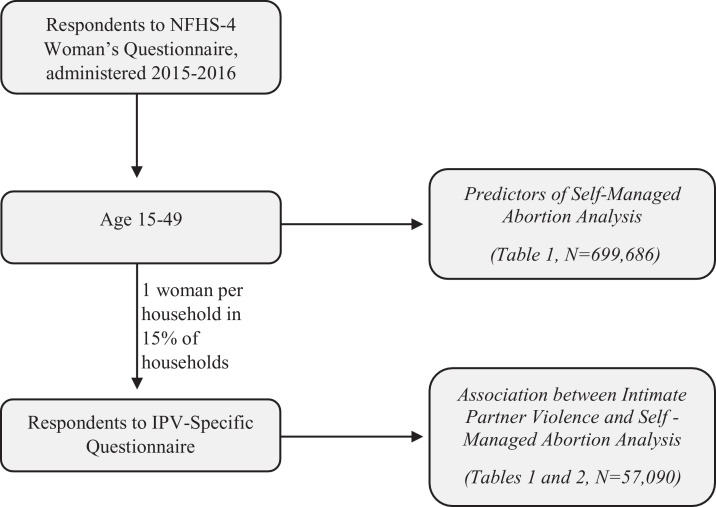
This is a cross-sectional analysis of responses of 57,090 married women to the National Family Health Survey-4 conducted across India from 2015 to 2016. The association between the type of intimate partner violence and self-managed abortion was analyzed using multivariable multinomial logistic regression.
Women who have ever experienced physical intimate partner violence were more likely to have any abortion (adjusted relative risk=1.5; 95% confidence interval, 1.2-2.0) and use self-managed abortion (adjusted relative risk=1.7; 95% confidence interval, 1.1-2.6) than women who have not experienced physical intimate partner violence. Women who have ever experienced sexual intimate partner violence may have been more likely to use self-managed abortion, though this association was not statistically significant (adjusted relative risk=2.7; 95% confidence interval, 0.7-10.4).
Women who have experienced physical intimate partner violence disproportionately use abortion care, both facility-based and self-managed. Women who have experienced sexual intimate partner violence may also be more likely to use self-managed abortion. Although abortion is legal, self-managed abortion is commonly occurring in India. Self-managed abortion represents an additional choice and enhances reproductive autonomy in settings where abortion is legal. The implementation of risk-mitigation resources and policies regarding self-managed abortion would provide protection and enhanced autonomy to susceptible groups across India.
以往研究表明,遭受亲密伴侣暴力的女性意外怀孕和堕胎的比率更高,但所获得的堕胎护理类型之间是否存在差异尚不清楚。了解自我管理堕胎的预测因素对于向意外怀孕和亲密伴侣暴力风险最高的人群提供降低风险的信息和资源非常重要。随着信息和药物流产药物的获取,自我管理堕胎有可能安全进行,从而增加女性的生殖自主权。
本研究的目的是评估遭受亲密伴侣暴力与使用自我管理堕胎之间的关联。
这是一项对2015年至2016年在印度全国范围内进行的第4次国家家庭健康调查中57090名已婚女性的回答进行横截面分析。使用多变量多项逻辑回归分析亲密伴侣暴力类型与自我管理堕胎之间的关联。
与未经历过身体亲密伴侣暴力的女性相比,曾经历过身体亲密伴侣暴力的女性更有可能进行任何形式的堕胎(调整后的相对风险=1.5;95%置信区间,1.2 - 2.0)和使用自我管理堕胎(调整后的相对风险=1.7;95%置信区间,1.1 - 2.6)。曾经历过性亲密伴侣暴力的女性可能更有可能使用自我管理堕胎,尽管这种关联在统计学上不显著(调整后的相对风险=2.7;95%置信区间,0.7 - 10.4)。
遭受过身体亲密伴侣暴力的女性在使用基于医疗机构的堕胎护理和自我管理堕胎方面的比例过高。遭受过性亲密伴侣暴力的女性也可能更有可能使用自我管理堕胎。虽然堕胎在印度是合法的,但自我管理堕胎在印度普遍存在。在堕胎合法的环境中,自我管理堕胎是一种额外的选择,并增强了生殖自主权。实施关于自我管理堕胎的降低风险资源和政策将为印度各地的易感人群提供保护并增强其自主权。