UCL School of Pharmacy, 29-39 Brunswick Square, London WC1N 1AX, UK.
Department of Neurocognitive Science, Institute of Brain Science, Nagoya City University Graduate School of Medical Sciences, 1 Kawasumi, Mizuho-cho, Mizuho-ku, Nagoya, Aichi 467-8601, Japan.
Semin Cell Dev Biol. 2023 Apr;139:55-72. doi: 10.1016/j.semcdb.2022.03.001. Epub 2022 Mar 12.
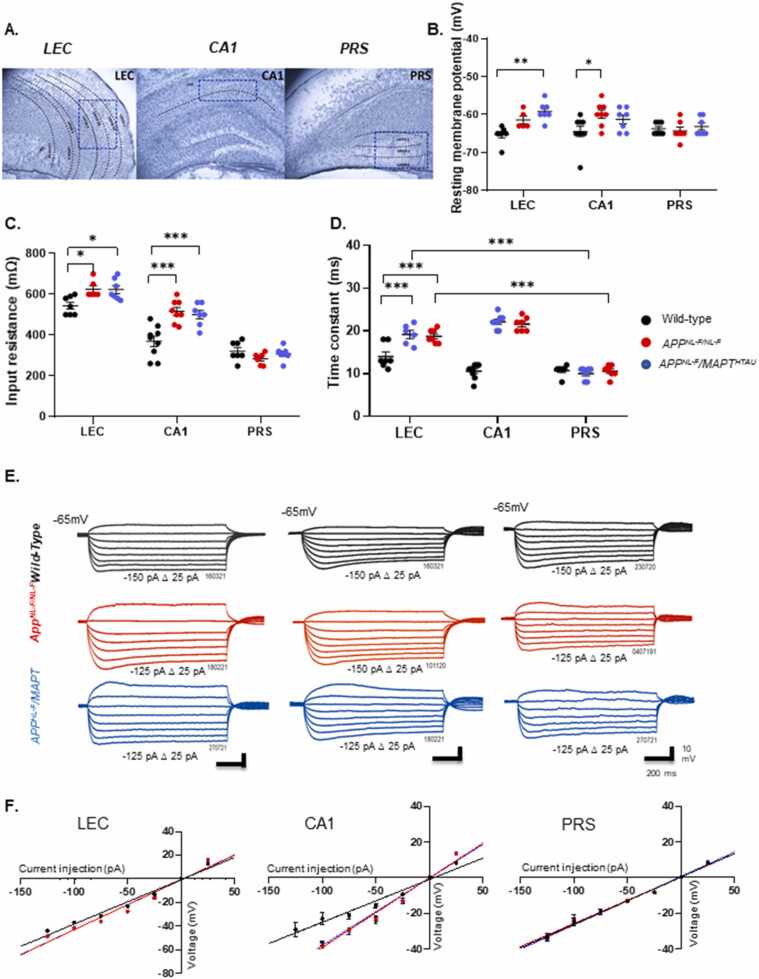
The presubiculum (PRS) is an integral component of the perforant pathway that has recently been recognised as a relatively unscathed region in clinical Alzheimer's disease (AD), despite neighbouring components of the perforant pathway, CA1 and the entorhinal cortex, responsible for formation of episodic memory and storage, showing severe hallmarks of AD including, amyloid-beta (Aβ) plaques, tau tangles and marked gliosis. However, the question remains whether this anatomical resilience translates into functional resilience of the PRS neurons. Using neuroanatomy combined with whole-cell electrophysiological recordings, we investigated whether the unique spatial profile of the PRS was replicable in two knock-in mouse models of AD, APP, and APP/MAPT and whether the intrinsic properties and morphological integrity of the PRS principal neurons was maintained compared to the lateral entorhinal cortex (LEC) and hippocampal CA1 principal cells. Our data revealed an age-dependent Aβ and tau pathology with neuroinflammation in the LEC and CA1, but a presence of fleece-like Aβ deposits with an absence of tau tangles and cellular markers of gliosis in the PRS of the mouse models at 11-16 and 18-22 months. These observations were consistent in human post-mortem AD tissue. This spatial profile also correlated with functional resilience of strong burst firing PRS pyramidal cells that showed unaltered sub- and suprathreshold intrinsic biophysical membrane properties and gross morphology in the AD models that were similar to the properties of pyramidal cells recorded in age-matched wild-type mice (11-14 months). This was in contrast to the LEC and CA1 principal cells which showed altered subthreshold intrinsic properties such as a higher input resistance, longer membrane time constants and hyperexcitability in response to suprathreshold stimulation that correlated with atrophied dendrites in both AD models. In conclusion, our data show for the first time that the unique anatomical profile of the PRS constitutes a diffuse AD pathology that is correlated with the preservation of principal pyramidal cell intrinsic biophysical and morphological properties despite alteration of LEC and CA1 pyramidal cells in two distinct genetic models of AD. Understanding the underlying mechanisms of this resilience could be beneficial in preventing the spread of disease pathology before cognitive deficits are precipitated in AD.
穹窿前野(PRS)是穿通纤维通路的一个组成部分,最近被认为是临床阿尔茨海默病(AD)中相对未受损的区域,尽管穿通纤维通路的邻近成分,包括 CA1 和内嗅皮层,负责形成情景记忆和存储,表现出 AD 的严重特征,包括淀粉样β(Aβ)斑块、tau 缠结和明显的神经胶质增生。然而,问题仍然是这种解剖学上的弹性是否转化为 PRS 神经元的功能弹性。我们使用神经解剖学结合全细胞膜片钳记录技术,研究了 PRS 的独特空间特征是否可以在两种 AD 的基因敲入小鼠模型 APP 和 APP/MAPT 中复制,以及 PRS 主神经元的内在特性和形态完整性是否与外侧内嗅皮层(LEC)和海马 CA1 主细胞保持一致。我们的数据显示,在 LEC 和 CA1 中存在与年龄相关的 Aβ和 tau 病理学以及神经炎症,但在 11-16 个月和 18-22 个月的小鼠模型的 PRS 中存在绒毛状 Aβ沉积,没有 tau 缠结和神经胶质增生的细胞标志物。这些观察结果在人类 AD 尸检组织中也是一致的。这种空间模式也与 PRS 中强爆发放电 PRS 锥体神经元的功能弹性相关,这些神经元的亚阈值和超阈值内在生物物理膜特性和总体形态在 AD 模型中没有改变,与在年龄匹配的野生型小鼠中记录的锥体细胞的特性相似(11-14 个月)。这与 LEC 和 CA1 主细胞形成对比,后者表现出改变的亚阈值内在特性,例如更高的输入电阻、更长的膜时间常数和超阈值刺激下的过度兴奋,这与两种 AD 模型中的树突萎缩有关。总之,我们的数据首次表明,PRS 的独特解剖学模式构成了弥漫性 AD 病理学,与 LEC 和 CA1 锥体细胞在两种不同的 AD 基因模型中的改变相关,尽管如此,PRS 的主要锥体细胞内在生物物理和形态特性仍然得以保留。了解这种弹性的潜在机制可能有助于在 AD 导致认知缺陷之前阻止疾病病理学的传播。