Shokri Samira, Abdoli Narges, Sadighara Parisa, Mahvi Amir Hossein, Esrafili Ali, Gholami Mitra, Jannat Behrooz, Yousefi Mahmood
Department of Environmental Health, Food Safety Division, School of Public Health, Tehran University of Medical Sciences, Tehran, Iran.
Iran Food and Drug Administration, Ministry of Health, Tehran, Iran.
Food Chem X. 2022 Mar 10;14:100283. doi: 10.1016/j.fochx.2022.100283. eCollection 2022 Jun 30.
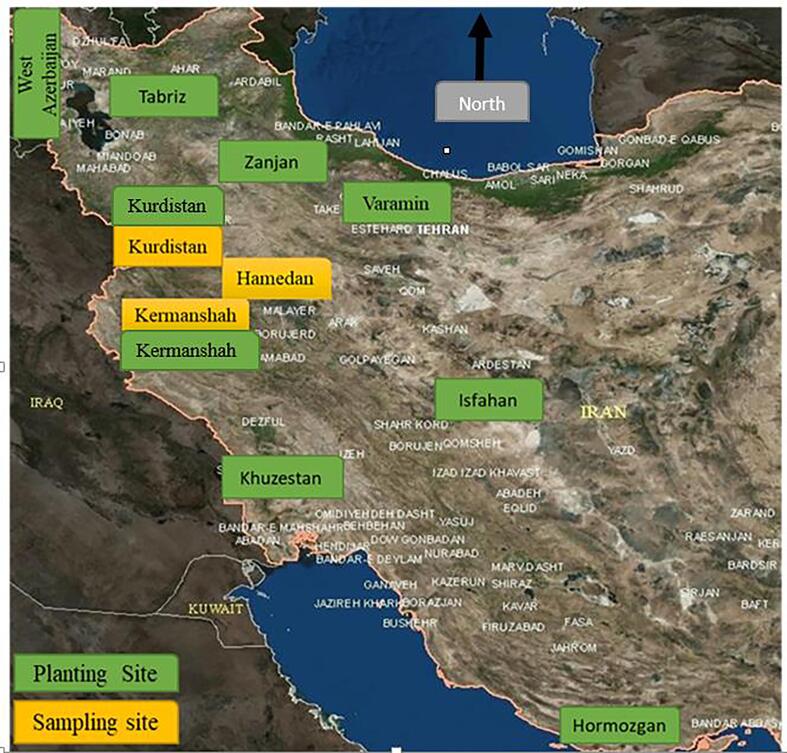
Considering the importance of onions consumption in the household diet, controlling of heavy elements' concentration in foodstuffs is important to ensure the safety of an individual's health. This study aimed to evaluate the risk of heavy metals through onion consumption on human health. In this cross-sectional experimental study, 22 onion samples with varieties red, yellow, and white in the two autumn and winter seasons in 2020 were randomly collected from the different provinces of Kurdistan, Hamedan, and Kermanshah. The concentrations of heavy metals were evaluated with an atomic absorption spectrometer. The risks of human health were evaluated by the hazard quotient (HQ) and the obtained results were analyzed with one-way ANOVA and one sample -test. The obtained findings demonstrated that all collected samples contained heavy metals. For example, the cadmium (Cd) concentration in onion samples in the province of West Azerbaijan, Kurdistan, Hormozgan, Isfahan, and Zanjan was 526.49, 274.49, 69.77, 67.39, 65.69 µg kg, respectively. While the standard specified in Iran for the concentration of Cd in onions is 50 μg kg. However, the rate of lead (Pb) contamination in samples collected from Isfahan, Hormozgan, Zanjan Khuzestan, Tehran (Varamin) was 296.50, 266.71, 261.49, 215.64, 106.19 µg kg, respectively, which less than maximum allowable limit recommended by WHO-FAO (300 µg kg). The HQ for non-cancerous diseases for Cd and Pb were 8.6 × 10 and 1.6 × 10, respectively, and the probability of carcinogenic risk for Pb (8.1 × 10) was at the level of acceptable. There is no concern about the non-carcinogenic diseases and carcinogenic risk of consuming heavy metals in onion. Therefore, for optimal management and prevention of further pollution, it is recommended to study the origin and determine the amounts of heavy metals for their potential contamination of foodstuffs from the region's soil, water, and dust.
考虑到洋葱消费在家庭饮食中的重要性,控制食品中重金属元素的浓度对于确保个人健康安全至关重要。本研究旨在评估通过食用洋葱摄入重金属对人体健康的风险。在这项横断面实验研究中,于2020年秋冬两季从库尔德斯坦、哈马丹和克尔曼沙赫等不同省份随机采集了22个红、黄、白品种的洋葱样本。使用原子吸收光谱仪评估重金属浓度。通过危害商数(HQ)评估人体健康风险,并采用单因素方差分析和单样本检验对所得结果进行分析。所得结果表明,所有采集的样本均含有重金属。例如,西阿塞拜疆省、库尔德斯坦省、霍尔木兹甘省、伊斯法罕省和赞詹省洋葱样本中的镉(Cd)浓度分别为526.49、274.49、69.77、67.39、65.69微克/千克。而伊朗规定的洋葱中镉浓度标准为50微克/千克。然而,从伊斯法罕省、霍尔木兹甘省、赞詹省、胡齐斯坦省、德黑兰(瓦拉明)采集的样本中铅(Pb)污染率分别为296.50、266.71、261.49、215.64、106.19微克/千克,低于世界卫生组织 - 联合国粮农组织建议的最大允许限量(300微克/千克)。镉和铅的非致癌疾病危害商数分别为8.6×10和1.6×10,铅的致癌风险概率(8.1×10)处于可接受水平。食用洋葱中重金属不存在非致癌疾病和致癌风险问题。因此,为了进行最佳管理和预防进一步污染,建议研究其来源并确定重金属含量,以了解该地区土壤、水和灰尘对食品的潜在污染情况。