Xi'an Key Laboratory of Stem Cell and Regenerative Medicine, Institute of Medical Research, Northwestern Polytechnical University, Xi'an, Shaanxi, 710072, P. R. China.
Department of Hematology and Hematopoietic Cell Transplantation, City of Hope National Medical Center, Los Angeles, CA, USA.
Mol Cancer. 2022 Mar 16;21(1):76. doi: 10.1186/s12943-022-01558-0.
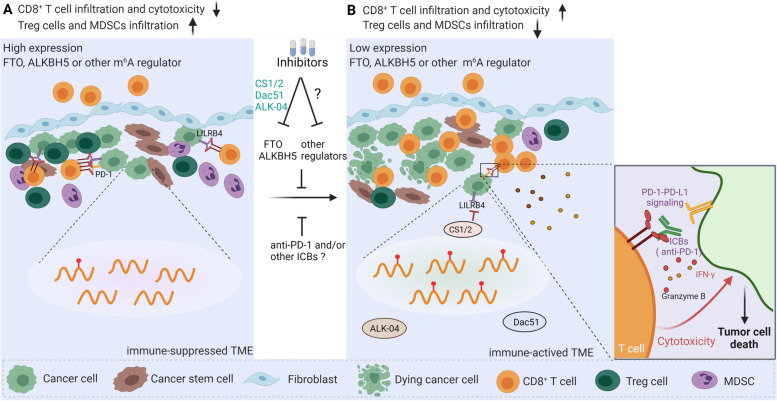
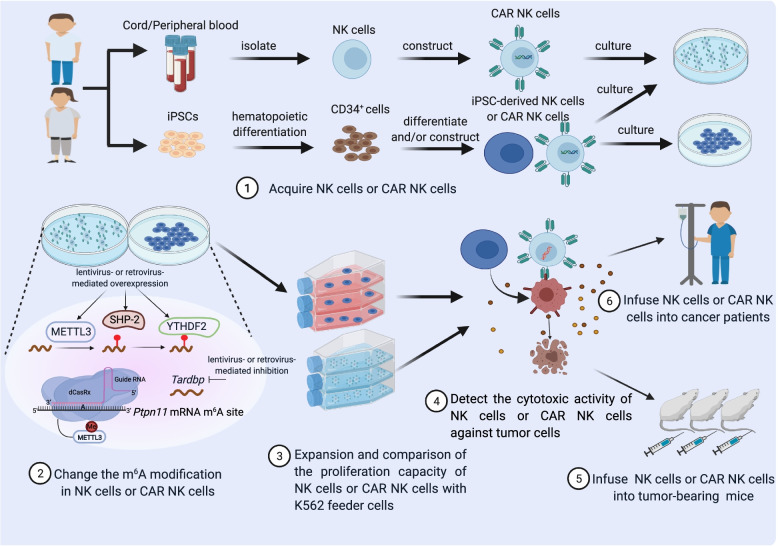
N-methyladenosine (mA) is the most abundant epigenetic modification of RNA, and its dysregulation drives aberrant transcription and translation programs that promote cancer occurrence and progression. Although defective gene regulation resulting from mA often affects oncogenic and tumor-suppressing networks, mA can also modulate tumor immunogenicity and immune cells involved in anti-tumor responses. Understanding this counterintuitive concept can aid the design of new drugs that target mA to potentially improve the outcomes of cancer immunotherapies. Here, we provide an up-to-date and comprehensive overview of how mA modifications intrinsically affect immune cells and how alterations in tumor cell mA modifications extrinsically affect immune cell responses in the tumor microenvironment (TME). We also review strategies for modulating endogenous anti-tumor immunity and discuss the challenge of reshaping the TME. Strategies include: combining specific and efficient inhibitors against mA regulators with immune checkpoint blockers; generating an effective programmable mA gene-editing system that enables efficient manipulation of individual mA sites; establishing an effective mA modification system to enhance anti-tumor immune responses in T cells or natural killer cells; and using nanoparticles that specifically target tumor-associated macrophages (TAMs) to deliver messenger RNA or small interfering RNA of mA-related molecules that repolarize TAMs, enabling them to remodel the TME. The goal of this review is to help the field understand how mA modifications intrinsically and extrinsically shape immune responses in the TME so that better cancer immunotherapy can be designed and developed.
N6-甲基腺苷(m6A)是 RNA 中最丰富的表观遗传修饰,其失调会导致异常的转录和翻译程序,从而促进癌症的发生和发展。尽管 m6A 导致的基因调控缺陷通常会影响致癌和抑癌网络,但 m6A 还可以调节肿瘤免疫原性和参与抗肿瘤反应的免疫细胞。了解这一违反直觉的概念可以帮助设计靶向 m6A 的新药,从而有可能改善癌症免疫疗法的效果。在这里,我们提供了一个最新和全面的概述,说明 m6A 修饰如何内在地影响免疫细胞,以及肿瘤细胞 m6A 修饰如何外在地影响肿瘤微环境(TME)中的免疫细胞反应。我们还回顾了调节内源性抗肿瘤免疫的策略,并讨论了重塑 TME 的挑战。策略包括:将针对 m6A 调节剂的特异性和高效抑制剂与免疫检查点抑制剂结合使用;生成有效的可编程 m6A 基因编辑系统,以实现对单个 m6A 位点的高效操作;建立有效的 m6A 修饰系统,以增强 T 细胞或自然杀伤细胞中的抗肿瘤免疫反应;并使用专门针对肿瘤相关巨噬细胞(TAMs)的纳米颗粒来递送 m6A 相关分子的信使 RNA 或小干扰 RNA,使 TAMs 重新极化,从而重塑 TME。本综述的目的是帮助该领域了解 m6A 修饰如何内在和外在地塑造 TME 中的免疫反应,以便更好地设计和开发癌症免疫疗法。