Department of Behavioural Science and Health, University College London, London, UK.
Department of Social Sciences and Social Work, Bournemouth University, Bournemouth, UK.
BMC Psychol. 2022 Mar 16;10(1):71. doi: 10.1186/s40359-022-00775-y.
Community and cultural engagement can support recovery, help symptom management and increase social connections for people with lived experience of mental health conditions. However, research suggests that people with mental health conditions experience significant barriers to participation. The aim of this study was to explore barriers and enablers of participation in community and cultural activities among people with mental health conditions.
A qualitative interview study with 23 people with mild-to-moderate mental health conditions was undertaken. Data were analysed thematically, and themes were mapped to domains of the Capability, Opportunity and Motivation Model of Behaviour (COM-B).
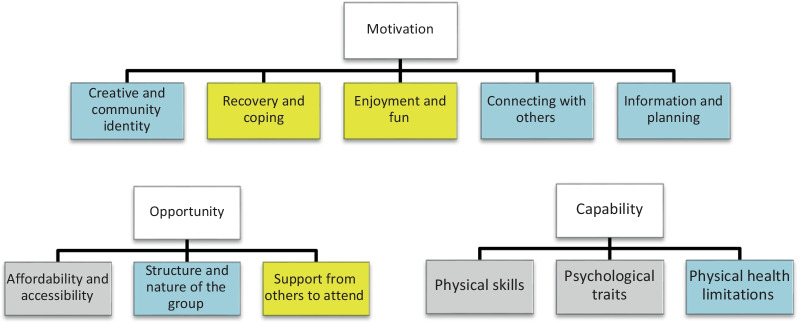
Eleven themes were identified from the analysis. Three themes involved participant Capability: physical skills, psychological traits and physical health limitations and three themes related to Opportunity: affordability and accessibility, structure and nature of the group, and support from others to attend. Five themes mapped to Motivation: creative identity, recovery and coping, enjoyment and fun, connecting with others, and information and planning. Participants were motivated to engage with community and cultural activities through "a creative identity", belief that engagement would help recovery from mental illness, and a desire to connect with others and make friends. Motivation to participate was sustained by the enjoyable nature of activities. However, participants' ability to engage was hampered by the expense, inaccessibility and sometimes unstructured nature of activities, and social anxiety associated with attending. Some participants had physical limitations such as fatigue or physical health problems to overcome. Interventions that could address these barriers include peer support, training for social prescribers to account for identity and previous experiences of participation, training for community organisations in providing a welcoming and structured environment, and provision of long-term sustainable funding to community organisations to subsidise attendance, transport or equipment costs.
People with mental health conditions may be at risk of experiencing barriers to community and cultural engagement due to existing social inequalities and social anxiety, however believing that involvement will support mental health was an enabler to participation. Future studies are needed to test the effectiveness of potential interventions to address the barriers and harness the facilitators identified here, to enable a more socially inclusive community and voluntary sector, and a potentially more responsive and effective social prescribing service in the UK for people experiencing mental health problems.
社区和文化参与可以支持康复,帮助管理症状,并增加有心理健康问题经历的人的社会联系。然而,研究表明,有心理健康问题的人在参与方面面临着重大障碍。本研究旨在探讨有心理健康问题的人参与社区和文化活动的障碍和促进因素。
对 23 名有轻度至中度心理健康问题的人进行了定性访谈研究。数据进行了主题分析,并将主题映射到行为能力、机会和动机模型(COM-B)的领域。
从分析中确定了 11 个主题。三个主题涉及参与者的能力:身体技能、心理特征和身体健康限制,三个主题与机会有关:负担能力和可及性、团体的结构和性质,以及他人支持参加。五个主题映射到动机:创造性身份、康复和应对、享受和乐趣、与他人联系和信息和计划。参与者通过“创造性身份”、参与有助于从精神疾病中康复的信念,以及与他人联系和交朋友的愿望,有动力参与社区和文化活动。活动的趣味性维持了参与的动机。然而,参与者参与的能力受到活动费用、难以企及和有时缺乏结构、以及参加活动时的社交焦虑的阻碍。一些参与者有身体限制,如疲劳或身体健康问题需要克服。可以解决这些障碍的干预措施包括同伴支持、为社会处方医生提供身份和以前参与经验的培训、为社区组织提供欢迎和结构化环境的培训,以及为社区组织提供长期可持续资金,以补贴参与、交通或设备费用。
由于现有的社会不平等和社交焦虑,有心理健康问题的人可能面临参与社区和文化活动的障碍,但相信参与将支持心理健康是参与的促进因素。需要进一步的研究来测试潜在干预措施的有效性,以解决这里确定的障碍,并利用促进因素,使社区和志愿部门更加具有社会包容性,并在英国为有心理健康问题的人提供更具响应性和更有效的社会处方服务。
