Halperson Elinor, Matalon Vered, Goldstein Gal, Saieg Spilberg Shirly, Herzog Karin, Fux-Noy Avia, Shmueli Aviv, Ram Diana, Moskovitz Moti
Faculty of Dental Medicine, Hebrew University of Jerusalem, Jerusalem, Israel.
Department of Pediatric Dentistry, Hadassah Medical Center, P.O.Box 12272, 9112102, Jerusalem, Israel.
Sci Rep. 2022 Mar 16;12(1):4485. doi: 10.1038/s41598-022-08266-1.
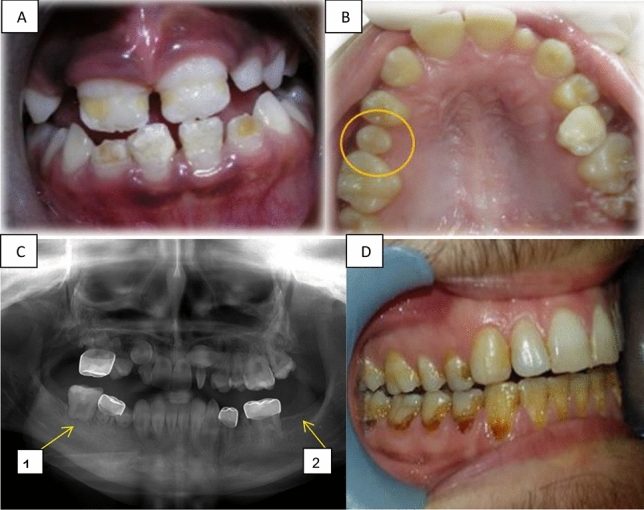
Survival following childhood cancer has increased considerably. In an observational cross-sectional study, we assessed the prevalence of dental developmental anomalies (DDA) among childhood cancer survivors according to types of anticancer treatment. Permanent teeth were examined clinically and radiographically in 121 adolescents with a history of childhood malignancies, to identify DDA, namely hypomineralization or hypoplasia, microdontia, root changes and hypodontia. DDA were observed in 56/121 individuals (46%), in 309/3388 teeth (9%). Hypomineralization or hypoplasia of enamel appeared in 21 (17%) patients. Altered root development appeared in 26 patients and hypodontia affected 13 (10%). Dental anomalies were observed in 36 (43%) individuals who received chemotherapy and not radiation, in 20 (52%) who received radiotherapy, and in 15 (60%) of those who received head and neck radiotherapy. Among patients who received only chemotherapy, young age (6 years or younger) was associated with a higher number of malformed teeth. In conclusion, antineoplastic treatment that combines chemotherapy and radiotherapy appears to increase the risk of DDA. Radiation to the head and neck area was shown to particularly increase the risk of DDA. No specific chemotherapy agent was found to be associated more than the others with DDA.
儿童癌症患者的生存率已显著提高。在一项观察性横断面研究中,我们根据抗癌治疗类型评估了儿童癌症幸存者中牙齿发育异常(DDA)的患病率。对121名有儿童恶性肿瘤病史的青少年的恒牙进行了临床和影像学检查,以确定DDA,即矿化不足或发育不全、过小牙、牙根改变和缺牙。在56/121名个体(46%)中观察到DDA,在309/3388颗牙齿(9%)中观察到DDA。21名(17%)患者出现牙釉质矿化不足或发育不全。26名患者出现牙根发育异常,13名(10%)患者出现缺牙。在接受化疗但未接受放疗的36名(4%)个体、接受放疗的20名(52%)个体以及接受头颈部放疗的15名(60%)个体中观察到牙齿异常。在仅接受化疗的患者中,年龄较小(6岁或以下)与更多的畸形牙齿有关。总之,联合化疗和放疗的抗肿瘤治疗似乎会增加DDA的风险。对头颈部区域的放疗尤其会增加DDA的风险。未发现有哪种特定的化疗药物比其他药物与DDA的关联更大。