Matos Randy, Pala Nezih
FIU College of Engineering and Computing, 10555 W Flagler St, Miami, FL, 33174, USA.
Sci Rep. 2022 Mar 16;12(1):4497. doi: 10.1038/s41598-022-08458-9.
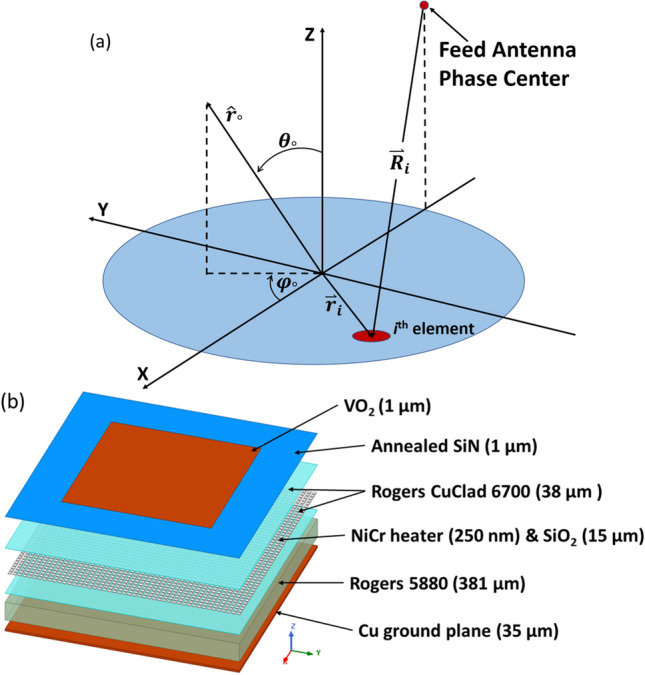
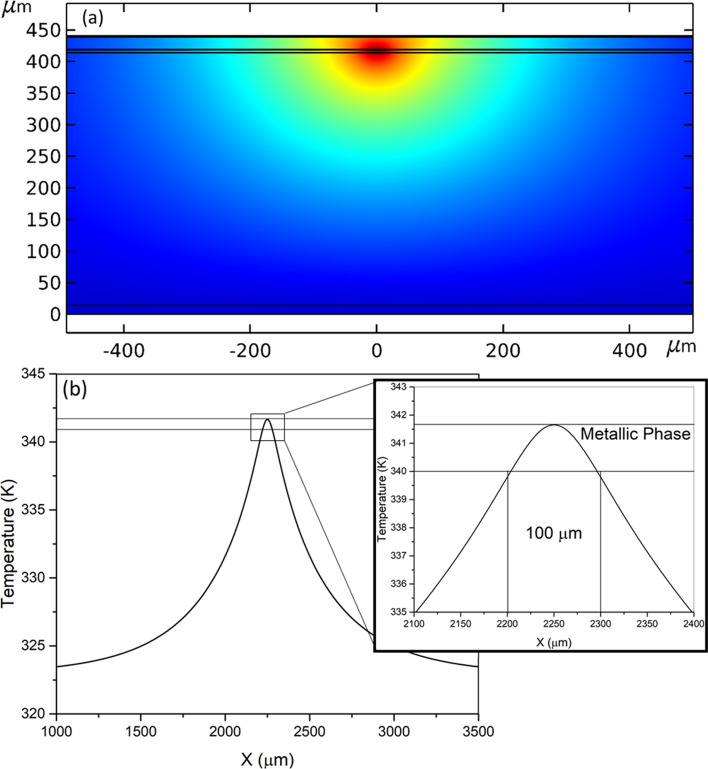
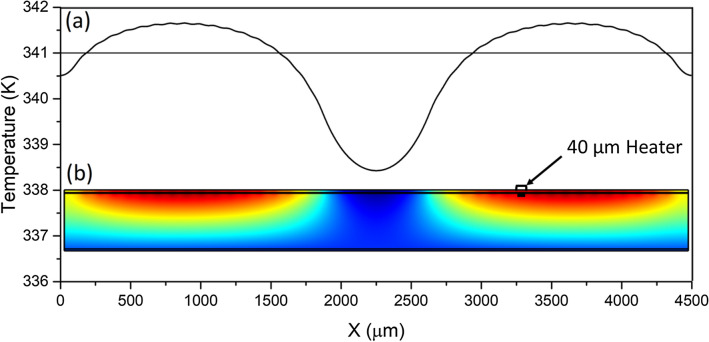
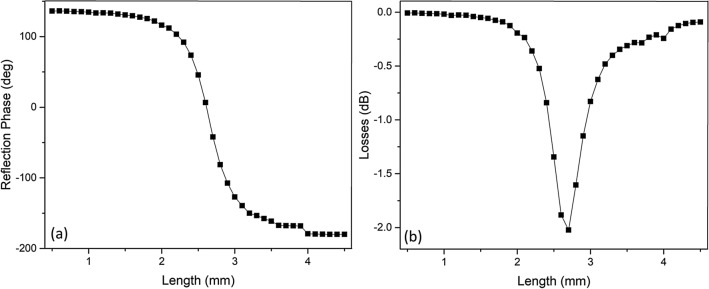
As demand for higher capacity wireless communications increases, new approaches are needed to improve capacity. The lack of configurable radio platforms and power consumed to create new signals are some of the limitations preventing further advancements. To address these limitations, we propose an Ultra-Reconfigurable Intelligent Surface (URIS) platform based on the metal-to-insulator transition property of VO. A VO layer is placed on a high-density micro-heater matrix consisting of pixels that can be electronically switched on. With this manner of control, heat can be transferred to selected areas of the VO layer and convert it to highly conductive metallic phase. This technique allows dynamically changing the shape of the reflection surface with high speed. We numerically investigated the heat activated switching and RF reflection characteristics of a reflectarray designed for potential 5G applications operating at 32 GHz. It consists of heating pixels with the size of 40 × 40 μm which can generate metallic VO patches or arbitrary shapes with ~ 100 × 100 μm spatial resolution. Our analyses resulted in large phase range of ~ 300° and approximate losses of -2 dB. The proposed device can serve as a novel platform for ultra-reconfigurable reflectarrays, other IRSs, and various wide spectral range RF applications.
随着对更高容量无线通信需求的增加,需要新的方法来提高容量。缺乏可配置的无线电平台以及创建新信号所消耗的功率是阻碍进一步发展的一些限制因素。为了解决这些限制,我们提出了一种基于VO的金属-绝缘体转变特性的超可重构智能表面(URIS)平台。在由可电子开启的像素组成的高密度微加热器矩阵上放置一层VO。通过这种控制方式,热量可以传递到VO层的选定区域,并将其转换为高导电金属相。该技术允许高速动态改变反射面的形状。我们对为32 GHz的潜在5G应用设计的反射阵列的热激活开关和射频反射特性进行了数值研究。它由尺寸为40×40μm的加热像素组成,这些像素可以生成金属VO贴片或具有~100×100μm空间分辨率的任意形状。我们的分析得出了约300°的大相位范围和约-2 dB的近似损耗。所提出的器件可作为超可重构反射阵列、其他智能反射面以及各种宽光谱范围射频应用的新型平台。