Mehan Sidharth, Bhalla Sonalika, Siddiqui Ehraz Mehmood, Sharma Nidhi, Shandilya Ambika, Khan Andleeb
Neuropharmacology Division, Department of Pharmacology, ISF College of Pharmacy, Moga, Punjab, India.
Department of Pharmacology & Toxicology, College of Pharmacy, Jazan University, Jazan, Kingdom of Saudi Arabia.
Degener Neurol Neuromuscul Dis. 2022 Mar 7;12:31-59. doi: 10.2147/DNND.S247153. eCollection 2022.
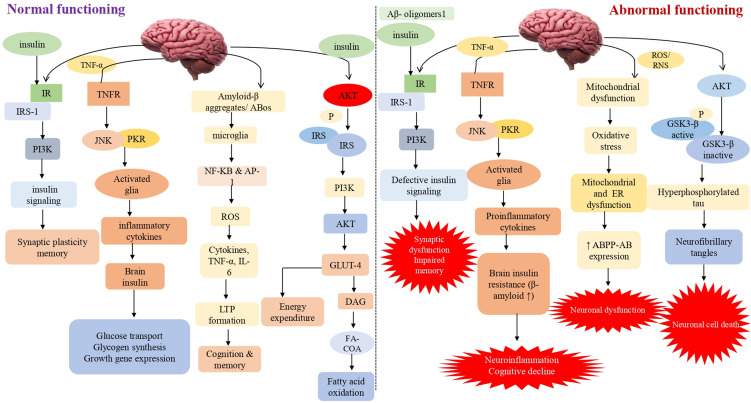
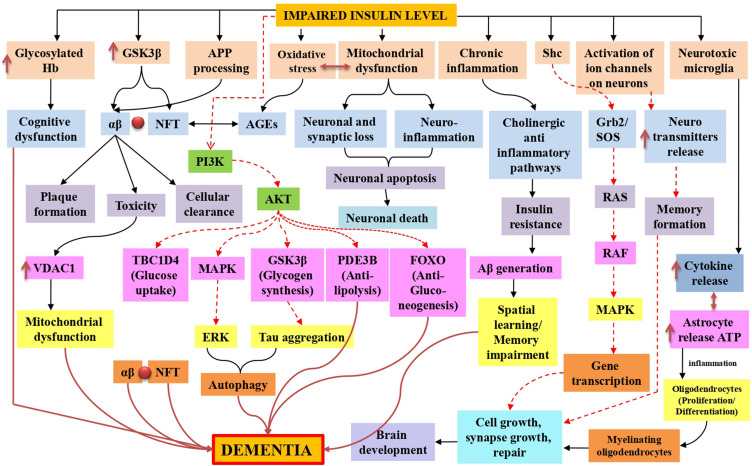
Dementia is a chronic, irreversible condition marked by memory loss, cognitive decline, and mental instability. It is clinically related to various progressive neurological diseases, including Parkinson's disease, Alzheimer's disease, and Huntington's. The primary cause of neurological disorders is insulin desensitization, demyelination, oxidative stress, and neuroinflammation accompanied by various aberrant proteins such as amyloid-β deposits, Lewy bodies accumulation, tau formation leading to neurofibrillary tangles. Impaired insulin signaling is directly associated with amyloid-β and α-synuclein deposition, as well as specific signaling cascades involved in neurodegenerative diseases. Insulin dysfunction may initiate various intracellular signaling cascades, including phosphoinositide 3-kinase (PI3K), c-Jun N-terminal kinases (JNK), and mitogen-activated protein kinase (MAPK). Neuronal death, inflammation, neuronal excitation, mitochondrial malfunction, and protein deposition are all influenced by insulin. Recent research has focused on GLP-1 receptor agonists as a potential therapeutic target. They increase glucose-dependent insulin secretion and are beneficial in neurodegenerative diseases by reducing oxidative stress and cytokine production. They reduce the deposition of abnormal proteins by crossing the blood-brain barrier. The purpose of this article is to discuss the role of insulin dysfunction in the pathogenesis of neurological diseases, specifically dementia. Additionally, we reviewed the therapeutic target (GLP-1) and its receptor activators as a possible treatment of dementia.
痴呆是一种慢性、不可逆的病症,其特征为记忆力减退、认知功能下降和精神不稳定。临床上它与多种进行性神经疾病相关,包括帕金森病、阿尔茨海默病和亨廷顿病。神经疾病的主要病因是胰岛素脱敏、脱髓鞘、氧化应激和神经炎症,同时伴有各种异常蛋白质,如β淀粉样蛋白沉积、路易小体积累、导致神经原纤维缠结的tau蛋白形成。胰岛素信号受损与β淀粉样蛋白和α-突触核蛋白沉积直接相关,也与神经退行性疾病中涉及的特定信号级联有关。胰岛素功能障碍可能引发各种细胞内信号级联反应,包括磷酸肌醇3激酶(PI3K)、c-Jun氨基末端激酶(JNK)和丝裂原活化蛋白激酶(MAPK)。神经元死亡、炎症、神经元兴奋、线粒体功能障碍和蛋白质沉积均受胰岛素影响。最近的研究集中在胰高血糖素样肽-1(GLP-1)受体激动剂作为一种潜在的治疗靶点。它们可增加葡萄糖依赖性胰岛素分泌,并通过减少氧化应激和细胞因子产生而对神经退行性疾病有益。它们可通过血脑屏障减少异常蛋白质的沉积。本文的目的是讨论胰岛素功能障碍在神经疾病,特别是痴呆发病机制中的作用。此外,我们综述了治疗靶点(GLP-1)及其受体激活剂作为痴呆可能的治疗方法。