Department of Pathology and Laboratory Medicine AKU, Section of Chemical Pathology, Karachi, Pakistan.
Department of Pediatrics & Child Health AKU, Karachi, Pakistan.
BMC Neurol. 2022 Mar 17;22(1):101. doi: 10.1186/s12883-022-02630-4.
Diagnosis of autism spectrum disorder (ASD) is generally made phenotypically and the hunt for ASD-biomarkers continues. The purpose of this study was to compare urine organic acids profiles of ASD versus typically developing (TD) children to identify potential biomarkers for diagnosis and exploration of ASD etiology.
This case control study was performed in the Department of Pathology and Laboratory Medicine in collaboration with the Department of Pediatrics and Child Health, Aga Khan University, Pakistan. Midstream urine was collected in the first half of the day time before noon from the children with ASD diagnosed by a pediatric neurologist based on DSM-5 criteria and TD healthy controls from August 2019 to June 2021. The urine organic acids were analyzed by Gas Chromatography-Mass Spectrometry. To identify potential biomarkers for ASD canonical linear discriminant analysis was carried out for the organic acids, quantified in comparison to an internal standard.
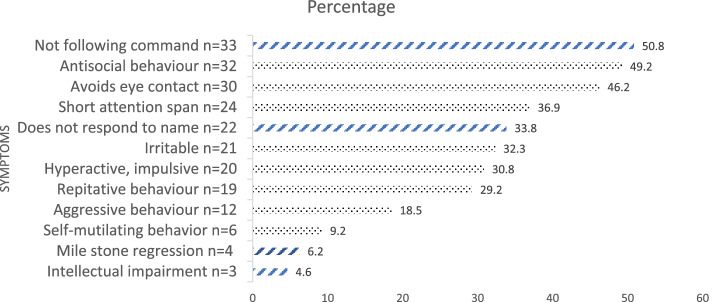
A total of 85 subjects were enrolled in the current study. The mean age of the ASD (n = 65) and TD groups (n = 20) was 4.5 ± 2.3 and 6.4 ± 2.2 years respectively with 72.3% males in the ASD group and 50% males in the TD group. Parental consanguinity was 47.7 and 30% in ASD and TD groups, respectively. The common clinical signs noted in children with ASD were developmental delay (70.8%), delayed language skills (66.2%), and inability to articulate sentences (56.9%). Discriminant analysis showed that 3-hydroxyisovalericc, homovanillic acid, adipic acid, suberic acid, and indole acetic were significantly different between ASD and TD groups. The biochemical classification results reveal that 88.2% of cases were classified correctly into ASD& TD groups based on the urine organic acid profiles.
3-hydroxy isovaleric acid, homovanillic acid, adipic acid, suberic acid, and indole acetic were good discriminators between the two groups. The discovered potential biomarkers could be valuable for future research in children with ASD.
自闭症谱系障碍(ASD)的诊断通常是表型诊断,寻找 ASD 生物标志物的工作仍在继续。本研究的目的是比较 ASD 与典型发育(TD)儿童的尿液有机酸谱,以确定潜在的生物标志物用于诊断和探索 ASD 的病因。
本病例对照研究由巴基斯坦 Aga Khan 大学病理与检验科与儿科和儿童健康系合作进行。2019 年 8 月至 2021 年 6 月,根据 DSM-5 标准,由儿科神经病学家诊断为 ASD 的儿童和 TD 健康对照组的儿童在上午的前半段时间采集中段尿液。采用气相色谱-质谱法分析尿液有机酸。为了确定 ASD 的潜在生物标志物,对有机酸进行了典型线性判别分析,并与内标进行了定量比较。
本研究共纳入 85 例受试者。ASD 组(n=65)和 TD 组(n=20)的平均年龄分别为 4.5±2.3 岁和 6.4±2.2 岁,ASD 组中 72.3%为男性,TD 组中 50%为男性。ASD 组和 TD 组的父母近亲结婚率分别为 47.7%和 30%。在 ASD 儿童中常见的临床症状有发育迟缓(70.8%)、语言发育迟缓(66.2%)和无法表达句子(56.9%)。判别分析显示,ASD 和 TD 组之间 3-羟基异戊酸、高香草酸、己二酸、琥珀酸和吲哚乙酸有显著差异。生化分类结果显示,根据尿液有机酸谱,88.2%的病例正确分类为 ASD 和 TD 组。
3-羟基异戊酸、高香草酸、己二酸、琥珀酸和吲哚乙酸是两组之间的良好判别因子。发现的潜在生物标志物可能对未来 ASD 儿童的研究有价值。