Qu Ming Da, Kausar Humera, Smith Stephen, Lazar Peter G, Kroll-Desrosiers Aimee R, Hollins Carl, Barton Bruce A, Ward Doyle V, Ellison Richard T
Department of Medicine, UMass Chan Medical School, Worcester, MA, United States of America.
Center for Microbiome Research, UMass Chan Medical School, Worcester, MA, United States of America.
PLoS One. 2022 Mar 18;17(3):e0265476. doi: 10.1371/journal.pone.0265476. eCollection 2022.
Panton-Valentine Leukocidin (PVL) toxin in Staphylococcus aureus has been associated with both severe pneumonia and skin and soft tissue infections. However, there are only limited data on how this virulence factor may influence the clinical course or complications of bacteremic S. aureus infections.
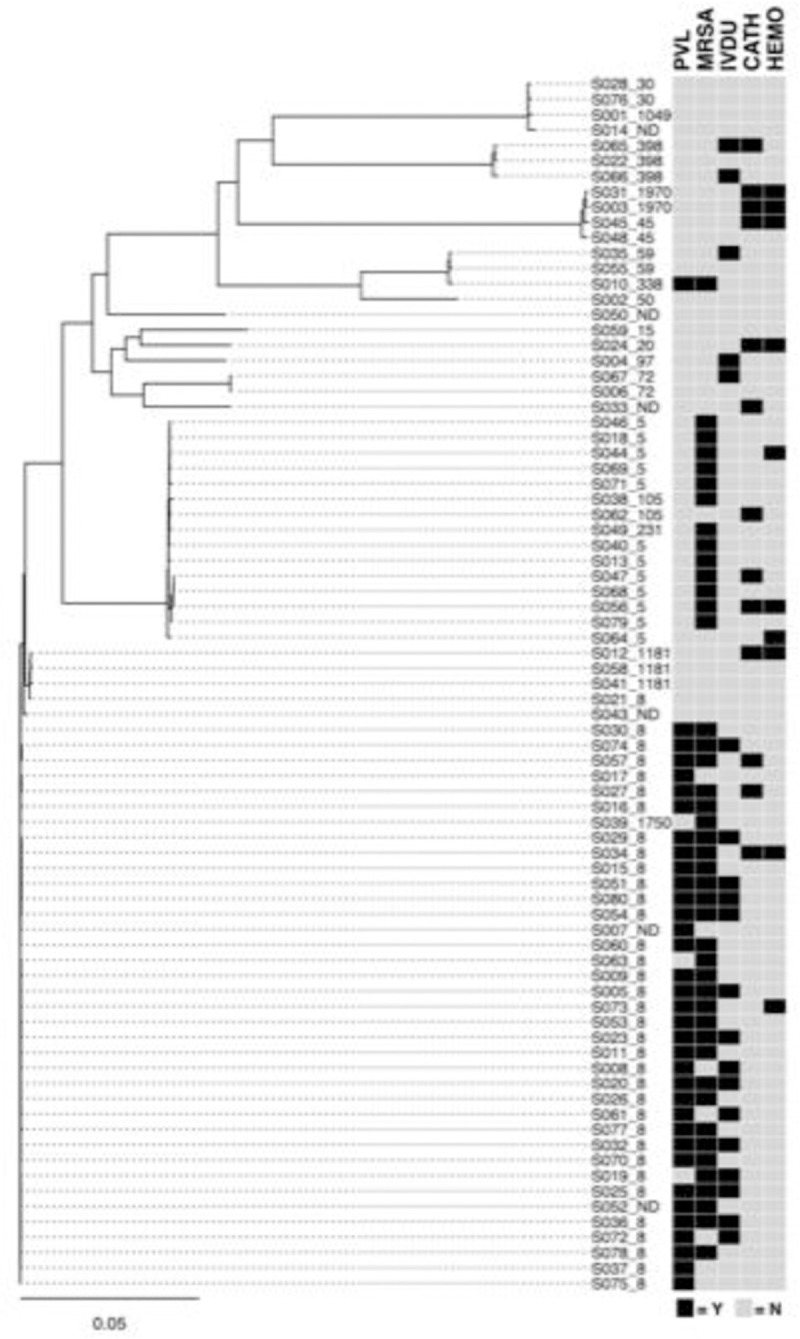
Between September 2016 and March 2018, S. aureus isolates from clinical cultures from hospitals in an academic medical center underwent comprehensive genomic sequencing. Four hundred sixty-nine (29%) of 1681 S. aureus sequenced isolates were identified as containing the genes that encode for PVL. Case patients with one or more positive blood cultures for PVL were randomly matched with control patients having positive blood cultures with lukF/lukS-PV negative (PVL strains from a retrospective chart review).
51 case and 56 control patients were analyzed. Case patients were more likely to have a history of injection drug use, while controls more likely to undergo hemodialysis. Isolates from 78.4% of case patients were methicillin resistant as compared to 28.6% from control patients. Case patients had a higher incidence of pneumonia and skin and soft tissue infection and longer duration of fever without differences in length of bacteremia. Clinical cure or expiration was comparable.
These results are consistent with prior observations associating the PVL toxin with both community-acquired MRSA strains as well as severe staphylococcal pneumonia. The presence of the PVL toxin does not appear to otherwise influence the natural history of bacteremic S. aureus disease other than in prolonging the duration of fever.
金黄色葡萄球菌中的杀白细胞素(PVL)毒素与严重肺炎以及皮肤和软组织感染有关。然而,关于这种毒力因子如何影响金黄色葡萄球菌菌血症感染的临床病程或并发症的数据有限。
2016年9月至2018年3月期间,对一所学术医疗中心医院临床培养的金黄色葡萄球菌分离株进行了全面的基因组测序。在1681株测序的金黄色葡萄球菌分离株中,有469株(29%)被鉴定为含有编码PVL的基因。将1例或多例血培养PVL阳性的病例患者与血培养lukF/lukS-PV阴性(通过回顾性病历审查确定的PVL菌株)的对照患者进行随机匹配。
分析了51例病例患者和56例对照患者。病例患者更可能有注射吸毒史,而对照患者更可能接受血液透析。78.4%的病例患者分离株对甲氧西林耐药,而对照患者为28.6%。病例患者肺炎、皮肤和软组织感染的发生率较高,发热持续时间较长,但菌血症持续时间无差异。临床治愈或死亡情况相当。
这些结果与先前将PVL毒素与社区获得性耐甲氧西林金黄色葡萄球菌菌株以及严重葡萄球菌肺炎相关联的观察结果一致。除了延长发热持续时间外,PVL毒素的存在似乎不会以其他方式影响金黄色葡萄球菌菌血症疾病的自然病程。