Institute of Hygiene, University Hospital Münster, DE 48149 Münster, Germany.
Department of Bacteria, Parasites, and Fungi, Statens Serum Institut, DK 2300 Copenhagen, Denmark.
Proc Natl Acad Sci U S A. 2017 Dec 5;114(49):E10596-E10604. doi: 10.1073/pnas.1702472114. Epub 2017 Nov 20.
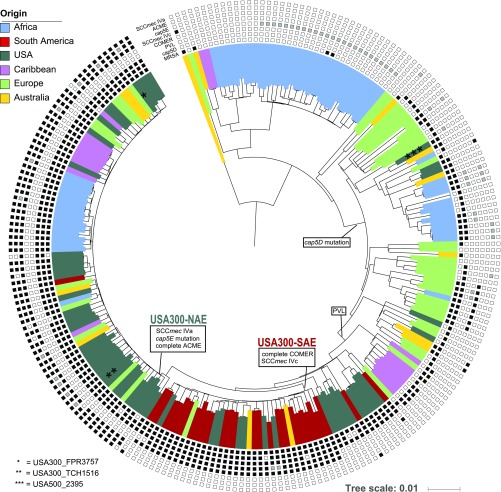
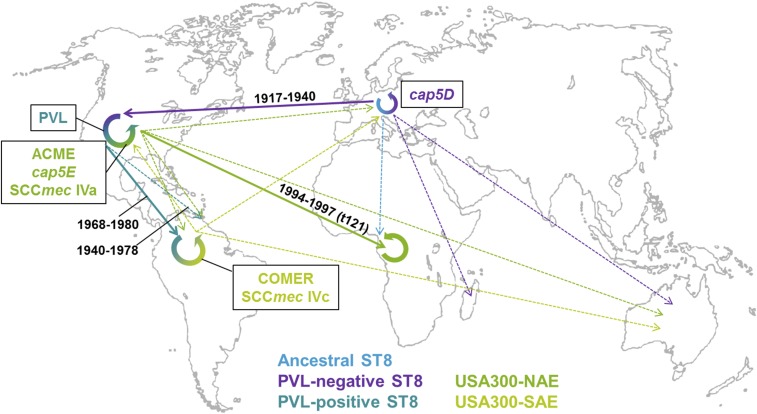
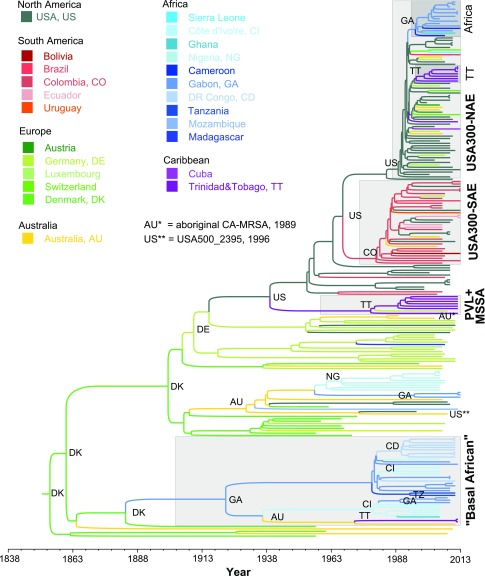
USA300 is a pandemic clonal lineage of hypervirulent, community-acquired, methicillin-resistant (CA-MRSA) with specific molecular characteristics. Despite its high clinical relevance, the evolutionary origin of USA300 remained unclear. We used comparative genomics of 224 temporal and spatial diverse isolates of multilocus sequence type (ST) 8 to reconstruct the molecular evolution and global dissemination of ST8, including USA300. Analyses of core SNP diversity and accessory genome variations showed that the ancestor of all ST8 most likely emerged in Central Europe in the mid-19th century. From here, ST8 was exported to North America in the early 20th century and progressively acquired the USA300 characteristics Panton-Valentine leukocidin (PVL), SCC IVa, the arginine catabolic mobile element (ACME), and a specific mutation in capsular polysaccharide gene Although the PVL-encoding phage ϕSa2USA was introduced into the ST8 background only once, various SCC types were introduced to ST8 at different times and places. Starting from North America, USA300 spread globally, including Africa. African USA300 isolates have aberrant -types (t112, t121) and form a monophyletic group within the clade of North American USA300. Large parts of ST8 methicillin-susceptible (MSSA) isolated in Africa represent a symplesiomorphic group of ST8 (i.e., a group representing the characteristics of the ancestor), which are rarely found in other world regions. Isolates previously discussed as USA300 ancestors, including USA500 and a "historic" CA-MRSA from Western Australia, were shown to be only distantly related to recent USA300 clones.
USA300 是一种具有特定分子特征的高毒力、社区获得性、耐甲氧西林的(CA-MRSA)大流行克隆谱系。尽管其具有重要的临床意义,但 USA300 的进化起源仍不清楚。我们使用 224 个时空多样化的多位点序列型(ST)8 分离株的比较基因组学,重建了 ST8 的分子进化和全球传播,包括 USA300。核心 SNP 多样性和辅助基因组变异分析表明,所有 ST8 的祖先很可能在 19 世纪中叶出现在中欧。从这里,ST8 在 20 世纪初被出口到北美,并逐渐获得了 USA300 的特征——杀伤白细胞素(PVL)、SCC IVa、精氨酸代谢移动元件(ACME)和荚膜多糖基因的特定突变。尽管编码 PVL 的噬菌体 ϕSa2USA 仅被引入 ST8 背景一次,但不同类型的 SCC 被不同时间和地点引入 ST8。从北美开始,USA300 开始在全球范围内传播,包括非洲。非洲 USA300 分离株具有异常的 t112 和 t121 类型,并在北美的 USA300 分支内形成一个单系群。在非洲分离的 ST8 耐甲氧西林敏感(MSSA)的大部分代表了 ST8 的一个同源群(即代表祖先特征的群体),在其他世界地区很少发现。先前被认为是 USA300 祖先的分离株,包括 USA500 和来自澳大利亚西部的“历史”CA-MRSA,与最近的 USA300 克隆株的关系仅为远亲关系。