Dpto. Producción Animal, Universidad de León, 24071, León, Spain.
The Roslin Institute and R(D)SVS, University of Edinburgh, Easter Bush Campus, Edinburgh, EH25 9RG, UK.
Genet Sel Evol. 2022 Mar 18;54(1):23. doi: 10.1186/s12711-022-00712-y.
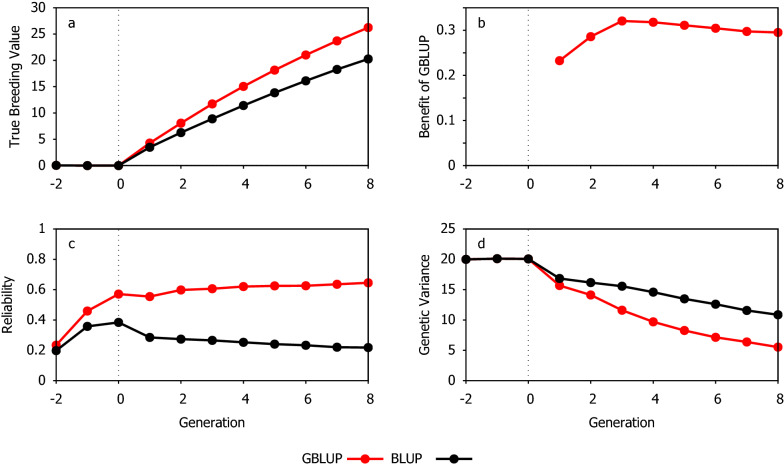
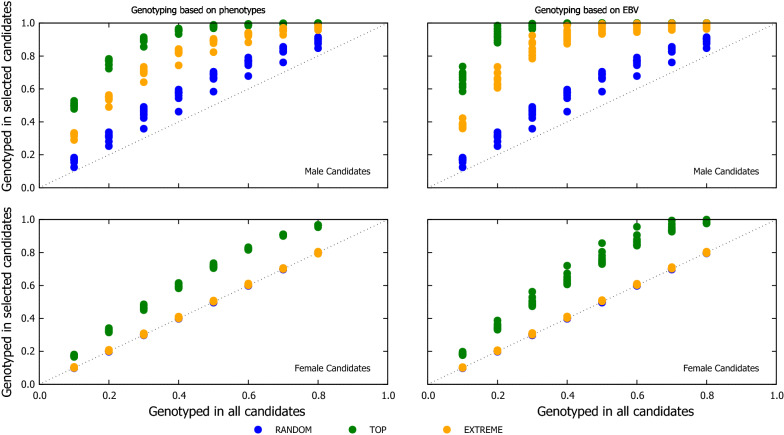
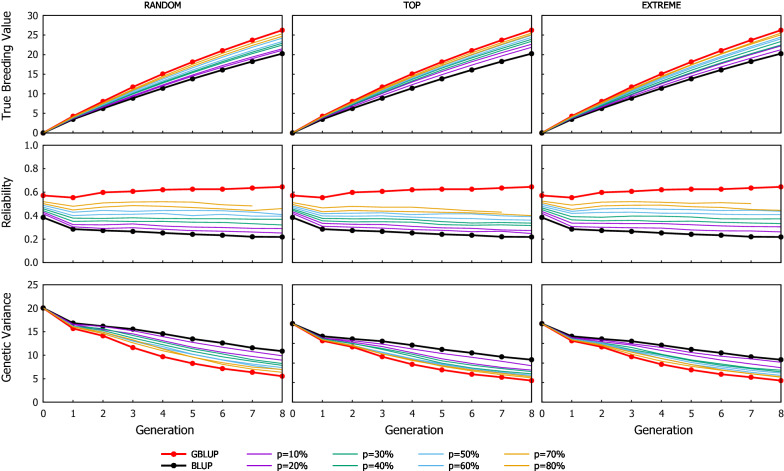
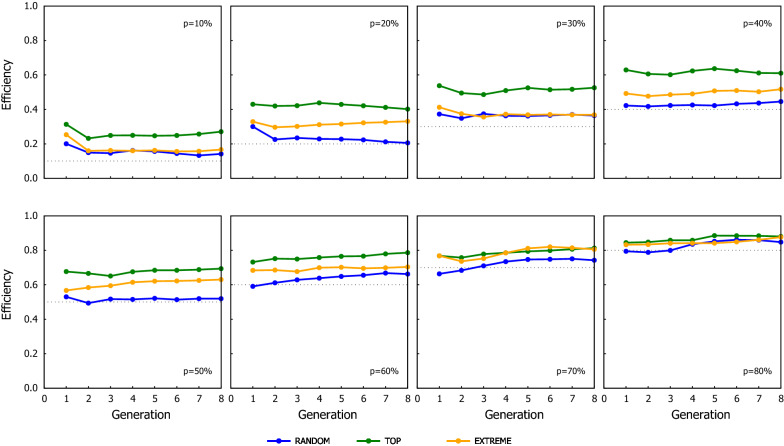
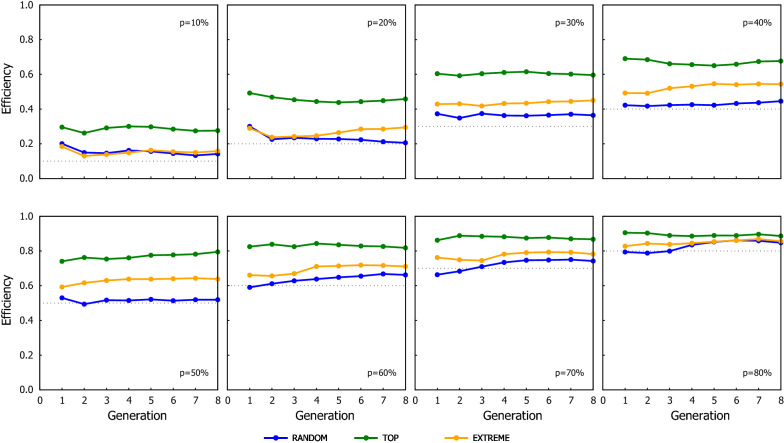
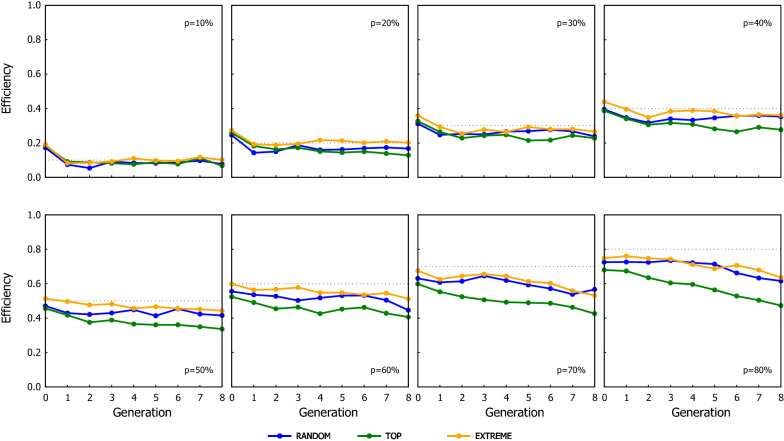
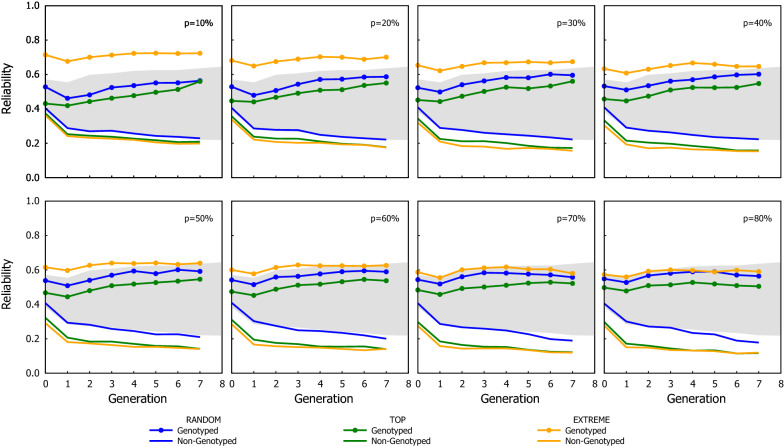
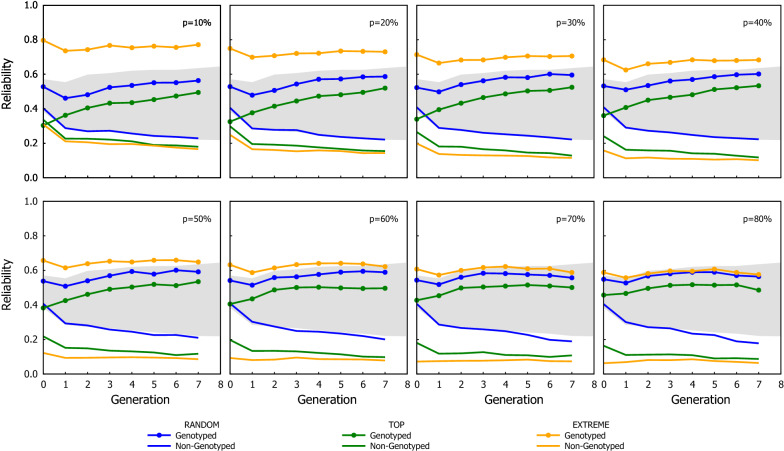
Single-step genomic best linear unbiased prediction (ssGBLUP) allows the inclusion of information from genotyped and ungenotyped individuals in a single analysis. This avoids the need to genotype all candidates with the potential benefit of reducing overall costs. The aim of this study was to assess the effect of genotyping strategies, the proportion of genotyped candidates and the genotyping criterion to rank candidates to be genotyped, when using ssGBLUP evaluation. A simulation study was carried out assuming selection over several discrete generations where a proportion of the candidates were genotyped and evaluation was done using ssGBLUP. The scenarios compared were: (i) three genotyping strategies defined by their protocol for choosing candidates to be genotyped (RANDOM: candidates were chosen at random; TOP: candidates with the best genotyping criterion were genotyped; and EXTREME: candidates with the best and worse criterion were genotyped); (ii) eight proportions of genotyped candidates (p); and (iii) two genotyping criteria to rank candidates to be genotyped (candidates' own phenotype or estimated breeding values). The criteria of the comparison were the cumulated gain and reliability of the genomic estimated breeding values (GEBV).
The genotyping strategy with the greatest cumulated gain was TOP followed by RANDOM, with EXTREME behaving as RANDOM at low p and as TOP with high p. However, the reliability of GEBV was higher with RANDOM than with TOP. This disparity between the trend of the gain and the reliability is due to the TOP scheme genotyping the candidates with the greater chances of being selected. The extra gain obtained with TOP increases when the accuracy of the selection criterion to rank candidates to be genotyped increases.
The best strategy to maximise genetic gain when only a proportion of the candidates are to be genotyped is TOP, since it prioritises the genotyping of candidates which are more likely to be selected. However, the strategy with the greatest GEBV reliability does not achieve the largest gain, thus reliability cannot be considered as an absolute and sufficient criterion for determining the scheme which maximises genetic gain.
单步基因组最佳线性无偏预测(ssGBLUP)允许将已分型和未分型个体的信息包含在单个分析中。这避免了对所有潜在候选者进行分型的需要,从而有可能降低总体成本。本研究旨在评估在使用 ssGBLUP 评估时,分型策略、已分型候选者的比例以及用于对候选者进行分型的分型标准对排名的影响。进行了一项模拟研究,假设在几个离散世代中进行选择,其中一部分候选者进行了分型,并且使用 ssGBLUP 进行了评估。比较的情景包括:(i)通过选择要分型的候选者的方案定义的三种分型策略(随机:随机选择候选者;最优:对具有最佳分型标准的候选者进行分型;极端:对最佳和最差标准的候选者进行分型);(ii)已分型候选者的八个比例(p);和(iii)用于对候选者进行分型的两个分型标准(候选者自身表型或估计育种值)。比较的标准是基因组估计育种值(GEBV)的累积增益和可靠性。
累积增益最大的分型策略是最优,其次是随机,而极端在低 p 时表现为随机,在高 p 时表现为最优。然而,GEBV 的可靠性随着随机的增加而增加。增益趋势和可靠性之间的这种差异是由于 TOP 方案对更有可能被选择的候选者进行了分型。当用于对候选者进行分型的选择标准的准确性增加时,TOP 获得的额外增益会增加。
当只有一部分候选者需要分型时,最大化遗传增益的最佳策略是最优,因为它优先对更有可能被选择的候选者进行分型。然而,具有最大 GEBV 可靠性的策略并不能获得最大增益,因此可靠性不能被视为确定最大化遗传增益的方案的绝对和充分标准。