Guasco L, Khaydukov Yu N, Pütter S, Silvi L, Paulin M A, Keller T, Keimer B
Max-Planck-Institut für Festkörperforschung, Heisenbergstraße 1, D-70569, Stuttgart, Germany.
Max Planck Society Outstation at the Heinz Maier-Leibnitz Zentrum (MLZ), D-85748, Garching, Germany.
Nat Commun. 2022 Mar 18;13(1):1486. doi: 10.1038/s41467-022-29092-z.
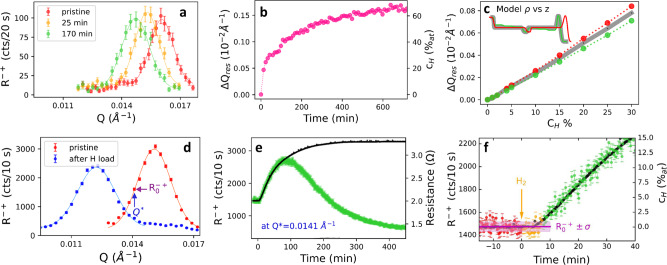
The detection and quantification of hydrogen is becoming increasingly important in research on electronic materials and devices, following the identification of the hydrogen content as a potent control parameter for the electronic properties. However, establishing quantitative correlations between the hydrogen content and the physical properties of solids remains a formidable challenge. Here we report neutron reflectometry experiments on 50 nm thick niobium films during hydrogen loading, and show that the momentum-space position of a prominent waveguide resonance allows tracking of the absolute hydrogen content with an accuracy of about one atomic percent on a timescale of less than a minute. Resonance-enhanced neutron reflectometry thus allows fast, direct, and non-destructive measurements of the hydrogen concentration in thin-film structures, with sensitivity high enough for real-time in-situ studies.
在将氢含量确定为电子特性的有效控制参数之后,氢的检测和定量在电子材料与器件研究中变得越来越重要。然而,在氢含量与固体物理性质之间建立定量关联仍然是一项艰巨的挑战。在此,我们报告了在氢加载过程中对50纳米厚铌膜进行的中子反射测量实验,结果表明,一个显著的波导共振在动量空间的位置能够在不到一分钟的时间尺度上以约百分之一原子的精度追踪绝对氢含量。因此,共振增强中子反射测量能够对薄膜结构中的氢浓度进行快速、直接且无损的测量,其灵敏度足以进行实时原位研究。