Singh Yash, Pettit Matthew, El-Hakeem Osama, Elwood Rachel, Norrish Alan, Audenaert Emmanuel, Khanduja Vikas
Addenbrooke's Hospital, University of Cambridge School of Clinical Medicine, Hills Road, Cambridge, CB2 0SP, UK.
Academic Orthopaedics, Trauma and Sports Medicine, University of Nottingham, Queens Medical Centre, Nottingham, NG7 2UH, UK.
Knee Surg Sports Traumatol Arthrosc. 2022 Oct;30(10):3546-3562. doi: 10.1007/s00167-022-06928-1. Epub 2022 Mar 19.
The literature on hip injuries in ballet dancers was systematically evaluated to answer (1) whether the prevalence of morphological abnormalities and pathology of hip injuries in dancers differs from the general population (2) if there are any specific risk factors which contribute to a higher rate of hip injury and (3) what are the outcomes of primary and secondary intervention strategies.
A systematic literature search of Medline, EMBASE and the Cochrane Library was undertaken for all literature relating to hip injuries in ballet dancers using the PRISMA guidelines. Reference lists were also searched for relevant literature. Clinical outcome studies, prospective/retrospective case series published between 1989 and October 2021 were included. Review articles (non-original data), case reports, studies on animals as well as book chapters were excluded.
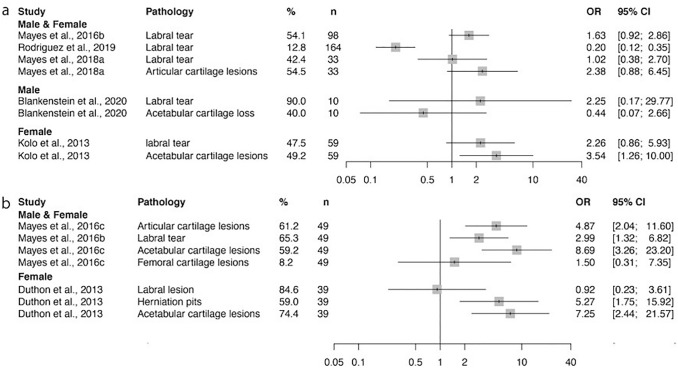
The search yielded 445 studies, of which 35 were included for final analyses after screening. This included 1655 participants, of which 1131 were females. The analyses revealed that damage at the chondrolabral junction and degenerative disease of the hip may develop at a higher rate in ballet dancers than in the general population (odds ratio > 1 in 15/18 cohorts). The intra-articular lesions were more frequently found in postero-superior region of the hip suggesting an alternative impingement mechanism. Furthermore, numerous risk factors specific for hip injury in ballet were highlighted amidst a wide body of literature which consistently reports risk factors for a more generic 'dancer vulnerability'.
Ballet dancers may suffer from both higher rates of chondrolabral damage and degenerative disease in their hips. In contrast to other sports, the intra-articular lesions are more frequently found in postero-superior region of the hip. Future research clarifying the prevalence of osseous abnormalities and prevention strategies in dancers may be pivotal in delaying the development of hip disease in this cohort.
Level IV.
对有关芭蕾舞演员髋部损伤的文献进行系统评价,以回答以下问题:(1)舞蹈演员髋部形态异常和损伤病理的患病率是否与普通人群不同;(2)是否存在导致髋部损伤发生率较高的特定危险因素;(3)一级和二级干预策略的结果如何。
按照PRISMA指南,对Medline、EMBASE和Cochrane图书馆进行系统文献检索,查找所有与芭蕾舞演员髋部损伤相关的文献。还检索了参考文献列表以获取相关文献。纳入1989年至2021年10月期间发表的临床结局研究、前瞻性/回顾性病例系列。排除综述文章(非原始数据)、病例报告、动物研究以及书籍章节。
检索得到445项研究,经筛选后35项纳入最终分析。这包括1655名参与者,其中1131名为女性。分析显示,芭蕾舞演员髋部软骨盂唇交界处损伤和退行性疾病的发生率可能高于普通人群(15/18个队列的优势比>1)。关节内病变更常见于髋部后上区域,提示存在另一种撞击机制。此外,在大量一致报道更普遍的“舞者易损性”危险因素的文献中,突出了许多芭蕾舞演员髋部损伤特有的危险因素。
芭蕾舞演员髋部软骨盂唇损伤和退行性疾病的发生率可能更高。与其他运动不同,关节内病变更常见于髋部后上区域。未来阐明舞者骨异常患病率和预防策略的研究可能对延缓该队列髋部疾病的发展至关重要。
四级。