TB Centre, London School of Hygiene & Tropical Medicine, London, UK.
Department of Epidemiology and Biostatistics, School of Public Health, University of Health and Allied Sciences, Hohoe, Ghana.
BMC Health Serv Res. 2022 Mar 19;22(1):368. doi: 10.1186/s12913-022-07711-1.
Ghana's national tuberculosis (TB) prevalence survey conducted in 2013 showed higher than expected TB prevalence indicating that many people with TB were not being identified and treated. Responding to this, we assessed barriers to TB case finding from the perspective, experiences and practices of healthcare workers (HCWs) in rural and urban health facilities in the Volta region, Ghana.
We conducted structured clinic observations and in-depth interviews with 12 HCWs (including five trained in TB case detection) in four rural health facilities and a municipal hospital. Interview transcripts and clinic observation data were manually organised, triangulated and analysed into health system-related and HCW-related barriers.
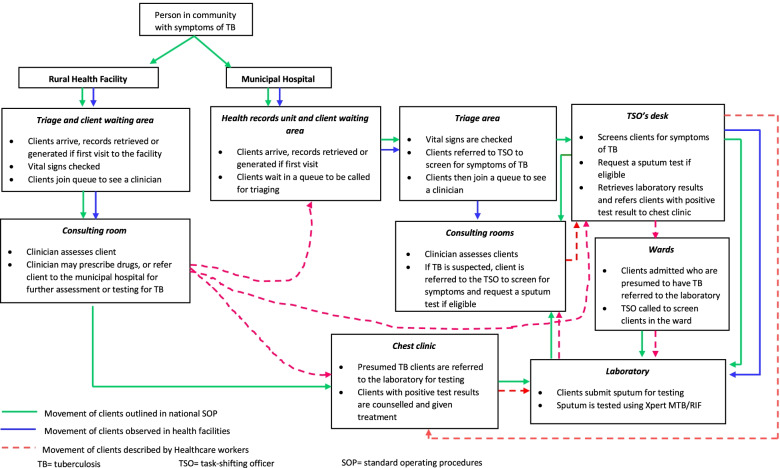
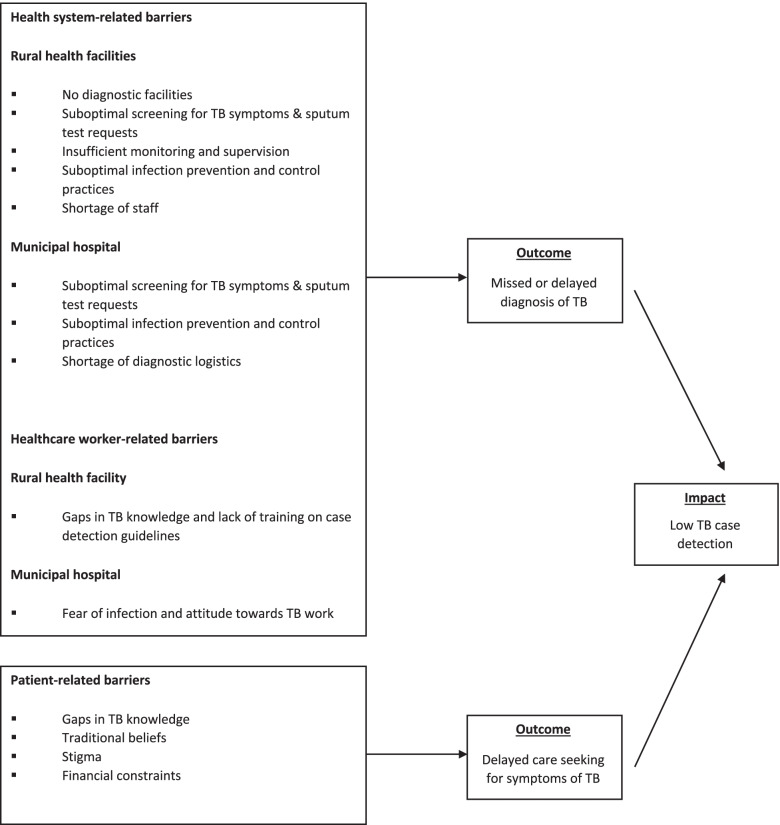
The key health system barriers identified included lack of TB diagnostic laboratories in rural health facilities and no standard referral system to the municipal hospital for further assessment and TB testing. In addition, missed opportunities for early diagnosis of TB were driven by suboptimal screening practices of HCWs whose application of the national standard operating procedures (SOP) for TB case detection was inconsistent. Further, infection prevention and control measures in health facilities were not implemented as recommended by the SOP. HCW-related barriers were mainly lack of training on case detection guidelines, fear of infection (exacerbated by lack of appropriate personal protective equipment [PPE]) and lack of motivation among HCWs for TB work. Solutions to these barriers suggested by HCWs included provision of at least one diagnostic facility in each sub-municipality, provision of transport subsidies to enable patients' travel for testing, training of newly-recruited staff on case detection guidelines, and provision of appropriate PPE.
TB case finding was undermined by few diagnostic facilities; inconsistent referral mechanisms; poor implementation, training and quality control of a screening tool and guidelines; and HCWs fearing infection and not being motivated. We recommend training for and quality monitoring of TB diagnosis and treatment with a focus on patient-centred care, an effective sputum transport system, provision of the TB symptom screening tool and consistent referral pathways from peripheral health facilities.
加纳 2013 年进行的国家结核病(TB)患病率调查显示,TB 患病率高于预期,表明许多 TB 患者未被发现和治疗。针对这一情况,我们从农村和城市卫生设施中医疗保健工作者(HCW)的角度、经验和实践出发,评估了 TB 病例发现的障碍。
我们在加纳沃尔塔地区的四个农村卫生设施和一家市立医院对 12 名 HCW(包括五名接受过 TB 病例检测培训的人员)进行了结构化临床观察和深入访谈。访谈记录和临床观察数据被手动组织、三角剖分并分析为与卫生系统相关和 HCW 相关的障碍。
确定的主要卫生系统障碍包括农村卫生设施缺乏 TB 诊断实验室,以及没有将患者标准转诊到市立医院进行进一步评估和 TB 检测的系统。此外,HCW 的筛选实践不理想,导致 TB 的早期诊断机会丧失,他们对国家 TB 病例检测标准操作程序(SOP)的应用不一致。此外,感染预防和控制措施在卫生设施中未按照 SOP 建议实施。HCW 相关障碍主要是缺乏病例检测指南培训、对感染的恐惧(由于缺乏适当的个人防护设备 [PPE] 而加剧)以及 HCW 对 TB 工作的缺乏动力。HCW 建议的解决这些障碍的方法包括在每个分区提供至少一个诊断设施、为患者检测旅行提供交通补贴、对新招聘的员工进行病例检测指南培训以及提供适当的 PPE。
诊断设施数量少、转诊机制不一致、筛选工具和指南的实施、培训和质量控制不佳以及 HCW 担心感染和缺乏动力,这些因素都对 TB 病例发现造成了阻碍。我们建议对 TB 诊断和治疗进行培训和质量监测,重点关注以患者为中心的护理、有效的痰标本运输系统、提供 TB 症状筛查工具以及从周边卫生设施建立一致的转诊途径。