Taub Institute for Research on Alzheimer's Disease and the Aging Brain, Vagelos College of Physicians and Surgeons, Columbia University, New York, New York, USA.
G.H. Sergievsky Center, Vagelos College of Physicians and Surgeons, Columbia University, New York, New York, USA.
Ann Clin Transl Neurol. 2022 May;9(5):756-761. doi: 10.1002/acn3.51529. Epub 2022 Mar 20.
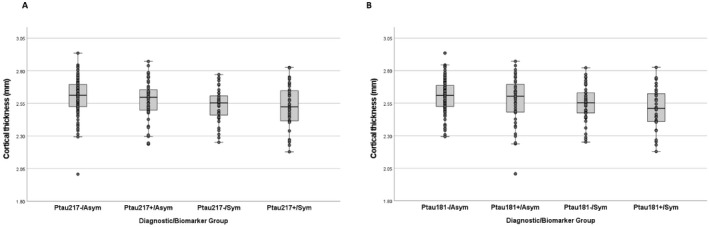
Blood-based phosphorylated tau (Ptau) 181 and 217 biomarkers are sensitive and specific for Alzheimer's disease. In this racial/ethnically diverse cohort study, participants were classified as biomarker positive (Ptau+) or negative (Ptau-) based on Ptau 181 and 217 concentrations and as cognitively impaired (Sym) or unimpaired (Asym). The four groups, Ptau-/Asym, Ptau+/Asym, Ptau-/Sym, and Ptau+/Sym, differed by age, APOE-4 allele frequency, total tau, neurofilament light chain, and cortical thickness measured by MRI. Our results add to increasing evidence that plasma Ptau 181 and 217 concentrations are valid Alzheimer's disease biomarkers in diverse populations.
基于血液的磷酸化 tau(Ptau)181 和 217 生物标志物对阿尔茨海默病具有敏感性和特异性。在这项种族/民族多样化的队列研究中,根据 Ptau 181 和 217 浓度将参与者分为生物标志物阳性(Ptau+)或阴性(Ptau-),并分为认知障碍(Sym)或无认知障碍(Asym)。Ptau-/Asym、Ptau+/Asym、Ptau-/Sym 和 Ptau+/Sym 这四个组在年龄、APOE-4 等位基因频率、总 tau、神经丝轻链和 MRI 测量的皮质厚度方面存在差异。我们的研究结果进一步证明了血浆 Ptau 181 和 217 浓度在不同人群中是阿尔茨海默病有效的生物标志物。