Clinical Memory Research Unit, Department of Clinical Sciences Malmö, Lund University, Lund, Sweden.
Neurochemistry Laboratory, Department of Clinical Chemistry, Amsterdam Neuroscience, Vrije Universiteit Amsterdam, Amsterdam University Medical Center, Amsterdam, the Netherlands.
JAMA Neurol. 2021 Nov 1;78(11):1375-1382. doi: 10.1001/jamaneurol.2021.3180.
Blood-based tests for brain amyloid-β (Aβ) pathology are needed for widespread implementation of Alzheimer disease (AD) biomarkers in clinical care and to facilitate patient screening and monitoring of treatment responses in clinical trials.
To compare the performance of plasma Aβ42/40 measured using 8 different Aβ assays when detecting abnormal brain Aβ status in patients with early AD.
DESIGN, SETTING, AND PARTICIPANTS: This study included 182 cognitively unimpaired participants and 104 patients with mild cognitive impairment from the BioFINDER cohort who were enrolled at 3 different hospitals in Sweden and underwent Aβ positron emission tomography (PET) imaging and cerebrospinal fluid (CSF) and plasma collection from 2010 to 2014. Plasma Aβ42/40 was measured using an immunoprecipitation-coupled mass spectrometry developed at Washington University (IP-MS-WashU), antibody-free liquid chromatography MS developed by Araclon (LC-MS-Arc), and immunoassays from Roche Diagnostics (IA-Elc); Euroimmun (IA-EI); and Amsterdam University Medical Center, ADx Neurosciences, and Quanterix (IA-N4PE). Plasma Aβ42/40 was also measured using an IP-MS-based method from Shimadzu in 200 participants (IP-MS-Shim) and an IP-MS-based method from the University of Gothenburg (IP-MS-UGOT) and another immunoassay from Quanterix (IA-Quan) among 227 participants. For validation, 122 participants (51 cognitively normal, 51 with mild cognitive impairment, and 20 with AD dementia) were included from the Alzheimer Disease Neuroimaging Initiative who underwent Aβ-PET and plasma Aβ assessments using IP-MS-WashU, IP-MS-Shim, IP-MS-UGOT, IA-Elc, IA-N4PE, and IA-Quan assays.
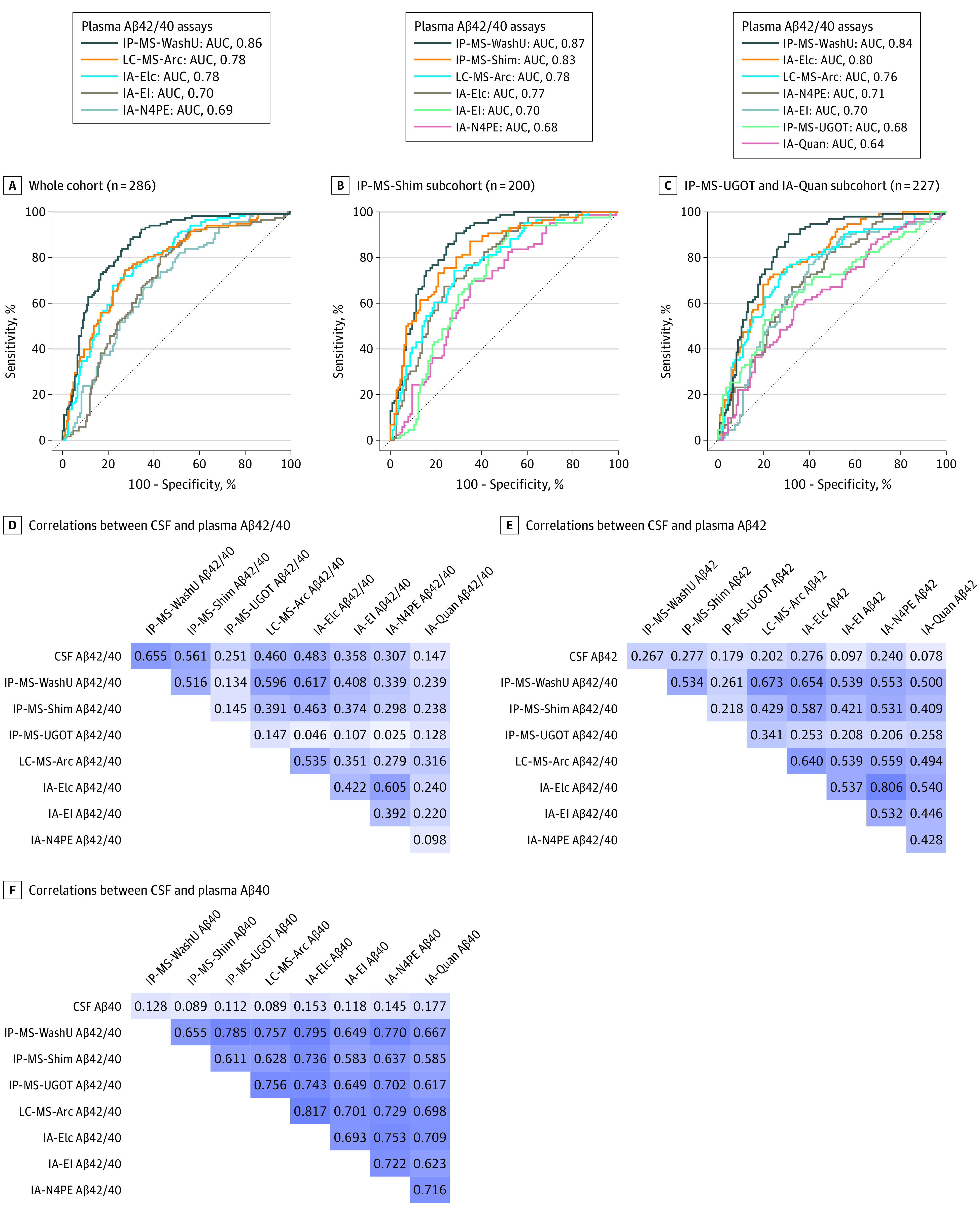
Discriminative accuracy of plasma Aβ42/40 quantified using 8 different assays for abnormal CSF Aβ42/40 and Aβ-PET status.
A total of 408 participants were included in this study. In the BioFINDER cohort, the mean (SD) age was 71.6 (5.6) years and 49.3% of the cohort were women. When identifying participants with abnormal CSF Aβ42/40 in the whole cohort, plasma IP-MS-WashU Aβ42/40 showed significantly higher accuracy (area under the receiver operating characteristic curve [AUC], 0.86; 95% CI, 0.81-0.90) than LC-MS-Arc Aβ42/40, IA-Elc Aβ42/40, IA-EI Aβ42/40, and IA-N4PE Aβ42/40 (AUC range, 0.69-0.78; P < .05). Plasma IP-MS-WashU Aβ42/40 performed significantly better than IP-MS-UGOT Aβ42/40 and IA-Quan Aβ42/40 (AUC, 0.84 vs 0.68 and 0.64, respectively; P < .001), while there was no difference in the AUCs between IP-MS-WashU Aβ42/40 and IP-MS-Shim Aβ42/40 (0.87 vs 0.83; P = .16) in the 2 subcohorts where these biomarkers were available. The results were similar when using Aβ-PET as outcome. Plasma IPMS-WashU Aβ42/40 and IPMS-Shim Aβ42/40 showed highest coefficients for correlations with CSF Aβ42/40 (r range, 0.56-0.65). The BioFINDER results were replicated in the Alzheimer Disease Neuroimaging Initiative cohort (mean [SD] age, 72.4 [5.4] years; 43.4% women), where the IP-MS-WashU assay performed significantly better than the IP-MS-UGOT, IA-Elc, IA-N4PE, and IA-Quan assays but not the IP-MS-Shim assay.
The results from 2 independent cohorts indicate that certain MS-based methods performed better than most of the immunoassays for plasma Aβ42/40 when detecting brain Aβ pathology.
为了在临床护理中广泛实施阿尔茨海默病(AD)生物标志物,并促进临床试验中患者的筛选和治疗反应监测,需要基于血液的脑淀粉样蛋白-β(Aβ)病理学检测。
比较使用 8 种不同 Aβ 检测方法测量的血浆 Aβ42/40 在检测早期 AD 患者异常脑 Aβ 状态时的性能。
设计、地点和参与者:本研究纳入了 182 名认知正常的参与者和 104 名轻度认知障碍患者,他们来自瑞典的 3 家不同医院,于 2010 年至 2014 年接受 Aβ 正电子发射断层扫描(PET)成像和脑脊液(CSF)及血浆采集。使用华盛顿大学(IP-MS-WashU)开发的免疫沉淀偶联质谱法、Araclon(LC-MS-Arc)开发的无抗体液相色谱质谱法和罗氏诊断公司(IA-Elc)、Euroimmun(IA-EI)以及阿姆斯特丹大学医学中心、ADx 神经科学和 Quanterix(IA-N4PE)的免疫测定法测量血浆 Aβ42/40。200 名参与者还使用岛津的基于 IP-MS 的方法(IP-MS-Shim)和哥德堡大学的基于 IP-MS 的方法(IP-MS-UGOT)以及 Quanterix 的另一种免疫测定法(IA-Quan)测量了血浆 Aβ42/40。在验证阶段,纳入了来自阿尔茨海默病神经影像学倡议的 122 名参与者(51 名认知正常、51 名轻度认知障碍和 20 名 AD 痴呆),他们使用 IP-MS-WashU、IP-MS-Shim、IP-MS-UGOT、IA-Elc、IA-N4PE 和 IA-Quan 检测方法进行 Aβ-PET 和血浆 Aβ 评估。
8 种不同方法检测异常 CSF Aβ42/40 和 Aβ-PET 状态时,血浆 Aβ42/40 的鉴别准确性。
本研究共纳入 408 名参与者。在 BioFINDER 队列中,参与者的平均(SD)年龄为 71.6(5.6)岁,队列中有 49.3%的女性。在整个队列中,当识别出 CSF Aβ42/40 异常的参与者时,基于 IP-MS 的血浆 Aβ42/40 显示出明显更高的准确性(受试者工作特征曲线下面积[AUC],0.86;95%CI,0.81-0.90),优于 LC-MS-Arc Aβ42/40、IA-Elc Aβ42/40、IA-EI Aβ42/40 和 IA-N4PE Aβ42/40(AUC 范围,0.69-0.78;P<.05)。基于 IP-MS 的血浆 Aβ42/40 明显优于 IP-MS-UGOT Aβ42/40 和 IA-Quan Aβ42/40(AUC,0.84 比 0.68 和 0.64,分别;P<.001),而在这两种生物标志物都可用的两个亚队列中,基于 IP-MS 的血浆 Aβ42/40 和 IP-MS-Shim Aβ42/40 的 AUC 无差异(0.87 比 0.83;P=.16)。当使用 Aβ-PET 作为结局时,结果相似。基于 IPMS-WashU Aβ42/40 和 IPMS-Shim Aβ42/40 与 CSF Aβ42/40 的相关性最高(r 范围,0.56-0.65)。阿尔茨海默病神经影像学倡议队列(平均[SD]年龄,72.4[5.4]岁;43.4%的女性)中复制了 BioFINDER 的结果,在该队列中,基于 IP-MS 的检测方法明显优于 IP-MS-UGOT、IA-Elc、IA-N4PE 和 IA-Quan 检测方法,但不如 IP-MS-Shim 检测方法。
来自 2 个独立队列的结果表明,当检测脑 Aβ 病理学时,某些基于 MS 的方法在检测血浆 Aβ42/40 时比大多数免疫测定法的性能更好。