Ozturk Erman, Elibol Tayfun, Kilicaslan Emrah, Kabayuka Beyza, Erdogan Ozunal Isil
Istanbul Medeniyet University Faculty of Medicine, Department of Hematology, Istanbul, Turkey.
Istanbul Goztepe Prof. Dr. Suleyman Yalcin City Hospital, Clinic of Hematology, Istanbul, Turkey.
Medeni Med J. 2022 Mar 18;37(1):85-91. doi: 10.4274/MMJ.galenos.2022.87422.
The international prognostic index (IPI) and the revised IPI (R-IPI) are used to determine the prognosis in diffuse large B-cell lymphoma (DLBCL). However, these scoring systems are insufficient to identify very high-risk patients. Recently, the prognostic nutritional index (PNI) -calculated with lymphocyte count and albumin- has been used to determine the prognosis in DLBCL. This study aimed to evaluate the effect of PNI score on prognosis and survival in patients with high-risk DLBCL.
Patients diagnosed with DLBCL and treated with rituximab, cyclophosphamide, doxorubicin, vincristine, and prednisolone were included. Pre-treatment IPI, R-IPI, and PNI scores and progression-free survival (PFS) and overall survival (OS) times were calculated. The cut-off value for PNI according to OS was determined by using the X-Tile program.
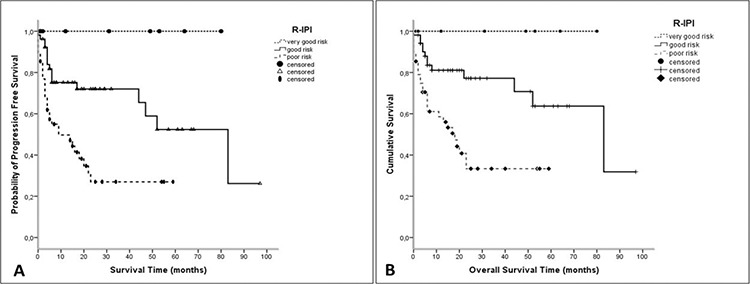
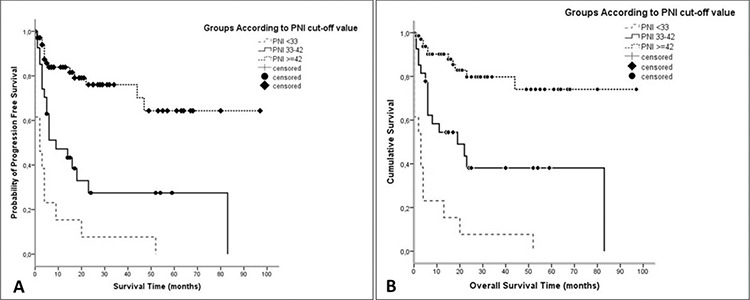
One hundred and ten patients were included, the median age was 63 years and the median follow-up period was 25 months. According to R-IPI, the median OS could not be reached for the very good risk group, and the median OS values were 83 and 17 months in the good and poor-risk groups, respectively (p=0.001). The cohort was divided into three groups according to the cut-off value for the PNI: patients with PNI <33 were classified as high-risk, 33-42 intermediate-risk, and ≥42 as low-risk. According to PNI, the median durations of PFS and OS were 2 months and 3 months in the high-risk group, 9 months and 19 months in the intermediate-risk group respectively, and in the low-risk group the median duration for PFS and OS could not be reached (p=0.001).
The R-IPI is widely used to estimate the prognosis in DLBCL. But in our cohort, in the poor-risk patient group, the OS was 17 months according to R-IPI, while this period was 3 months according to PNI. This finding demonstrated that PNI might predict early mortality in DLBCL.
国际预后指数(IPI)和修订后的IPI(R-IPI)用于确定弥漫性大B细胞淋巴瘤(DLBCL)的预后。然而,这些评分系统不足以识别极高风险患者。最近,通过淋巴细胞计数和白蛋白计算得出的预后营养指数(PNI)已被用于确定DLBCL的预后。本研究旨在评估PNI评分对高危DLBCL患者预后和生存的影响。
纳入诊断为DLBCL并接受利妥昔单抗、环磷酰胺、阿霉素、长春新碱和泼尼松龙治疗的患者。计算治疗前的IPI、R-IPI和PNI评分以及无进展生存期(PFS)和总生存期(OS)。使用X-Tile程序确定根据OS的PNI临界值。
纳入110例患者,中位年龄为63岁,中位随访期为25个月。根据R-IPI,极低风险组未达到中位OS,良好风险组和不良风险组的中位OS值分别为83个月和17个月(p = 0.001)。根据PNI临界值将队列分为三组:PNI<33的患者被分类为高危,33-42为中危,≥42为低危。根据PNI,高危组的PFS和OS中位持续时间分别为2个月和3个月,中危组分别为9个月和19个月,低危组未达到PFS和OS的中位持续时间(p = 0.001)。
R-IPI被广泛用于估计DLBCL的预后。但在我们的队列中,在不良风险患者组中,根据R-IPI的OS为17个月,而根据PNI此期为3个月。这一发现表明PNI可能预测DLBCL的早期死亡率。