Karbownik Michał Seweryn, Mokros Łukasz, Dobielska Maria, Kowalczyk Mateusz, Kowalczyk Edward
Department of Pharmacology and Toxicology, Medical University of Lodz, Łódź, Poland.
Department of Clinical Pharmacology, Medical University of Lodz, Łódź, Poland.
Front Nutr. 2022 Mar 3;9:850249. doi: 10.3389/fnut.2022.850249. eCollection 2022.
Gut microbiota-based therapeutic strategies, such as probiotic and prebiotic preparations, may benefit mental health. However, commonly consumed fermented and prebiotic-containing foods have not been well-tested. The aim of the present study was to determine whether consumption of fermented food and food-derived prebiotics is associated with cognitive performance, depressive, and anxiety symptoms in psychiatrically healthy medical students under psychological stress.
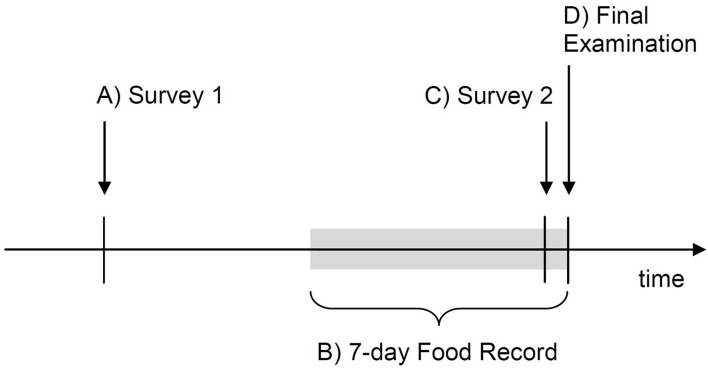
The study protocol with data analysis plan was prospectively registered. Food consumption was evaluated with a 7-day dietary record. Cognitive performance was modeled with academic examination performance in relation to subject knowledge. Pre-exam depressive and anxiety symptoms were assessed with the Patient Health Questionnaire-9 and Generalized Anxiety Disorder-7, respectively.
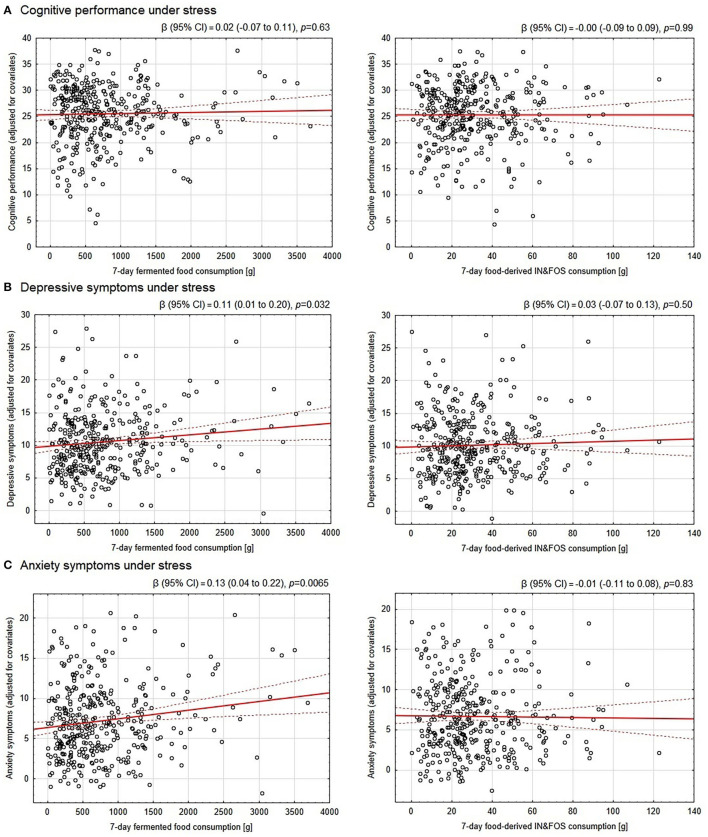
In total, 372 medical students (22.7 ± 1.1 years of age, 66% female) completed the study. No relationship was observed between cognitive performance under stress and either fermented food (adjusted β 0.02, 95% CI -0.07-0.11, = 0.63) or food-derived prebiotics consumption (adjusted β -0.00, 95% CI -0.09-0.09, = 0.99). High intake of fermented food was associated with more severe depressive (adjusted β 0.11, 95% CI 0.01-0.20, = 0.032) and anxiety symptoms under stress (adjusted β 0.13, 95% CI 0.04-0.22, = 0.0065); however, no such link was observed for food-derived prebiotics (adjusted β 0.03, 95% CI -0.07-0.13, = 0.50 and -0.01, 95% CI -0.11-0.08, = 0.83, for depression and anxiety, respectively).
Under psychological stress in medical students, consumption of fermented food and food-derived prebiotics appears to be not associated with cognitive performance. High intake of fermented food, but not food-derived prebiotics, may be associated with severity of depressive and anxiety symptoms. The safety of fermented food in this regard therefore requires further clarification.
基于肠道微生物群的治疗策略,如益生菌和益生元制剂,可能有益于心理健康。然而,常见的发酵食品和含益生元的食品尚未得到充分测试。本研究的目的是确定食用发酵食品和食物来源的益生元是否与处于心理压力下的精神健康医学生的认知表现、抑郁和焦虑症状有关。
带有数据分析计划的研究方案进行了前瞻性注册。通过7天饮食记录评估食物摄入量。认知表现以与学科知识相关的学业考试成绩为模型。考前抑郁和焦虑症状分别用患者健康问卷-9和广泛性焦虑障碍量表-7进行评估。
共有372名医学生(年龄22.7±1.1岁,66%为女性)完成了研究。在压力下的认知表现与发酵食品(调整后β值为0.02,95%置信区间为-0.07至0.11,P = 0.63)或食物来源的益生元摄入量(调整后β值为-0.00,95%置信区间为-0.09至0.09,P = 0.99)之间均未观察到相关性。高发酵食品摄入量与压力下更严重的抑郁(调整后β值为0.11,95%置信区间为0.01至0.20,P = 0.032)和焦虑症状(调整后β值为0.13,95%置信区间为0.04至0.22,P = 0.0065)相关;然而,食物来源的益生元未观察到此类关联(抑郁和焦虑的调整后β值分别为0.03,95%置信区间为-0.07至0.13,P = 0.50和-0.01,95%置信区间为-0.11至0.08,P = 0.83)。
在医学生的心理压力下,食用发酵食品和食物来源的益生元似乎与认知表现无关。高发酵食品摄入量而非食物来源的益生元摄入量可能与抑郁和焦虑症状的严重程度有关。因此,发酵食品在这方面的安全性需要进一步阐明。