Nagakura Toshiki, Schubert Florian, Wagner Dirk, Kallmeyer Jens
GFZ German Research Centre for Geosciences, Section 3.7 Geomicrobiology, Potsdam, Germany.
Institute of Geosciences, University of Potsdam, Potsdam, Germany.
Front Microbiol. 2022 Mar 3;13:845250. doi: 10.3389/fmicb.2022.845250. eCollection 2022.
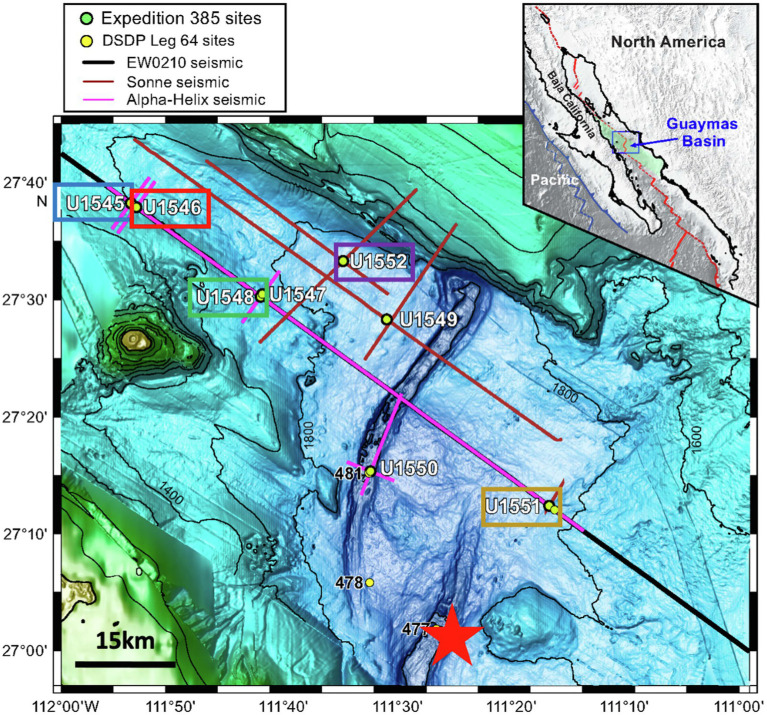
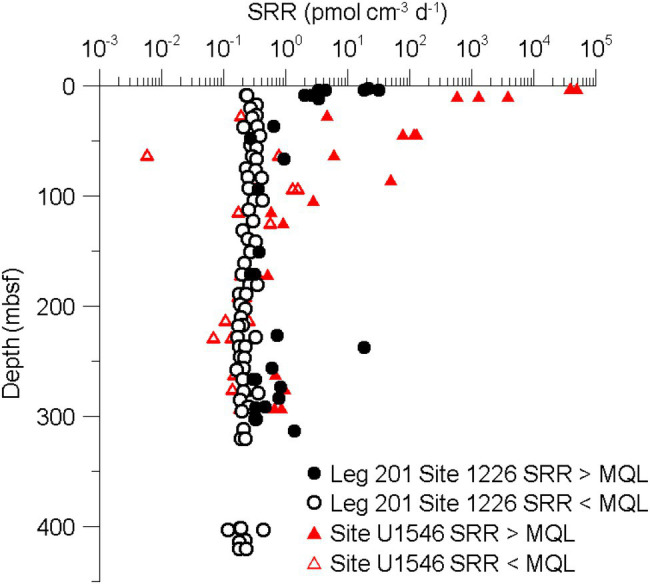
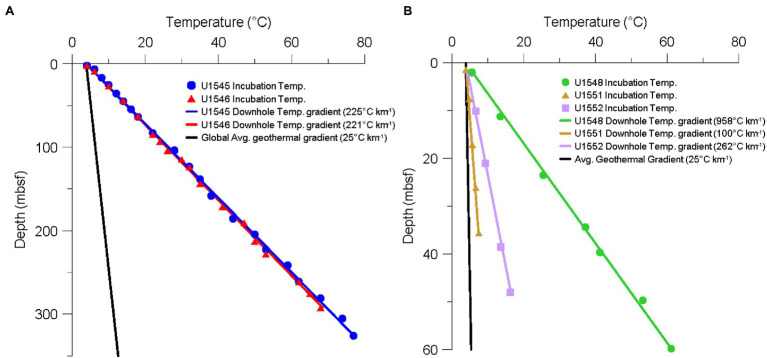
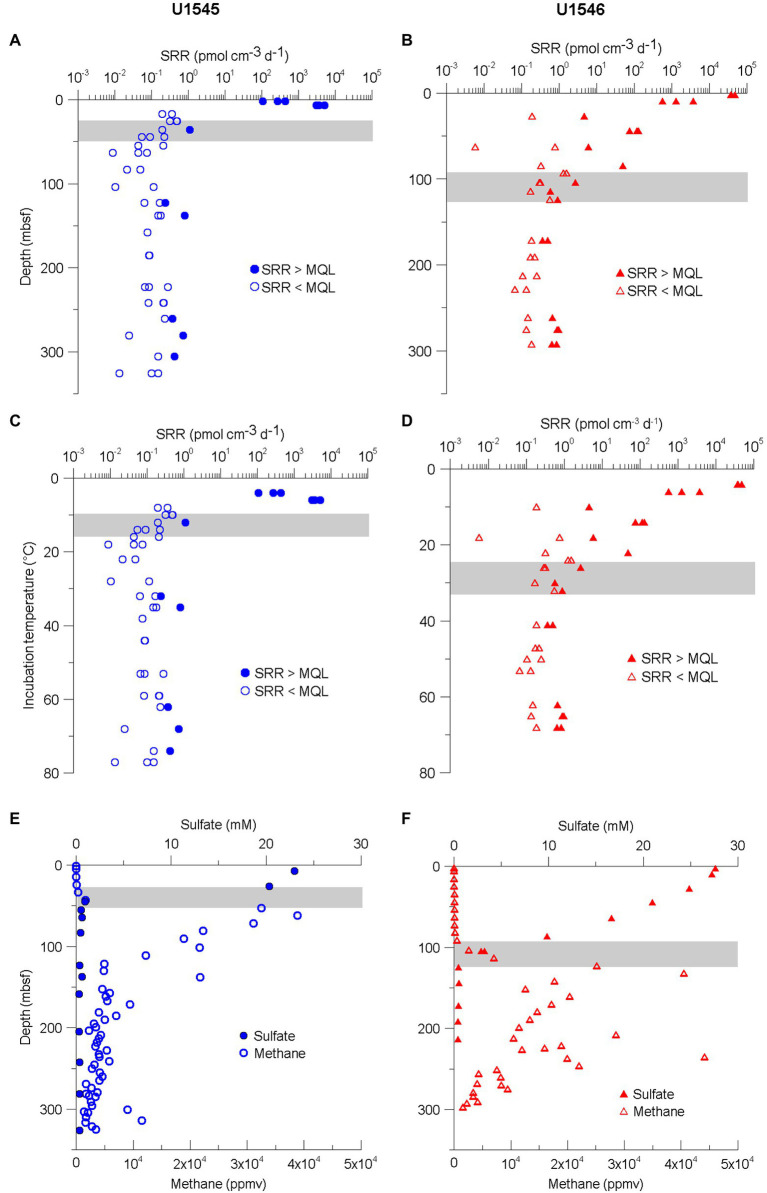
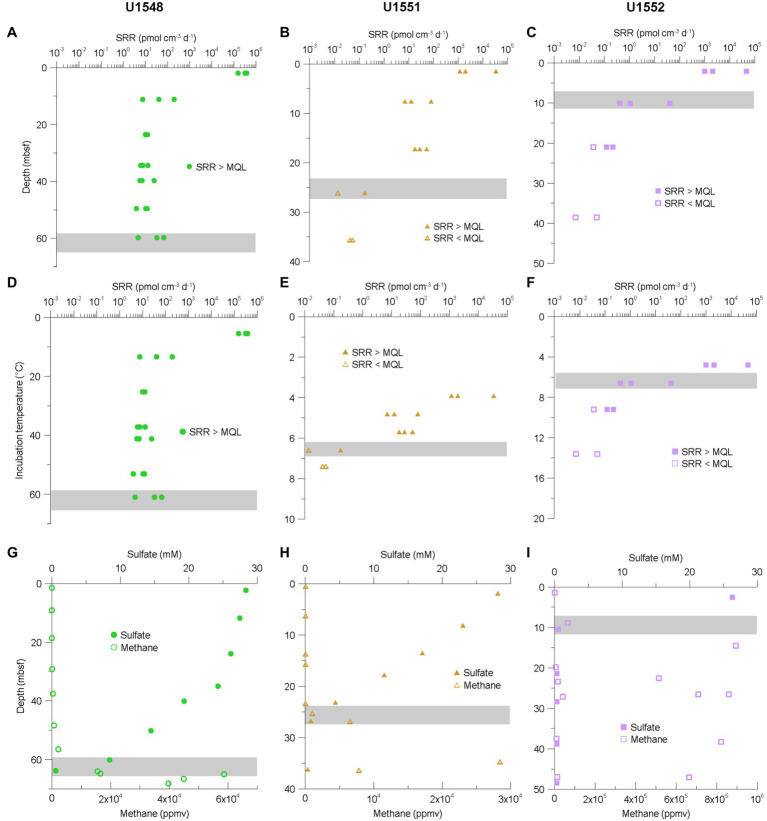
Sulfate reduction is the quantitatively most important process to degrade organic matter in anoxic marine sediment and has been studied intensively in a variety of settings. Guaymas Basin, a young marginal ocean basin, offers the unique opportunity to study sulfate reduction in an environment characterized by organic-rich sediment, high sedimentation rates, and high geothermal gradients (100-958°C km). We measured sulfate reduction rates (SRR) in samples taken during the International Ocean Discovery Program (IODP) Expedition 385 using incubation experiments with radiolabeled SO carried out at pressure and temperature. The highest SRR (387 nmol cm d) was recorded in near-surface sediments from Site U1548C, which had the steepest geothermal gradient (958°C km). At this site, SRR were generally over an order of magnitude higher than at similar depths at other sites (e.g., 387-157 nmol cm d at 1.9 mbsf from Site U1548C vs. 46-1.0 nmol cm d at 2.1 mbsf from Site U1552B). Site U1546D is characterized by a sill intrusion, but it had already reached thermal equilibrium and SRR were in the same range as nearby Site U1545C, which is minimally affected by sills. The wide temperature range observed at each drill site suggests major shifts in microbial community composition with very different temperature optima but awaits confirmation by molecular biological analyses. At the transition between the mesophilic and thermophilic range around 40°C-60°C, sulfate-reducing activity appears to be decreased, particularly in more oligotrophic settings, but shows a slight recovery at higher temperatures.
硫酸盐还原是缺氧海洋沉积物中降解有机物的最重要的定量过程,并且已经在各种环境中进行了深入研究。瓜伊马斯盆地是一个年轻的边缘海盆,提供了一个独特的机会来研究在以富含有机物的沉积物、高沉积速率和高地热梯度(100 - 958°C/km)为特征的环境中的硫酸盐还原。我们在国际大洋发现计划(IODP)385航次期间采集的样本中测量了硫酸盐还原速率(SRR),使用在压力和温度下进行的放射性标记SO的培养实验。最高的SRR(387 nmol cm d)记录在U1548C站点的近表层沉积物中,该站点具有最陡的地热梯度(958°C/km)。在该站点,SRR通常比其他站点类似深度处高出一个数量级以上(例如,U1548C站点1.9米海底以下为387 - 157 nmol cm d,而U1552B站点2.1米海底以下为46 - 1.0 nmol cm d)。U1546D站点的特征是有岩槛侵入,但它已经达到热平衡,SRR与附近受岩槛影响最小的U1545C站点处于相同范围。在每个钻探站点观察到的宽温度范围表明微生物群落组成发生了重大变化,具有非常不同的最适温度,但有待分子生物学分析的证实。在40°C - 60°C左右的嗜温范围和嗜热范围之间的过渡阶段,硫酸盐还原活性似乎降低,特别是在营养更贫瘠的环境中,但在较高温度下略有恢复。