Li Jing, Yan Shanle, Zhang Xiaohui, Xiang Mengqi, Zhang Chuanhua, Gu Ling, Wei Xiaoying, You Chuanyun, Chen Shenhua, Zeng Daxiong, Jiang Junhong
Department of Medicine, Respiratory, Emergency and Intensive Care Medicine, The Affiliated Dushu Lake Hospital of Soochow University, Suzhou, China.
Department of Rheumatology and Immunology, The Affiliated Dushu Lake Hospital of Soochow University, Suzhou, China.
Front Med (Lausanne). 2022 Mar 2;9:853941. doi: 10.3389/fmed.2022.853941. eCollection 2022.
D-dimer is a fibrin-degrading substance that is soluble and whose degradation is produced by plasma protein-mediated degradation of cross-linked fibrin. Previous investigations have shown a link between D-dimer and the mortality in lung cancer patients. However, different investigations varied whether D-dimer could predict prognosis in these patients.
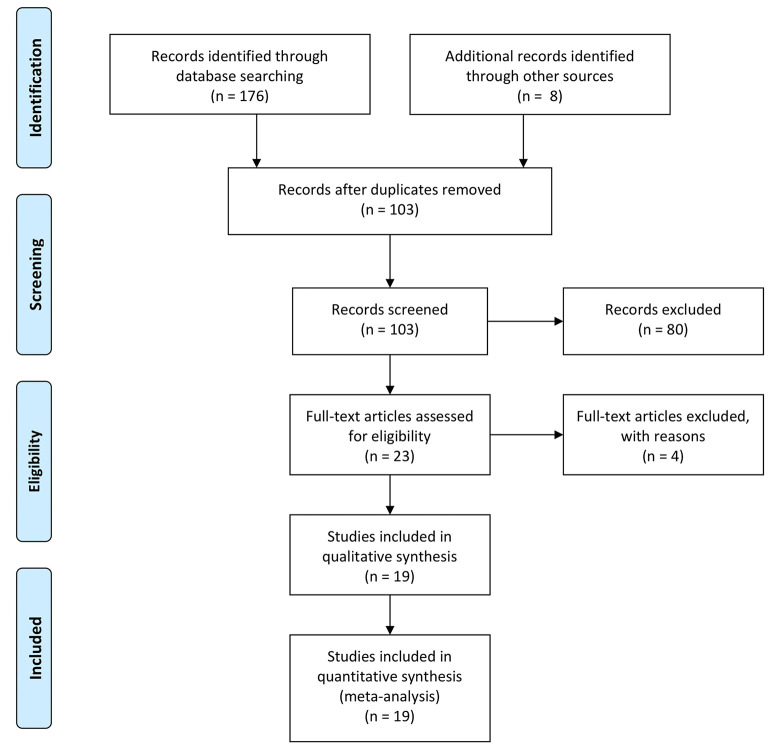
A meta-analysis and systematic review of all available cohort studies were performed on the link between circulating D-dimer levels and survival of lung cancer patients. Relevant studies were searched in Embase, Cochrane Library, and PubMed databases. Data from 540 lung cancer patients from the First Hospital of Soochow University and Sichuan Cancer Hospital were used for external validation.
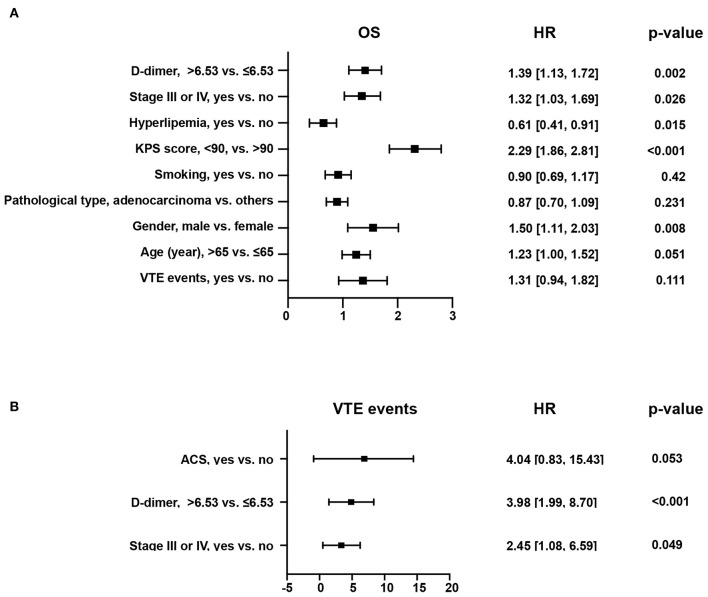
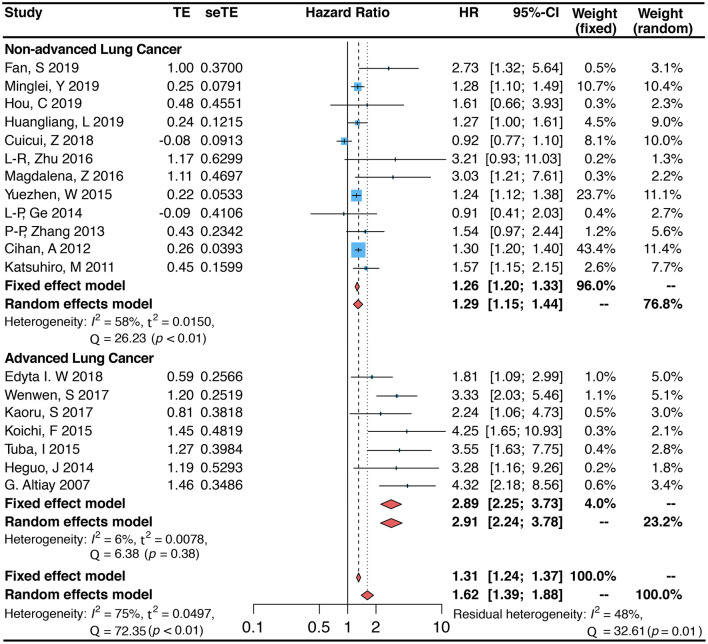
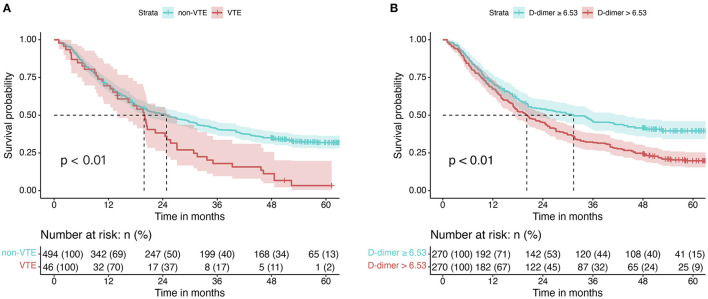
We finally obtained 19 eligible cohort studies with pooled HR showing that high D-dimer levels contribute to death in tumor group (HR 1.62, 95% CI: 1.39-1.88, I = 75.0%). Further stratified analysis showed that higher circulating D-dimer in the advanced lung cancer group was linked to a 1.91-fold risk (HR = 2.91, 95% CI: 2.24-3.78, I = 6.0%). Incorporation of other variables, including days of follow-up, country, design, public year, population, disease status, and quality score, into the meta-regression model, indicated that disease status was an additional source of heterogeneity ( < 0.001). External validation of 540 patients also showed that high levels of D-dimer showed a higher risk of overall mortality (HR 1.39, 95% CI: 1.13-1.72, = 0.002) and VTE events (HR 3.98, 95% CI: 1.99-8.70, = 0.002) in lung cancer patients.
High circulating plasma D-dimer levels independently predict long-term prognosis and the risk of venous thromboembolism in lung cancer.
D - 二聚体是一种可溶的纤维蛋白降解物质,其降解是由血浆蛋白介导的交联纤维蛋白降解产生的。先前的研究表明D - 二聚体与肺癌患者的死亡率之间存在联系。然而,不同的研究对于D - 二聚体是否能预测这些患者的预后存在差异。
对所有可用的队列研究进行荟萃分析和系统评价,以探讨循环D - 二聚体水平与肺癌患者生存率之间的联系。在Embase、Cochrane图书馆和PubMed数据库中检索相关研究。来自苏州大学第一医院和四川省肿瘤医院的540例肺癌患者的数据用于外部验证。
我们最终获得了19项符合条件的队列研究,合并风险比显示高D - 二聚体水平导致肿瘤组死亡(风险比1.62,95%置信区间:1.39 - 1.88,I² = 75.0%)。进一步的分层分析表明,晚期肺癌组中较高的循环D - 二聚体与1.91倍的风险相关(风险比 = 2.91,95%置信区间:2.24 - 3.78,I² = 6.0%)。将其他变量,包括随访天数、国家、设计、发表年份、人群、疾病状态和质量评分,纳入荟萃回归模型,表明疾病状态是异质性的另一个来源(P < 0.001)。对540例患者的外部验证也表明,高D - 二聚体水平在肺癌患者中显示出更高的全因死亡率风险(风险比1.39,95%置信区间:1.13 - 1.72,P = 0.002)和静脉血栓栓塞事件风险(风险比3.98,95%置信区间:1.99 - 8.70,P = 0.002)。
高循环血浆D - 二聚体水平独立预测肺癌的长期预后和静脉血栓栓塞风险。