Liang Hua-Gang, Gao Kun, Jia Rui, Li Jian, Wang Chao
Department of Thoracic Surgery, The First Hospital of Qinhuangdao, Qinhuangdao, Hebei 066000, P.R. China.
Oncol Lett. 2019 Feb;17(2):1435-1444. doi: 10.3892/ol.2018.9760. Epub 2018 Nov 26.
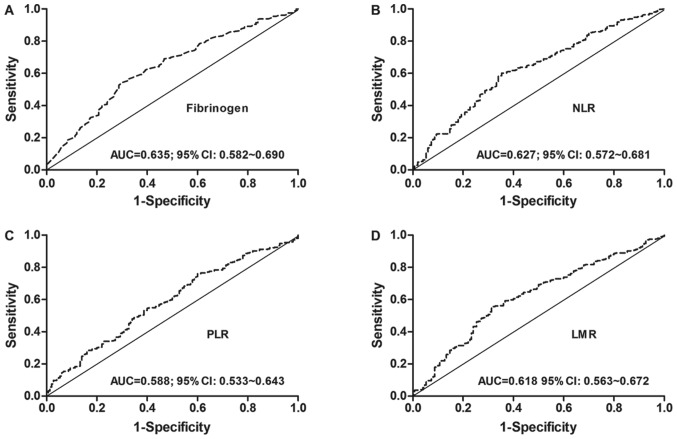
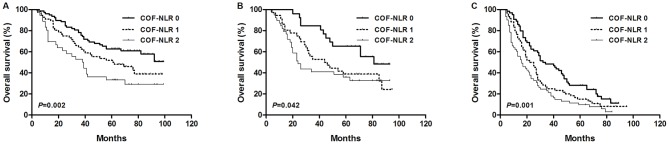
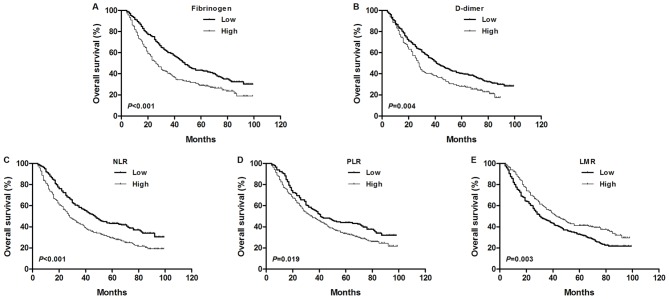
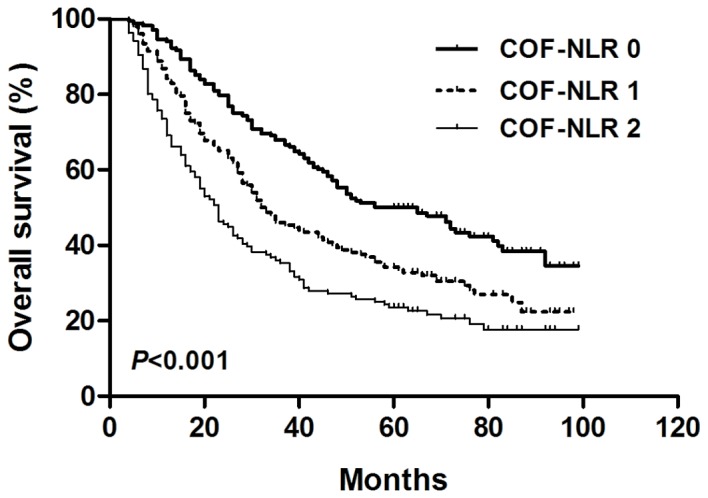
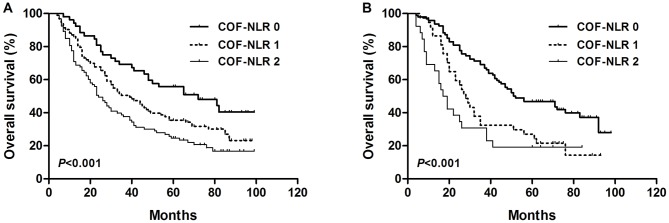
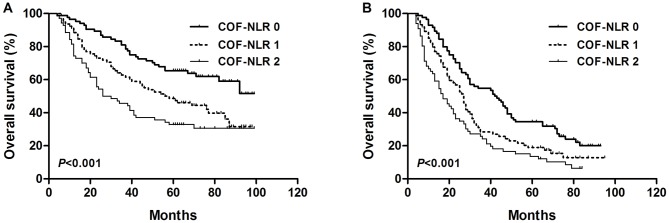
The purpose of the present study was to evaluate the prognostic value of preoperative coagulation factor levels (including fibrinogen and D-dimer) and inflammatory indicators in patients with non-small cell lung cancer (NSCLC). The medical records of 456 patients with NSCLC who had undergone curative resection were retrospectively analysed. The recommended cut-off values for preoperative fibrinogen, neutrophil-lymphocyte ratio (NLR), platelet-lymphocyte ratio and lymphocyte-monocyte ratio were determined using receiver operating characteristic curve analyses. The associations between preoperative fibrinogen or D-dimer levels and clinicopathological variables were analysed using the χ test. Univariate Kaplan-Meier analysis and a multivariate Cox proportional hazards model were applied to identify which prognostic variables were significantly associated with overall survival (OS) rates. Multivariate analyses revealed that lymph node metastasis (P<0.001), preoperative fibrinogen (P=0.024) and NLR (P=0.028) were effective independent prognostic variables associated with OS. Based on this result, a novel, single inflammation-based combination of fibrinogen and NLR (COF-NLR) score was proposed for the determination of prognosis. Patients with elevated fibrinogen and NLR levels were allocated a score of 2 (n=136), and those that demonstrated elevated levels of one or neither were allocated a score of 1 (n=152) or 0 (n=168), respectively. The 5-year OS rates were significantly poorer for patients with COF-NLR=2 compared with those with COF-NLR=1 or 0 (23.5% vs. 34.2% vs. 50.0%, P<0.001). A subgroup analysis demonstrated that the prognostic significance of COF-NLR was independent of histological subtype, lymph node metastasis and pathological stage. Therefore, COF-NLR has potential as a novel and useful blood marker for predicting tumour progression and the postoperative survival of patients with NSCLC. It may assist clinicians in risk stratification, prognosis predictions and facilitating individualised treatment.
本研究的目的是评估术前凝血因子水平(包括纤维蛋白原和D-二聚体)及炎症指标对非小细胞肺癌(NSCLC)患者的预后价值。回顾性分析了456例行根治性切除的NSCLC患者的病历。采用受试者工作特征曲线分析确定术前纤维蛋白原、中性粒细胞与淋巴细胞比值(NLR)、血小板与淋巴细胞比值及淋巴细胞与单核细胞比值的推荐临界值。采用χ检验分析术前纤维蛋白原或D-二聚体水平与临床病理变量之间的关联。应用单因素Kaplan-Meier分析和多因素Cox比例风险模型来确定哪些预后变量与总生存率(OS)显著相关。多因素分析显示,淋巴结转移(P<0.001)、术前纤维蛋白原(P=0.024)和NLR(P=0.028)是与OS相关的有效独立预后变量。基于这一结果,提出了一种新的、基于单一炎症指标的纤维蛋白原和NLR联合(COF-NLR)评分来确定预后。纤维蛋白原和NLR水平升高的患者得分为2分(n=136),仅一项指标升高或两项指标均未升高的患者分别得分为1分(n=152)或0分(n=168)。COF-NLR=2的患者5年OS率明显低于COF-NLR=1或0的患者(23.5% vs. 34.2% vs. 50.0%,P<0.001)。亚组分析表明,COF-NLR的预后意义独立于组织学亚型、淋巴结转移和病理分期。因此,COF-NLR作为一种新的、有用的血液标志物,在预测NSCLC患者的肿瘤进展和术后生存方面具有潜力。它可能有助于临床医生进行风险分层、预后预测并促进个体化治疗。