Lai Xiaozhen, Wahl Brian, Yu Wenzhou, Xu Tingting, Zhang Haijun, Garcia Cristina, Qin Ying, Guo Yan, Yin Zundong, Knoll Maria Deloria, Fang Hai
China Center for Health Development Studies, Peking University, Beijing, China.
Department of Health Policy and Management, School of Public Health, Peking University, Beijing, China.
Lancet Reg Health West Pac. 2022 Mar 16;22:100430. doi: 10.1016/j.lanwpc.2022.100430. eCollection 2022 May.
Vaccination against (pneumococcus) and type b (Hib) is not included in China's national immunization programme. To inform China's immunization polices, we estimated annual national, regional, and provincial childhood mortality and morbidity attributable to pneumococcus and Hib in 2010-17.
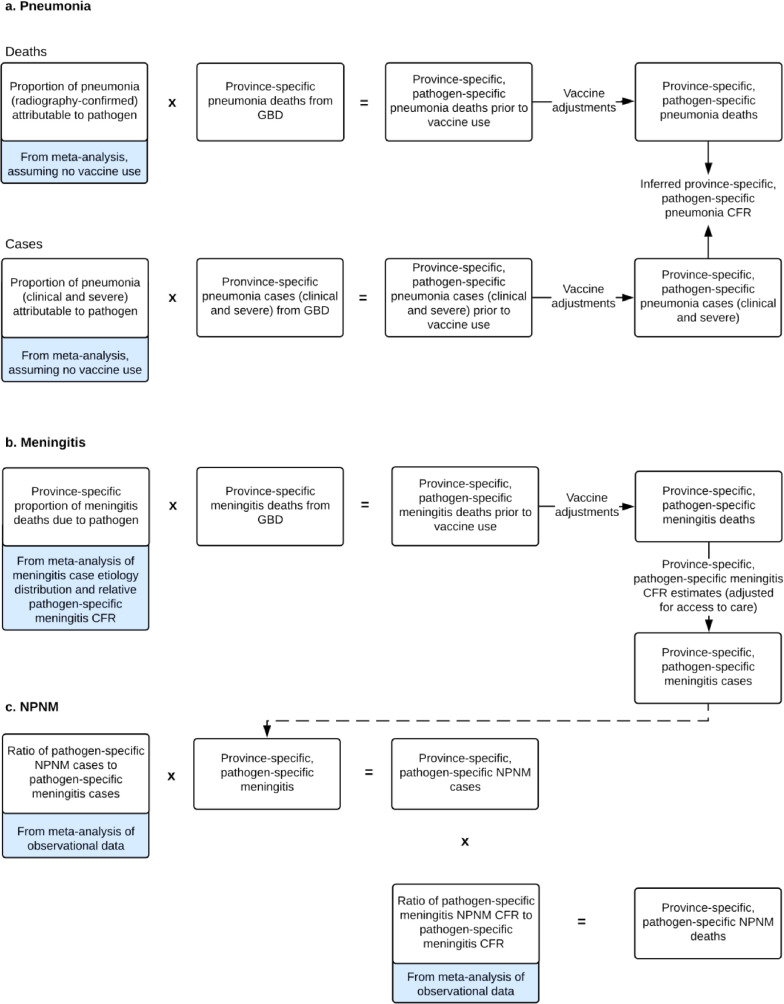
We estimated proportions of pneumonia and meningitis deaths and cases attributable to pneumococcus and Hib using evidence from vaccine clinical trials and surveillance studies of bacterial meningitis and pathogen-specific case fatality ratios (CFR). Then we applied the proportions to model provincial-level pneumonia cases and deaths, meningitis deaths and meningitis CFR in children aged 1-59 months, accounting for vaccine coverage. Non-pneumonia, non-meningitis (NPNM) invasive disease cases were derived by applying NPNM meningitis ratios to meningitis estimates.
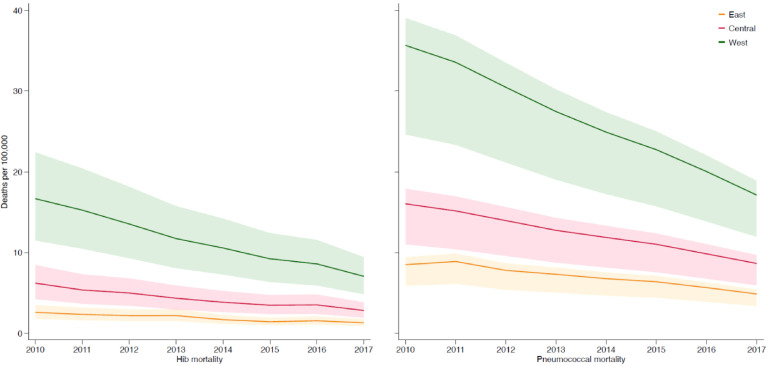
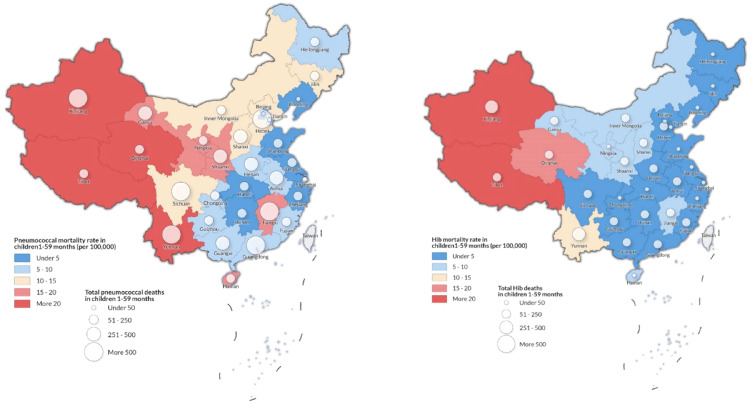
In 2010-17, annual pneumococcal deaths fell by 49% from 15 600 (uncertainty range: 10 800-17 300) to 8 000 (5 500-8 900), and Hib deaths fell by 56% from 6 500 (4 500-8 800) to 2 900 (2 000-3 900). Severe pneumococcal and Hib cases decreased by 16% to 218 200 (161 500-252 200) in 2017 and 29% to 49 900 (29 000-99 100). Estimated 2017 national three-dose coverage in private market was 1·3% for PCV and 33·4% for Hib vaccine among children aged 1-59 months. Provinces in the west region had the highest disease burden.
Childhood mortality and morbidity attributable to pneumococcal and Hib has decreased in China, but still substantially varied by region and province. Higher vaccine coverage could further reduce disease burden.
Bill & Melinda Gates Foundation.
肺炎球菌疫苗和b型流感嗜血杆菌(Hib)疫苗接种未纳入中国国家免疫规划。为了给中国的免疫政策提供参考依据,我们估算了2010 - 2017年全国、各地区以及各省由肺炎球菌和Hib导致的儿童死亡率和发病率。
我们利用疫苗临床试验证据以及细菌性脑膜炎监测研究和病原体特异性病死率(CFR)来估算肺炎和脑膜炎死亡及病例中由肺炎球菌和Hib导致的比例。然后将这些比例应用于1至59月龄儿童省级肺炎病例和死亡、脑膜炎死亡及脑膜炎CFR的模型中,同时考虑疫苗接种覆盖率。非肺炎、非脑膜炎(NPNM)侵袭性疾病病例是通过将NPNM脑膜炎比例应用于脑膜炎估算值得出的。
在2010 - 2017年期间,每年肺炎球菌死亡人数从15600例(不确定范围:10800 - 17300例)下降了49%,降至8000例(5500 - 8900例),Hib死亡人数从6500例(4500 - 8800例)下降了56%,降至2900例(2000 - 3900例)。2017年,严重肺炎球菌和Hib病例分别减少了16%,降至218200例(161500 - 252200例)和减少了29%,降至49900例(29000 - 99100例)。2017年全国1至59月龄儿童中,私立市场上PCV三剂接种覆盖率估计为1.3%,Hib疫苗为33.4%。西部地区各省的疾病负担最高。
中国由肺炎球菌和Hib导致的儿童死亡率和发病率有所下降,但地区和省份之间仍存在很大差异。更高的疫苗接种覆盖率可能进一步降低疾病负担。
比尔及梅琳达·盖茨基金会。