Puce Luca, Chamari Karim, Marinelli Lucio, Mori Laura, Bove Marco, Faelli Emanuela, Fassone Marco, Cotellessa Filippo, Bragazzi Nicola Luigi, Trompetto Carlo
Department of Neuroscience, Rehabilitation, Ophthalmology, Genetics, Maternal and Child Health, University of Genoa, Genoa, Italy.
Aspetar, Orthopaedic and Sports Medicine Hospital, FIFA Medical Centre of Excellence, Doha, Qatar.
Front Physiol. 2022 Mar 3;13:835766. doi: 10.3389/fphys.2022.835766. eCollection 2022.
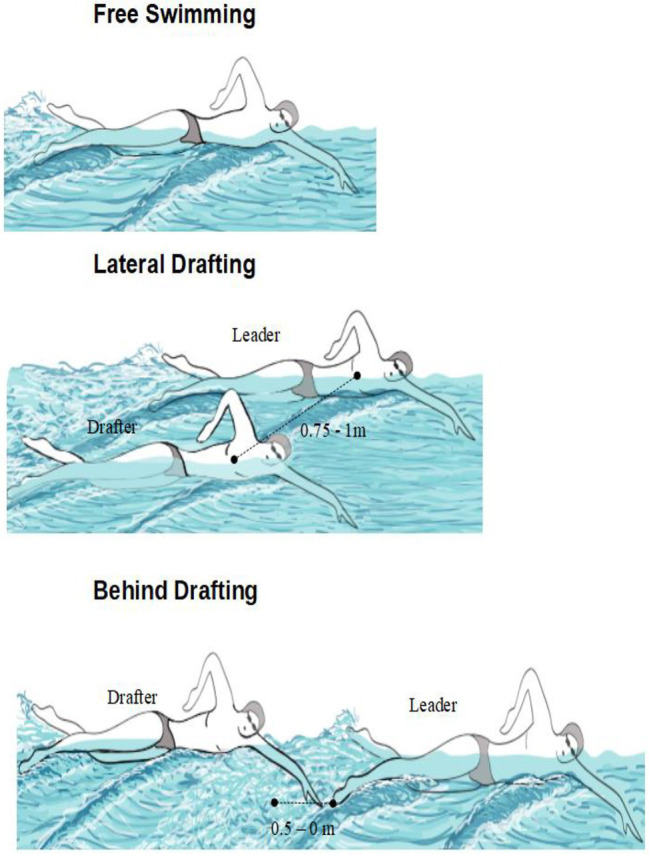
Drafting in swimming is a tactic in which an athlete (drafter) swims in the wave of another athlete (leader). Our aim was to compare the effects of this tactic on the drafter, as far as muscle fatigue, muscle activity, and swimming efficiency are concerned. Fifteen drafters performed three 200 m front crawl trials at a controlled submaximal pace in three configurations: Behind Drafting (BD), Lateral Drafting (LD), and Free Swimming (FS). Muscle fatigue, muscle activity, and swimming efficiency were obtained by surface electromyography (EMG) and video analysis from flexor carpi radialis, triceps brachii, latissimus dorsi, and rectus femoris muscles. The outcome measures were: time slope of Mean Frequency (MNF), for muscle fatigue; time slope of Root Mean Square (RMS), for muscle activity; and Stroke Index (SI) for swimming efficiency. Negative variations of MNF were 5.1 ± 1.7%, 6.6 ± 4.1%, and 11.1 ± 2.7% in BD, LD, and FS, respectively. Statistical significance was found for all cases except for the rectus femoris. Positive variations of RMS were 3.4 ± 1.2%, 4.7 ± 2.7%, and 7.8 ± 4.6% in BD, LD, and FS, respectively. Statistical significance was found only for the slopes of latissimus dorsi in FS and LD. The largest mean in SI was measured in the BD (2.01 m/s), while the smallest was measured in the FS (1.86 m/s). BD was found to be the best swimming configuration, in terms of lower muscle fatigue and higher swimming efficiency. Also, LD resulted to be advantageous with respect to FS.
在游泳中,跟随划水是一种策略,即一名运动员(跟随者)在另一名运动员(领游者)产生的波浪中游泳。我们的目的是就肌肉疲劳、肌肉活动和游泳效率而言,比较这种策略对跟随者的影响。15名跟随者以受控的次最大强度配速,在三种配置下进行了三次200米自由泳试验:在后方跟随划水(BD)、侧面跟随划水(LD)和自由泳(FS)。通过表面肌电图(EMG)和视频分析,从桡侧腕屈肌、肱三头肌、背阔肌和股直肌获取肌肉疲劳、肌肉活动和游泳效率数据。结果指标为:用于衡量肌肉疲劳的平均频率(MNF)的时间斜率;用于衡量肌肉活动的均方根(RMS)的时间斜率;以及用于衡量游泳效率的划水指数(SI)。BD、LD和FS中MNF的负向变化分别为5.1±1.7%、6.6±4.1%和11.1±2.7%。除股直肌外,所有情况均具有统计学意义。BD、LD和FS中RMS的正向变化分别为3.4±1.2%、4.7±2.7%和7.8±4.6%。仅在FS和LD中背阔肌的斜率具有统计学意义。SI的最大平均值出现在BD(2.01米/秒),而最小平均值出现在FS(1.86米/秒)。就较低的肌肉疲劳和较高的游泳效率而言,BD被发现是最佳的游泳配置。此外,LD相对于FS也具有优势。