Monaghan Ann, Jennings Glenn, Xue Feng, Byrne Lisa, Duggan Eoin, Romero-Ortuno Roman
Discipline of Medical Gerontology, School of Medicine, Trinity College Dublin, Dublin, Ireland.
Falls and Syncope Unit, Mercer's Institute for Successful Ageing, St James's Hospital, Dublin, Ireland.
Front Physiol. 2022 Mar 4;13:833650. doi: 10.3389/fphys.2022.833650. eCollection 2022.
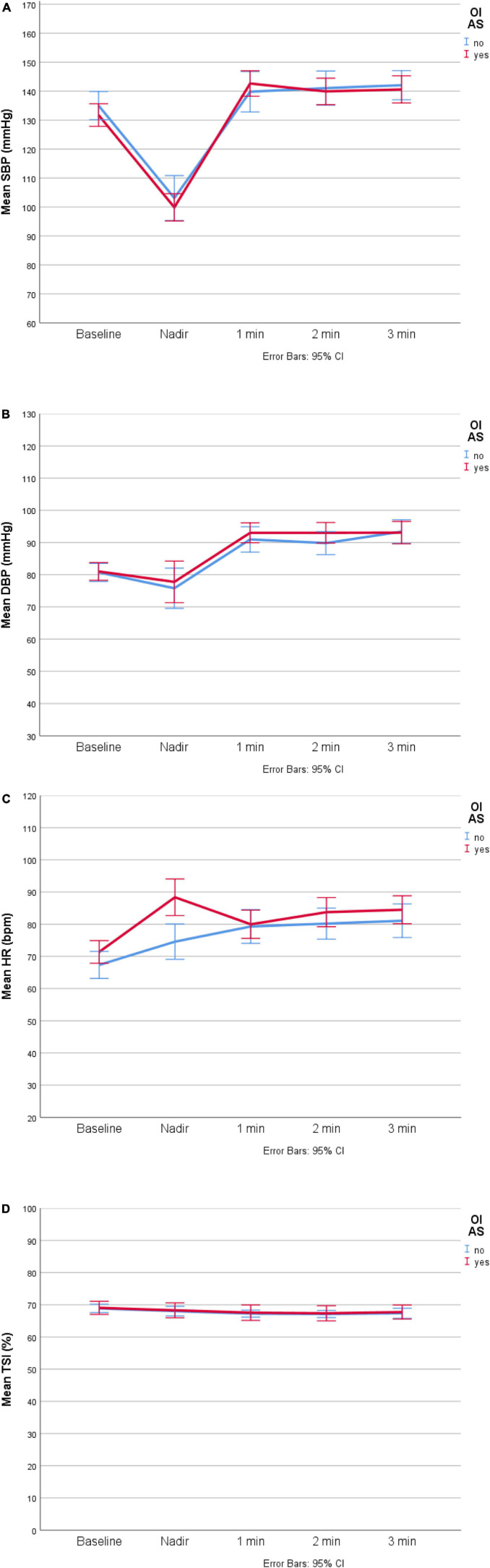
In this observational cross-sectional study, we investigated predictors of orthostatic intolerance (OI) in adults reporting long COVID symptoms. Participants underwent a 3-min active stand (AS) with Finapres NOVA, followed by a 10-min unmedicated 70° head-up tilt test. Eighty-five participants were included (mean age 46 years, range 25-78; 74% women), of which 56 (66%) reported OI during AS (OI). OI seemed associated with female sex, more fatigue and depressive symptoms, and greater inability to perform activities of daily living (ADL), as well as a higher heart rate (HR) at the lowest systolic blood pressure (SBP) point before the first minute post-stand (mean HR: 88 vs. 75 bpm, = 0.004). In a regression model also including age, sex, fatigue, depression, ADL inability, and peak HR after the nadir SBP, HR was the only OI predictor (OR = 1.09, 95% CI: 1.01-1.18, = 0.027). Twenty-two (26%) participants had initial (iOH) and 5 (6%) classical (cOH) orthostatic hypotension, but neither correlated with OI. Seventy-one participants proceeded to tilt, of which 28 (39%) had OI during tilt (OI). Of the 53 who had a 10-min tilt, 7 (13%) had an HR increase >30 bpm without cOH (2 to HR > 120 bpm), but six did not report OI. In conclusion, OI was associated with a higher initial HR on AS, which after 1 min equalised with the non-OI group. Despite these initial orthostatic HR differences, POTS was infrequent (2%). ClinicalTrials.gov Identifier: NCT05027724 (retrospectively registered on August 30, 2021).
在这项观察性横断面研究中,我们调查了报告有长新冠症状的成年人中体位性不耐受(OI)的预测因素。参与者使用Finapres NOVA进行3分钟主动站立(AS),随后进行10分钟无药物的70°头高位倾斜试验。纳入了85名参与者(平均年龄46岁,范围25 - 78岁;74%为女性),其中56名(66%)在AS期间报告有OI(OI组)。OI似乎与女性性别、更多疲劳和抑郁症状、更大的日常生活活动(ADL)能力受限以及站立后第一分钟内最低收缩压(SBP)点时更高的心率(HR)相关(平均HR:88对75次/分钟,P = 0.004)。在一个还包括年龄、性别、疲劳、抑郁、ADL能力受限以及SBP最低点后的HR峰值的回归模型中,HR是唯一的OI预测因素(OR = 1.09,95%CI:1.01 - 1.18,P = 0.027)。22名(26%)参与者有初始体位性低血压(iOH),5名(6%)有经典体位性低血压(cOH),但两者均与OI无关。71名参与者进行了倾斜试验,其中28名(39%)在倾斜期间有OI(OI组)。在53名进行了10分钟倾斜试验的参与者中,7名(13%)在无cOH的情况下HR增加>30次/分钟(至HR > 120次/分钟),但有6名未报告有OI。总之,OI与AS时更高的初始HR相关,1分钟后该HR与非OI组持平。尽管存在这些初始体位性HR差异,但直立性心动过速综合征(POTS)并不常见(2%)。ClinicalTrials.gov标识符:NCT05027724(于2021年8月30日追溯注册)。