Kammeyer Ryan, Mizenko Christopher, Sillau Stefan, Richie Alanna, Owens Gregory, Nair Kavita V, Alvarez Enrique, Vollmer Timothy L, Bennett Jeffrey L, Piquet Amanda L
Department of Neurology, University of Colorado Anschutz Medical Campus, Aurora, CO, United States.
Department of Pharmacy, University of Colorado Anschutz Medical Campus, Aurora, CO, United States.
Front Neurol. 2022 Mar 2;13:689975. doi: 10.3389/fneur.2022.689975. eCollection 2022.
To evaluate plasma neurofilament light (NfL) levels in autoimmune neurologic disorders (AINDs) and autoimmune encephalitis (AE).
Each particular neural autoantibody syndrome has a different clinical phenotype, making one unifying clinical outcome measure difficult to assess. While this is a heterogeneous group of disorders, the final common pathway is likely CNS damage and inflammation. Defining a biomarker of CNS injury that is easily obtainable through a blood sample and reflects a positive treatment response would be highly advantageous in future therapeutic trials. Measurement of blood concentration of neurofilament light (NfL) chain, however, may provide a biomarker of central nervous system (CNS) injury in AE and other AINDs. Here we provide an initial evaluation of plasma NfL levels in AE as well as other AINDs during active and chronic phases of disease and demonstrate its potential utility as a minimally-invasive biomarker for AE and AINDs.
DESIGN/METHODS: Patients were retrospectively identified who were enrolled in the biorepository at the Rocky Mountain MS Center at the University of Colorado, or were prospectively enrolled after initial presentation. Patients had a well-defined AIND and were followed between 2014 and 2021. NfL was tested using the Single Molecule Array (SIMOA) technology. Patients with headaches but without other significant neurologic disease were included as controls.
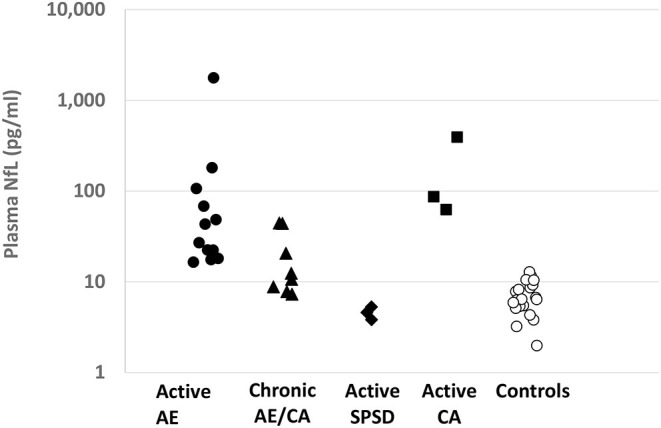
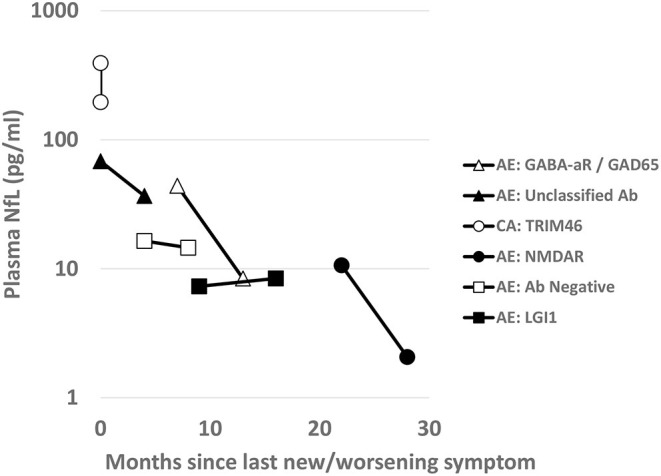
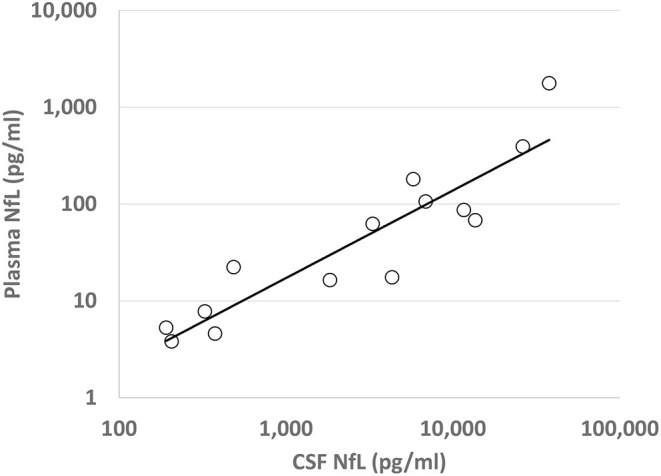
Twenty-six plasma and 14 CSF samples of patients with AINDs, and 20 plasma control samples stored in the biorepository were evaluated. A positive correlation was found between plasma and CSF NfL levels for patients with an AIND ( = 0.83, < 0.001). Elevated plasma levels of NfL were seen in patients with active AE compared to controls [geometric mean (GM) 51.4 vs. 6.4 pg/ml, = 0.002]. Patients with chronic symptoms (>6 months since new or worsening symptoms) of AE or cerebellar ataxia (CA) showed a trend toward lower plasma NfL levels (GM 15.1 pg/ml) compared to active AE or CA. Six patients with longitudinal, prospective sampling available demonstrated a trend in decreased plasma NfL levels over time.
Our findings support the use of plasma NfL as a potential minimally-invasive biomarker of CNS injury.
评估自身免疫性神经系统疾病(AINDs)和自身免疫性脑炎(AE)患者的血浆神经丝轻链(NfL)水平。
每种特定的神经自身抗体综合征都有不同的临床表型,使得统一的临床结局指标难以评估。虽然这是一组异质性疾病,但最终的共同途径可能是中枢神经系统(CNS)损伤和炎症。确定一种易于通过血样获得且能反映积极治疗反应的CNS损伤生物标志物,在未来的治疗试验中将具有极大优势。然而,测量神经丝轻链(NfL)的血浓度可能为AE及其他AINDs中的中枢神经系统(CNS)损伤提供生物标志物。在此,我们对AE以及其他AINDs在疾病活动期和慢性期的血浆NfL水平进行了初步评估,并证明了其作为AE和AINDs微创生物标志物的潜在效用。
设计/方法:回顾性确定了科罗拉多大学落基山多发性硬化症中心生物样本库中登记的患者,或在初次就诊后前瞻性登记的患者。患者患有明确的AIND,并在2014年至2021年期间接受随访。使用单分子阵列(SIMOA)技术检测NfL。将有头痛但无其他重大神经系统疾病的患者作为对照。
对26份AINDs患者的血浆样本、14份脑脊液样本以及生物样本库中保存的20份血浆对照样本进行了评估。发现AINDs患者的血浆和脑脊液NfL水平呈正相关(r = 0.83,P < 0.001)。与对照组相比,活动期AE患者的血浆NfL水平升高[几何均值(GM)51.4 vs. 6.4 pg/ml,P = 0.002]。与活动期AE或小脑性共济失调(CA)患者相比,AE或CA慢性症状(自新症状或症状加重起>6个月)患者的血浆NfL水平呈降低趋势(GM 15.1 pg/ml)。6例有纵向、前瞻性样本的患者显示血浆NfL水平随时间呈降低趋势。
我们的研究结果支持将血浆NfL用作CNS损伤潜在的微创生物标志物。