Persis Jenefa, Kiran Tanvi, Goel Kapil, Rana Kirtan, Mohindra Ritin, Padhi Bijaya Kumar
Department of Community Medicine and School of Public Health, Post Graduate Institute of Medical Education and Research, Chandigarh, India.
Department of Internal Medicine, Post Graduate Institute of Medical Education and Research, Chandigarh, India.
J Family Med Prim Care. 2022 Jan;11(1):305-311. doi: 10.4103/jfmpc.jfmpc_1544_21. Epub 2022 Jan 31.
The aim of this study was to analyze the clinical features of patients attending the screening clinic of a dedicated COVID-19 hospital (DCH), including COVID-19 RT-PCR test positivity rate, symptom predictors for COVID-19 positivity, the proportion of recovery, and the mortality among COVID-19 positive cases.
We conducted a cross-sectional study of the patients who reported in the screening clinic of a DCH. Data were retrieved from medical records. Step-wise binary logistic regression was applied to determine the symptom predictors for determining the likelihood of the suspects turning out to be COVID-19 positive.
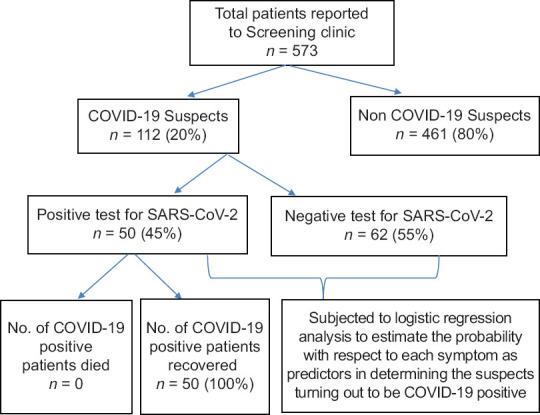
A total of 573 patients reported to the screening clinic were enrolled, and their median age was 36 ± 14 years. Of the total patients, 237 (41%) were females and 112 (20%) patients were COVID-19 suspects. Fifty (45%) suspects tested COVID-19 positive. The majority of the positives had complaints of cough, fever, and sore throat. Running nose (OR = 7.951) and history of contact with a COVID-19-positive case (OR = 169.9) were found to be statistically significant symptom predictors for COVID-19 positivity. All patients recovered with nil case fatality.
Running nose and history of contact with COVID-positive patients were significant predictors for COVID-19 positivity. In this pandemic state, patients who present with any of the upper respiratory infection (URI) symptoms such as cough, sore throat, running nose, headache, and loss of taste/smell should be tested for COVID-19 for early identification and isolation to break the chain of transmission. The public should be encouraged to undergo COVID-19 testing if they develop any of the URI symptoms.
本研究旨在分析一家专门的新冠肺炎医院(DCH)筛查门诊患者的临床特征,包括新冠肺炎逆转录聚合酶链反应(RT-PCR)检测阳性率、新冠肺炎阳性的症状预测因素、康复比例以及新冠肺炎阳性病例的死亡率。
我们对在一家DCH筛查门诊就诊的患者进行了横断面研究。数据从医疗记录中获取。应用逐步二元逻辑回归来确定症状预测因素,以判断疑似患者最终成为新冠肺炎阳性的可能性。
共有573名到筛查门诊就诊的患者被纳入研究,他们的中位年龄为36±14岁。在所有患者中,237名(41%)为女性,112名(20%)为新冠肺炎疑似患者。50名(45%)疑似患者新冠肺炎检测呈阳性。大多数阳性患者有咳嗽、发热和喉咙痛的症状。流涕(比值比[OR]=7.951)和与新冠肺炎阳性病例接触史(OR=169.9)被发现是新冠肺炎阳性的统计学显著症状预测因素。所有患者均康复,无死亡病例。
流涕和与新冠肺炎阳性患者接触史是新冠肺炎阳性的重要预测因素。在这种大流行状态下,出现咳嗽、喉咙痛、流涕、头痛和味觉/嗅觉丧失等任何上呼吸道感染(URI)症状的患者应进行新冠肺炎检测,以便早期识别和隔离,从而切断传播链。如果公众出现任何URI症状,应鼓励他们接受新冠肺炎检测。