Broomfield Grace, Brown Scott D, Yap Marie B H
Turner Institute for Brain and Mental Health, Monash University, Clayton, Australia.
School of Psychological Sciences, The University of Newcastle, Callaghan, Australia.
Internet Interv. 2022 Mar 8;28:100522. doi: 10.1016/j.invent.2022.100522. eCollection 2022 Apr.
The positive impact of parenting programs for youth mental health is undermined by difficulties engaging parents. Low engagement disproportionately impacts parents of lower-socioeconomic positions (SEPs). Internet- and mobile-based interventions hold potential for overcoming barriers to enrolment, but additional research is needed to understand how programs can appropriately meet the needs of parents across SEPs. Consumer preference methods such as discrete choice experiments may be valuable in this endeavour.
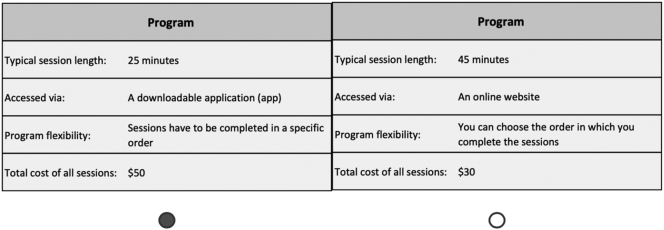
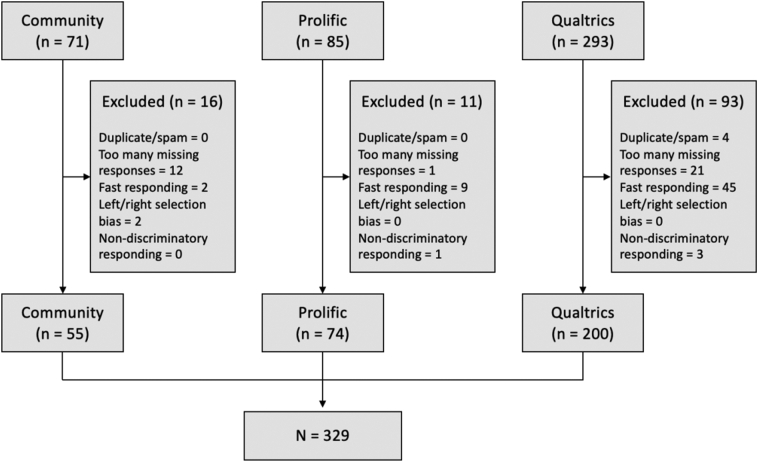
A discrete choice experiment was used to determine the relative influence of modifiable program features on parents' intent to enrol. 329 Australian parents of children aged 0-18 repeatedly selected their preferred program from randomized sets of hypothetical programs in an online survey. Each hypothetical program was unique, varying across four program features: module duration, program platform, user control, and program cost. Cumulative link models were used to predict choices, with education, household income, and community advantage used as indicators of SEP.
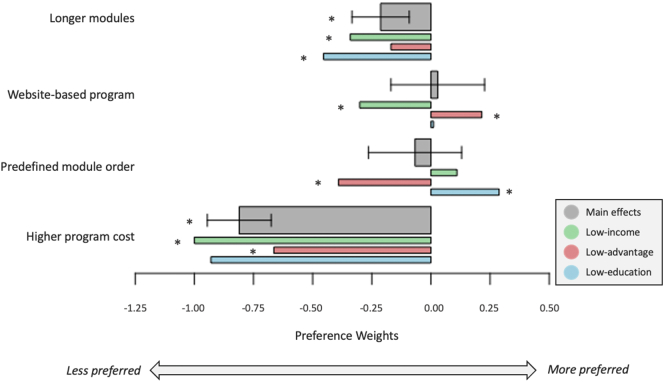
Overall, parents preferred cheaper programs and briefer modules. Parents' preferences differed based on their socioeconomic challenges. Lower-income parents preferred briefer modules, cheaper programs and application-based programs compared to higher-income parents. Parents with less education preferred briefer modules and a predefined module order. Parents living in areas of less advantage preferred website-based programs, user choice of module order, and more expensive programs.
This study offers program developers evidence-based strategies for tailoring internet- and mobile-based parenting interventions to increase lower-SEP parent enrolment. Findings also highlight the importance of considering parents' socioeconomic challenges to ensure programs do not perpetuate existing mental health inequalities, as "one-size-fits-all" approaches are likely insufficient for reaching lower-SEP parents.
家长参与困难削弱了育儿项目对青少年心理健康的积极影响。参与率低对社会经济地位较低(SEP)的家长影响尤为严重。基于互联网和移动设备的干预措施有可能克服入学障碍,但需要更多研究来了解这些项目如何能适当满足不同SEP家长的需求。诸如离散选择实验等消费者偏好方法在这项工作中可能很有价值。
采用离散选择实验来确定可修改的项目特征对家长入学意愿的相对影响。329名澳大利亚0至18岁儿童的家长在一项在线调查中,从随机生成的假设项目组中反复选择他们喜欢的项目。每个假设项目都是独特的,在四个项目特征上有所不同:模块时长、项目平台、用户控制和项目成本。使用累积链接模型来预测选择,将教育程度、家庭收入和社区优势作为SEP的指标。
总体而言,家长更喜欢费用较低的项目和时长较短的模块。家长的偏好因其社会经济挑战而有所不同。与高收入家长相比,低收入家长更喜欢时长较短的模块、费用较低的项目和基于应用程序的项目。受教育程度较低的家长更喜欢时长较短的模块和预定义的模块顺序。生活在优势较少地区的家长更喜欢基于网站的项目、用户可选择的模块顺序和费用较高的项目。
本研究为项目开发者提供了基于证据的策略,以定制基于互联网和移动设备的育儿干预措施,从而提高社会经济地位较低的家长的参与率。研究结果还强调了考虑家长社会经济挑战的重要性,以确保项目不会使现有的心理健康不平等现象长期存在,因为“一刀切”的方法可能不足以覆盖社会经济地位较低的家长。