Department of Emergency, Qingdao Municipal Hospital, Qingdao, Shandong 266000, China.
Comput Math Methods Med. 2022 Mar 9;2022:4672535. doi: 10.1155/2022/4672535. eCollection 2022.
To explore the expression of peripheral blood dendritic cells (DCs) CD86, CD80, and Th1/Th2 in patients with sepsis and their value on survival prediction.
118 patients with sepsis from January 2019 to December 2020 were selected, According to the prognosis, the patients were divided into the death group ( = 46) and survival group ( = 72). The general data and pathogen division of the two groups were collected, and the levels of peripheral blood DCs CD86, CD80, and Th1/Th2; APACHE II score; inflammatory factor (procalcitonin (PCT)); and cell growth chemokine (GRO) were compared between the two groups heparin-binding protein (HBP) and myocardial enzyme indexes (creatine kinase (CK), creatine kinase isozyme (CK-MB), and lactate dehydrogenase (LDH)) to explore the relationship between CD86, CD80, Th1/Th2, and various serological indexes and the evaluation value of prognosis.
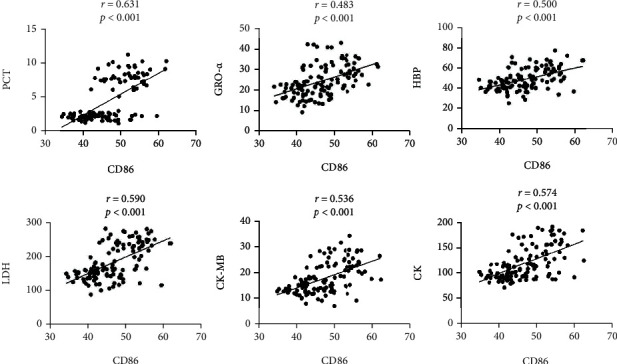
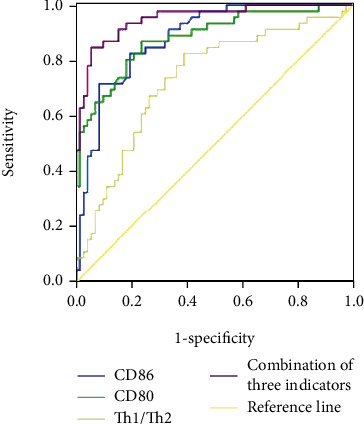
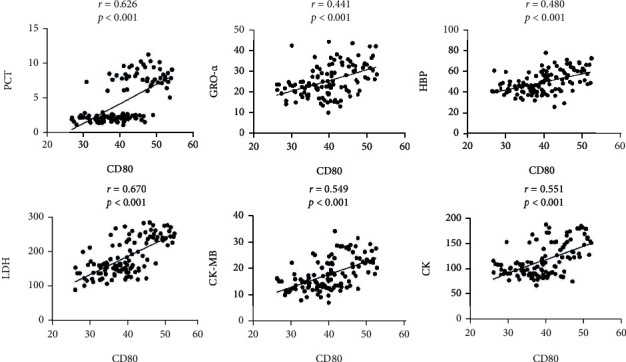
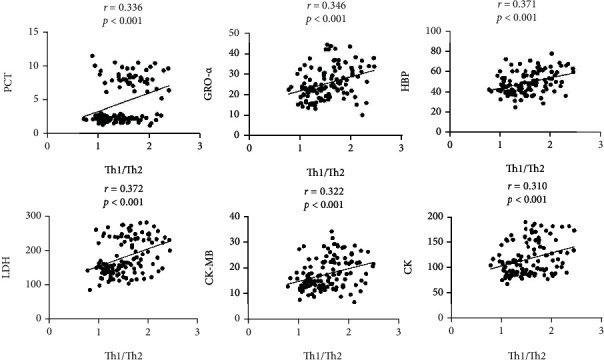
124 strains of pathogenic bacteria were isolated from 118 patients, including 78 strains of gram-negative bacteria (62.90%), 31 strains of Gram-positive bacteria (25.00%), and 15 strains of fungi (12.10%). The scores of CD86, CD80, Th1, Th2, Th1/Th2, and APACHE II in the dead group were higher than those in the surviving group, and the difference was statistically significant ( < 0.05). PCT, GRO-, HBP, LDH, CK-MB, and CK levels of patients in death group were higher than those in survival group, and the difference was statistically significant ( < 0.05). The levels of peripheral blood DCs CD86, CD80, and Th1/Th2 were positively correlated with PCT, GRO-, HBP, LDH, CK-MB, and CK ( < 0.05). ROC curve analysis showed that the AUC of the combined detection of DCs CD86, CD80, and Th1/Th2 in peripheral blood was 0.951, which was higher than 0.882, 0.883, and 0.734 of single index ( < 0.05).
All patients with sepsis have immune imbalance, and the peripheral blood CD86, CD80, and Th1/Th2 of the dead patients are higher than those of the survivors. The combined detection of these three indicators has the highest predictive value for the prognosis of patients.
探讨脓毒症患者外周血树突状细胞(DC)CD86、CD80 和 Th1/Th2 的表达及其对生存预测的价值。
选取 2019 年 1 月至 2020 年 12 月间的 118 例脓毒症患者,根据预后将患者分为死亡组(=46)和存活组(=72)。收集两组的一般资料和病原体分布,比较两组外周血 DCs CD86、CD80、Th1/Th2;急性生理与慢性健康评分 II (APACHE II)评分;炎症因子(降钙素原(PCT));细胞生长趋化因子(GRO);肝素结合蛋白(HBP)和心肌酶指标(肌酸激酶(CK)、肌酸激酶同工酶(CK-MB)和乳酸脱氢酶(LDH),探讨 CD86、CD80、Th1/Th2 与各血清学指标的关系及对预后的评估价值。
118 例患者共分离出 124 株病原菌,其中革兰阴性菌 78 株(62.90%),革兰阳性菌 31 株(25.00%),真菌 15 株(12.10%)。死亡组的 CD86、CD80、Th1、Th2、Th1/Th2 和 APACHE II 评分均高于存活组,差异有统计学意义(<0.05)。死亡组 PCT、GRO-、HBP、LDH、CK-MB 和 CK 水平均高于存活组,差异有统计学意义(<0.05)。外周血 DCs CD86、CD80 和 Th1/Th2 水平与 PCT、GRO-、HBP、LDH、CK-MB 和 CK 呈正相关(<0.05)。ROC 曲线分析显示,外周血 DCs CD86、CD80 和 Th1/Th2 联合检测的 AUC 为 0.951,高于单个指标的 0.882、0.883 和 0.734(<0.05)。
所有脓毒症患者均存在免疫失衡,死亡患者外周血 CD86、CD80 和 Th1/Th2 高于存活患者。这三个指标的联合检测对患者预后的预测价值最高。