Department of Anesthesiology, Wuhan Fourth Hospital, Puai Hospital, Tongji Medical College, Huazhong University of Science and Technology, Jiefang Avenue, Gutiansan Road, Wuhan, 430000, People's Republic of China.
Ir J Med Sci. 2021 Aug;190(3):1173-1181. doi: 10.1007/s11845-020-02382-5. Epub 2020 Oct 20.
We aimed to investigate the association between Jun N-terminal kinase (JNK) pathway-associated phosphatase (JKAP) and T helper type 1 (Th1) cell or Th17 cell, and their clinical values in sepsis patients.
Totally 125 sepsis patients and 100 healthy subjects as controls were included. Peripheral blood was extracted from each sepsis patient and each control, then serum and peripheral blood mononuclear cell (PBMC) were separated. JKAP and inflammatory cytokines were detected in serum by ELISA; Th1 cell or Th17 cell proportion was detected in PBMC using flow cytometry.
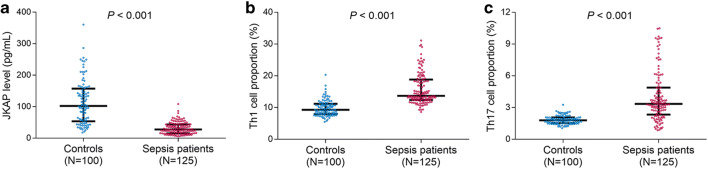
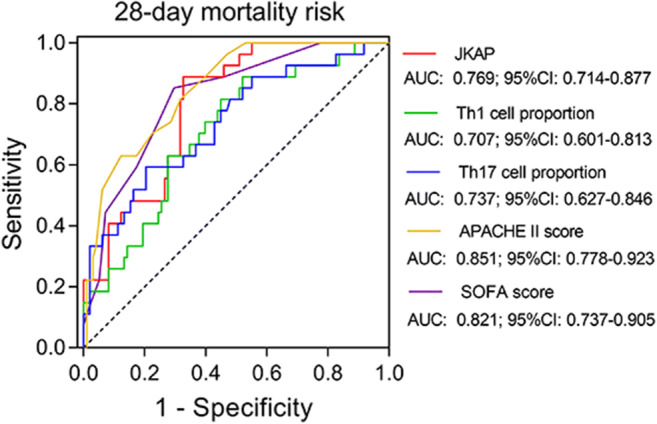
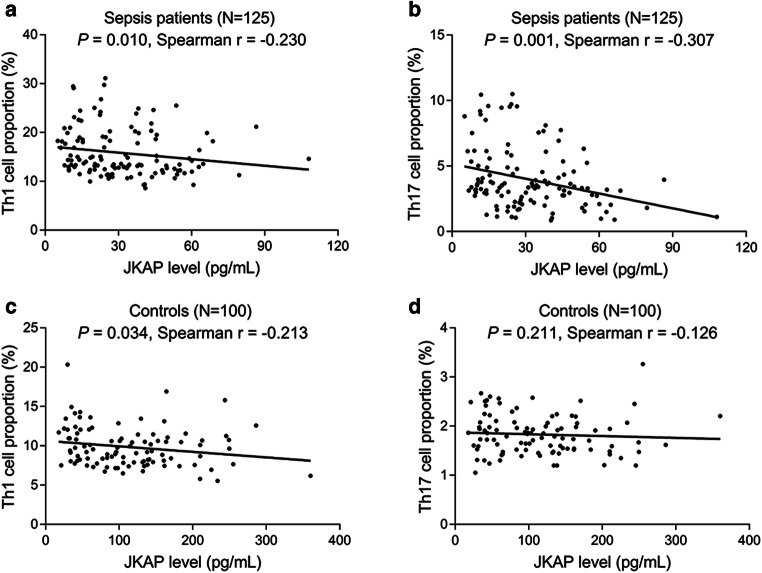
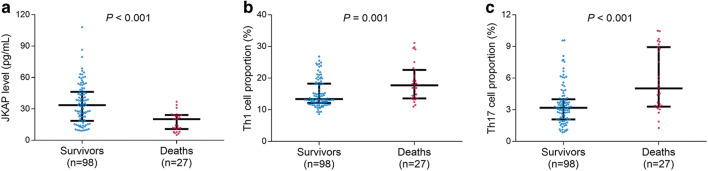
JKAP level was downregulated while Th1 and Th17 cell proportions were upregulated in sepsis patients compared with controls. JKAP level negatively correlated with Th1 cell proportion in sepsis patients and controls, while was only negatively associated with Th17 cell proportion in sepsis patients but not in controls. In sepsis patients, JKAP level negatively associated with TNF-α, IL-1β, and IL-17 expressions. Meanwhile, JKAP level negatively but Th17 cell proportion positively correlated with acute physiology and chronic health evaluation II (APACHE II) and sequential organ failure assessment (SOFA) scores; however, Th1 cell proportion only positively associated with APACHE II score but not SOFA score. Additionally, JKAP level was reduced, while Th1 and Th17 cell proportions were increased in septic deaths compared with survivors. Multivariate logistic regression model disclosed that JKAP level and Th17 cell proportion independently predicted 28-day mortality.
Blood JKAP correlates with decreased Th1 and Th17 cells, also associates with reduced inflammatory cytokines, disease severity, and favorable outcome in sepsis patients.
我们旨在研究 Jun N-末端激酶(JNK)通路相关磷酸酶(JKAP)与辅助性 T 细胞 1(Th1)或 Th17 细胞之间的关系,及其在脓毒症患者中的临床价值。
共纳入 125 例脓毒症患者和 100 例健康对照者。从每位脓毒症患者和每位对照者提取外周血,然后分离血清和外周血单个核细胞(PBMC)。采用酶联免疫吸附试验(ELISA)检测血清中 JKAP 和炎症细胞因子;采用流式细胞术检测 PBMC 中 Th1 或 Th17 细胞比例。
与对照组相比,脓毒症患者的 JKAP 水平降低,Th1 和 Th17 细胞比例升高。JKAP 水平与脓毒症患者和对照组的 Th1 细胞比例呈负相关,而仅与脓毒症患者的 Th17 细胞比例呈负相关,与对照组无关。在脓毒症患者中,JKAP 水平与 TNF-α、IL-1β 和 IL-17 的表达呈负相关。同时,JKAP 水平与急性生理学和慢性健康评估 II(APACHE II)和序贯器官衰竭评估(SOFA)评分呈负相关,但 Th17 细胞比例与 APACHE II 评分呈正相关,与 SOFA 评分无关。此外,与存活者相比,死亡的脓毒症患者中 JKAP 水平降低,Th1 和 Th17 细胞比例升高。多变量 logistic 回归模型显示,JKAP 水平和 Th17 细胞比例独立预测 28 天死亡率。
血液 JKAP 与 Th1 和 Th17 细胞减少相关,也与炎症细胞因子减少、疾病严重程度和脓毒症患者的良好预后相关。