Zheng Chenghui, Xie Lin, Qin Haihong, Liu Xiao, Chen Xi, Lv Fan, Wang Li, Zhu Xiaohua, Xu Jinhua
Department of Dermatology, Huashan Hospital, Fudan University, Shanghai, China.
Front Cell Dev Biol. 2022 Mar 2;10:835566. doi: 10.3389/fcell.2022.835566. eCollection 2022.
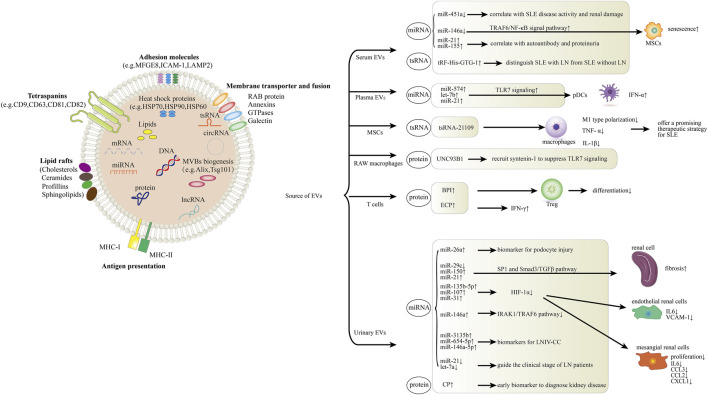
Extracellular Vesicles (EVs) are small vesicles that can be actively secreted by most cell types into the extracellular environment. Evidence indicates that EVs can carry microRNAs (miRNAs), long non-coding RNAs (lncRNAs), tRNA-derived small RNAs (tsRNAs), proteins, and lipids to target cells or tissue organizations. Latest studies show that EVs play a vital role in the immune modulation and may contribute to the pathogenesis of autoimmune diseases. Systemic lupus erythematosus (SLE) is a common autoimmune disease characterized by abnormal T cell activation and sustained production of autoantibodies against self-antigens, resulting in inflammation and damage to multiple systems. Pathogenic mechanisms of SLE, however, are still not well understood. In this review, we summarize the latest research advances on the functions and mechanisms of EVs, and its role in the pathogenesis, diagnosis, and treatment of SLE.
细胞外囊泡(EVs)是一种小囊泡,大多数细胞类型都可以将其主动分泌到细胞外环境中。有证据表明,细胞外囊泡可以携带微小RNA(miRNA)、长链非编码RNA(lncRNA)、tRNA衍生的小RNA(tsRNA)、蛋白质和脂质至靶细胞或组织器官。最新研究表明,细胞外囊泡在免疫调节中起重要作用,可能与自身免疫性疾病的发病机制有关。系统性红斑狼疮(SLE)是一种常见的自身免疫性疾病,其特征为T细胞异常活化以及针对自身抗原的自身抗体持续产生,从而导致多个系统的炎症和损伤。然而,SLE的发病机制仍未完全明确。在本综述中,我们总结了细胞外囊泡的功能和机制及其在SLE发病机制、诊断和治疗中的作用的最新研究进展。