Vineethakumari Chithran, Lüders Jens
Institute for Research in Biomedicine (IRB Barcelona), The Barcelona Institute of Science and Technology, Barcelona, Spain.
Front Cell Dev Biol. 2022 Mar 3;10:867870. doi: 10.3389/fcell.2022.867870. eCollection 2022.
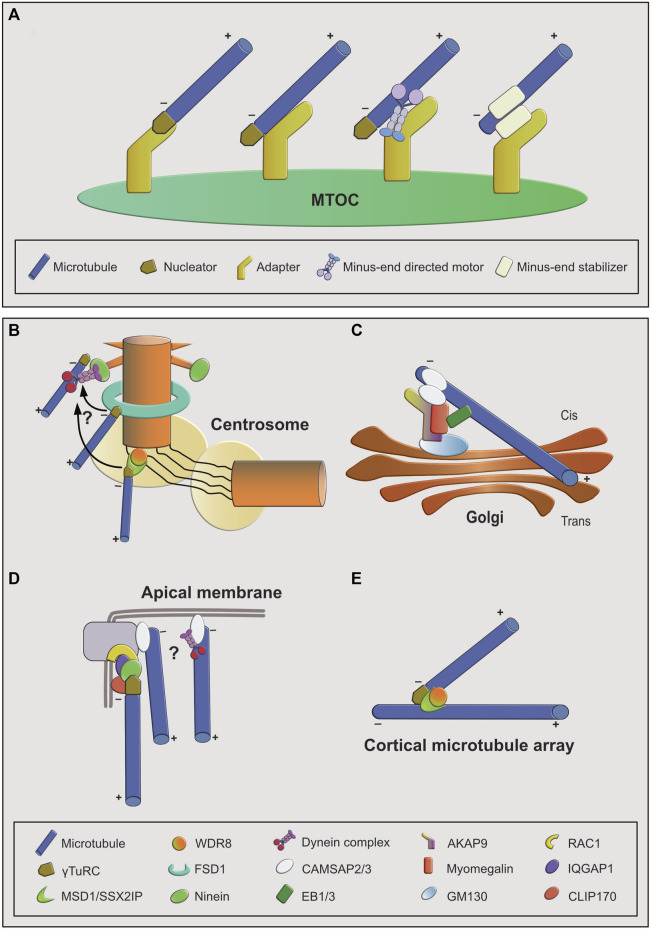
Microtubules are dynamic, filamentous polymers composed of α- and β-tubulin. Arrays of microtubules that have a specific polarity and distribution mediate essential processes such as intracellular transport and mitotic chromosome segregation. Microtubule arrays are generated with the help of microtubule organizing centers (MTOC). MTOCs typically combine two principal activities, the formation of microtubules, termed nucleation, and the immobilization of one of the two ends of microtubules, termed anchoring. Nucleation is mediated by the γ-tubulin ring complex (γTuRC), which, in cooperation with its recruitment and activation factors, provides a template for α- and β-tubulin assembly, facilitating formation of microtubule polymer. In contrast, the molecules and mechanisms that anchor newly formed microtubules at MTOCs are less well characterized. Here we discuss the mechanistic challenges underlying microtubule anchoring, how this is linked with the molecular activities of known and proposed anchoring factors, and what consequences defective microtubule anchoring has at the cellular and organismal level.
微管是由α-微管蛋白和β-微管蛋白组成的动态丝状聚合物。具有特定极性和分布的微管阵列介导细胞内运输和有丝分裂染色体分离等重要过程。微管阵列在微管组织中心(MTOC)的帮助下形成。MTOC通常结合两种主要活动,即微管的形成(称为成核)和微管两端之一的固定(称为锚定)。成核由γ-微管蛋白环复合物(γTuRC)介导,γTuRC与其募集和激活因子协同作用,为α-微管蛋白和β-微管蛋白组装提供模板,促进微管聚合物的形成。相比之下,将新形成的微管锚定在MTOC的分子和机制则了解较少。在这里,我们讨论微管锚定背后的机制挑战,它如何与已知和推测的锚定因子的分子活动相关联,以及有缺陷的微管锚定在细胞和机体水平上会产生什么后果。